
A study found a connection between the antiviral drug molnupiravir and distinct SARS-CoV-2 mutations, emphasizing the need for careful assessment in drug development.
Researchers at the Francis Crick Institute, the University of Cambridge, Imperial College London, the University of Liverpool, the University of Cape Town, and the The UK Health Security Agency (UKHSA) have uncovered a link between an antiviral drug for COVID-19 infections called molnupiravir and a pattern of mutations in the SARS-CoV-2 virus.
Molnupiravir works by inducing mutations in the virus’s genetic information, or genome, during replication. Many of these mutations will damage or kill the virus, reducing viral load in the body. It was one of the first antivirals available on the market during the COVID-19 pandemic and was widely adopted by many countries.
In research published in Nature today (September 25), the scientists used global sequencing databases to map mutations in the SARS-CoV-2 virus over time. They analyzed a family tree of 15 million SARS-CoV-2 sequences so that at each point in each virus’s evolutionary history they could see which mutations had occurred.
Unusual Mutation Patterns
Although viruses mutate all the time, the researchers identified mutational events in the global sequencing database which looked very different to typical patterns of COVID-19 mutations, and that they were strongly associated with individuals who had taken molnupiravir.
These mutations increased in 2022, coinciding with the introduction of molnupiravir. They were also more likely to be seen in older age groups, consistent with the use of the antivirals to treat people who are more at risk, and in countries that are known to have high molnupiravir use. In England, the researchers analyzed treatment data and found that at least 30% of the events involved use of molnupiravir.
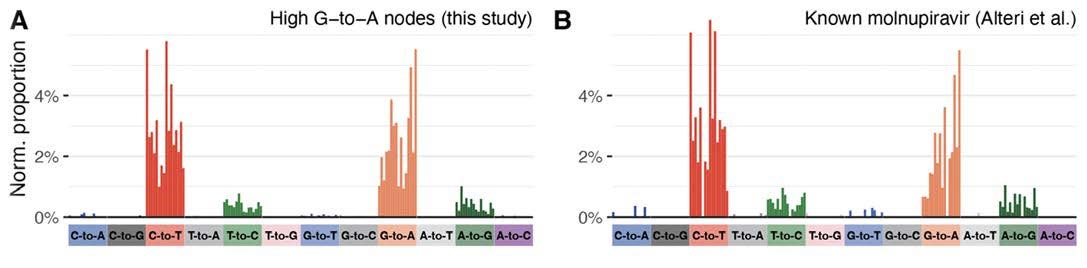
The causes of mutational events can be traced by looking at their ‘mutational signature’: a preference for mutations to occur at particular sequences in the genome. The researchers found a close match between the signature seen in these mutational events and the signature in clinical trials of molnupiravir.
The researchers also saw small clusters of mutations which suggests onward transmission from one person to another, although no established variants of concern are currently linked to this signature.
Implications and Expert Insights
Understanding the impact of molnupiravir treatment on the risks of new variants, and any impact they might have on public health is difficult. It is also important to consider that chronic COVID-19 infections, which molnupiravir is used for, can themselves result in new mutations.
Theo Sanderson, lead author and postdoctoral researcher at the Francis Crick Institute, said: “COVID-19 is still having a major effect on human health, and some people have difficulty clearing the virus, so it’s important we develop drugs that aim to cut short the length of infection. But our evidence shows that a specific antiviral drug, molnupiravir, also results in new mutations, increasing the genetic diversity in the surviving viral population.
“Our findings are useful for ongoing assessment of the risks and benefits of molnupiravir treatment. The possibility of persistent antiviral-induced mutations needs to be taken into account for the development of new drugs that work in a similar way. Our work shows that the unprecedented size of post-pandemic sequence datasets, collaboratively built by thousands of researchers and healthcare workers around the world, creates huge power to reveal insights into virus evolution that would not be possible from analysis of data from any individual country.’”
Christopher Ruis from the Department of Medicine at the University of Cambridge, said: “Molnupiravir is one of a number of drugs being used to fight COVID-19. It belongs to a class of drugs that can cause the virus to mutate so much that it is fatally weakened. But what we’ve found is that in some patients, this process doesn’t kill all the viruses, and some mutated viruses can spread. This is important to take into account when assessing the overall benefits and risks of molnupiravir and similar drugs.”
Reference: “A molnupiravir-associated mutational signature in global SARS-CoV-2 genomes” by Theo Sanderson, Ryan Hisner, I’ah Donovan-Banfield, Hassan Hartman, Alessandra Løchen, Thomas P. Peacock and Christopher Ruis, 25 September 2023, Nature.
DOI: 10.1038/s41586-023-06649-6
Never miss a breakthrough: Join the SciTechDaily newsletter.
Follow us on Google and Google News.
1 Comment
Serves ’em right. They should have stuck with hydroxychloroquine and ivermectin.