
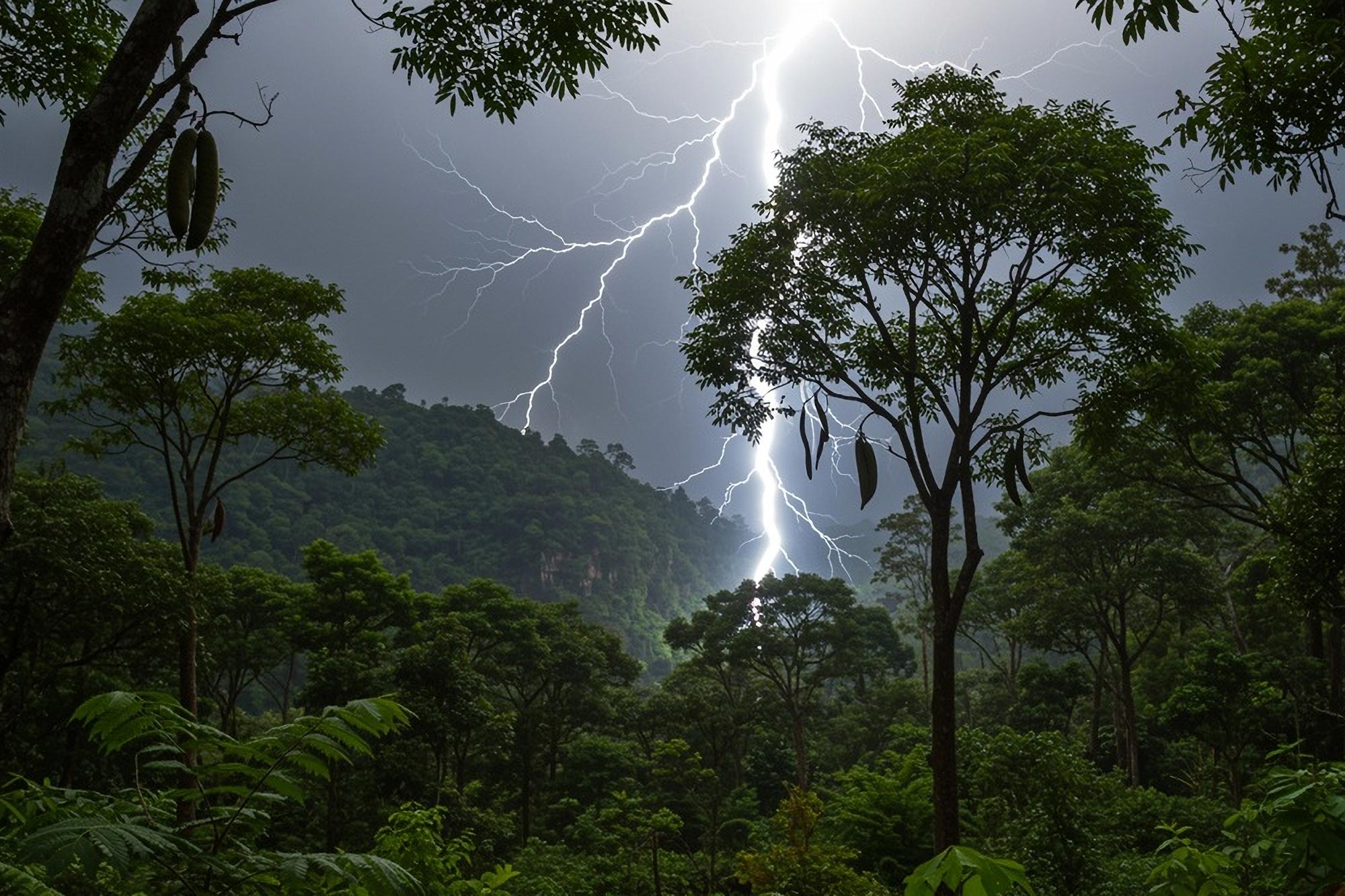
Tropical trees are dying at accelerating rates, and a surprising new culprit is emerging: thunderstorms.
While drought and heat have long been blamed, scientists now believe fast, fierce convective storms—loaded with lightning and destructive winds—may be responsible for as much as 60% of tree deaths in some rainforests. These storms are becoming more frequent with climate change, and researchers say they could undermine forest stability and carbon storage more than previously thought.
Rising Tree Death in Tropical Forests
Tropical trees are dying faster than ever, and that could rattle the planet’s climate engine. Deforestation remains the chief culprit, yet even untouched rainforests are losing trees at an alarming pace. Scientists have long blamed drought, rising heat, and fires, but a new study led by forest ecologist Evan Gora of the Cary Institute of Ecosystem Studies highlights another force: ordinary thunderstorms, now more frequent in a warming world.
These short-lived convective storms are nothing like sprawling hurricanes or cyclones. They flare up quickly, whip the canopy with fierce winds, and release bolts of lightning that can snap towering trunks in seconds. Writing in Ecology Letters, Gora and colleagues argue that such tempests may be a major driver of the rising tree-mortality trend, stripping forests of the carbon they store and reshaping biodiversity.
“Tropical forests have massive effects on global climate. They’re like the lungs of the Earth, and we’re seeing trees in them dying at higher rates than in the past, and the composition of forests is changing, too,” said Gora. “That could be really problematic for the future of not just tropical forests, but for the planet.”

Thunderstorm Threat Revealed
Understanding what’s causing the trends in tree death is critical to guiding decisions about which tree species to plant or conserve in a forest, so that forest managers can ensure forests continue thriving and storing carbon long into the future.
“Being in the forest during a tropical storm is unforgettable,” said coauthor Vanessa Rubio, a forest ecologist in Gora’s lab at Cary Institute. “As the storm quickly builds, the sky darkens, humidity changes drastically, and strong winds shake the trees. Then, thunder and lightning come. Leaves and branches fall to the ground, rain pours down, and your instinct is to get back to the field station as quickly as possible.”
Despite their obvious danger to people, storms had been overlooked and understudied as a potential culprit in tree mortality trends. But when the team reanalyzed data from previous studies on tropical forest carbon stocks, they found that storms were at least as good as drought and temperature in explaining the patterns of tree mortality and forest carbon storage.

Storms Eclipse Drought as Killer
“We were surprised to find that storms may be the largest single factor causing tree death in these forests, and they’re largely overlooked by research into carbon storage in the tropics,” said Gora. “Our estimates suggest that storms are responsible for 30 to 60% of tree mortality in the past, and that number must be increasing as storm activity increases by 5 to 25% each decade.”
The team also added storms to the largest plot-based study of forest biomass carbon dynamics to date. That study had previously concluded that when temperatures go above a certain threshold, tropical forests experience a fast decline in carbon stocks. “But when you add storms, that relationship goes away,” said Gora. “It basically shows that you have to include storms, or you might not get the answers right.”
Storms and droughts are not mutually exclusive, the scientists note — the same forests can experience both high storm activity and drought stress. They found high convective storm activity across the southern Amazon, where water stress is also high and patterns of change are among the most extreme.

Tracking Tiny Tempests with Tech
“During my studies on threats to tropical forests, my professors, our textbooks, and even overall climate policy never mentioned small, convective storms as a potential source of forest mortality,” said coauthor Ian McGregor, a Cary Institute forest ecologist in Gora’s lab. “I don’t remember seeing them in global climate models used to inform climate policy. Given our findings, however, it’s clear we need a more thorough understanding of these storms to have more accurate climate models, and thus more effective policy.”
There are good reasons why scientists have overlooked storms until now. Temperature and water stress can be monitored with meteorological stations and readily connected to long-term forest plot data. It is much harder to detect storms and track their highly localized damage. Mortality caused by thunderstorms is not easily detected via satellite, and it’s not practical for researchers on foot to survey large forested areas frequently enough to pinpoint the damage caused by a specific storm.
Gigante, a project led by Gora and co-author Adriane Esquivel-Muelbert from the University of Birmingham, offers one way to overcome these challenges. The project combines a lightning location system, drone scouts, and on-the-ground experts to sample large areas of tropical forest frequently. With these tools, they are starting to quantify when, where, and why tropical trees are dying, and which species are most affected.

Guiding Reforestation for Resilience
Understanding current and future threats to tropical forests is crucial to informing long-term conservation and restoration efforts.
“If we make decisions about which species to plant or conserve based on an incorrect understanding of what’s actually killing these trees and which species are most vulnerable, those forests won’t reach their full potential,” said Gora. Storms are most deadly to mature trees, so the consequences of misguided reforestation efforts might not be known until decades after the trees are planted.
“However,” Gora continued, “if we can build a more holistic picture of what’s driving forest change, we can be a lot more confident in guiding forest management practices for long-term sustainability.”
Reference: “Storms Are an Important Driver of Change in Tropical Forests” by Evan M. Gora, Ian R. McGregor, Helene C. Muller-Landau, Jeffrey C. Burchfield, K. C. Cushman, Vanessa E. Rubio, Gisele Biem Mori, Martin J. P. Sullivan, Matthew W. Chmielewski and Adriane Esquivel-Muelbert, 9 July 2025, Ecology Letters.
DOI: 10.1111/ele.70157
Never miss a breakthrough: Join the SciTechDaily newsletter.
Follow us on Google and Google News.
3 Comments
“…, highlights another force: ordinary thunderstorms, now more frequent in a warming world.”
Where is the empirical evidence to support that claim? Just because the global average temperature may be increasing, it doesn’t mean that it is necessarily true for the tropics. What we do know is that Arctic temperatures are increasing at a rate 3-4X the global average, and most of the increases in the average are the result of increases in nighttime and wintertime temperatures. Thunderstorms, by definition, require lightning. We have had satellites monitoring lightning for years. The author might have provided use with the percentage increase over the time that counts have been available.
Since the article blames climate change, a political not scientific phenomenon, I give it no credence. Hog Island, off of Manhattan was wiped off the map in the late 19th Century. Greenwich, Ct was wrecked by a Hurricane in 1932. Do the editors think they can just make statements of fact as though a statement is fact?
Put some lightning rods on top of some of the tallest trees, and see if that has an effect, compared with other similar areas.