
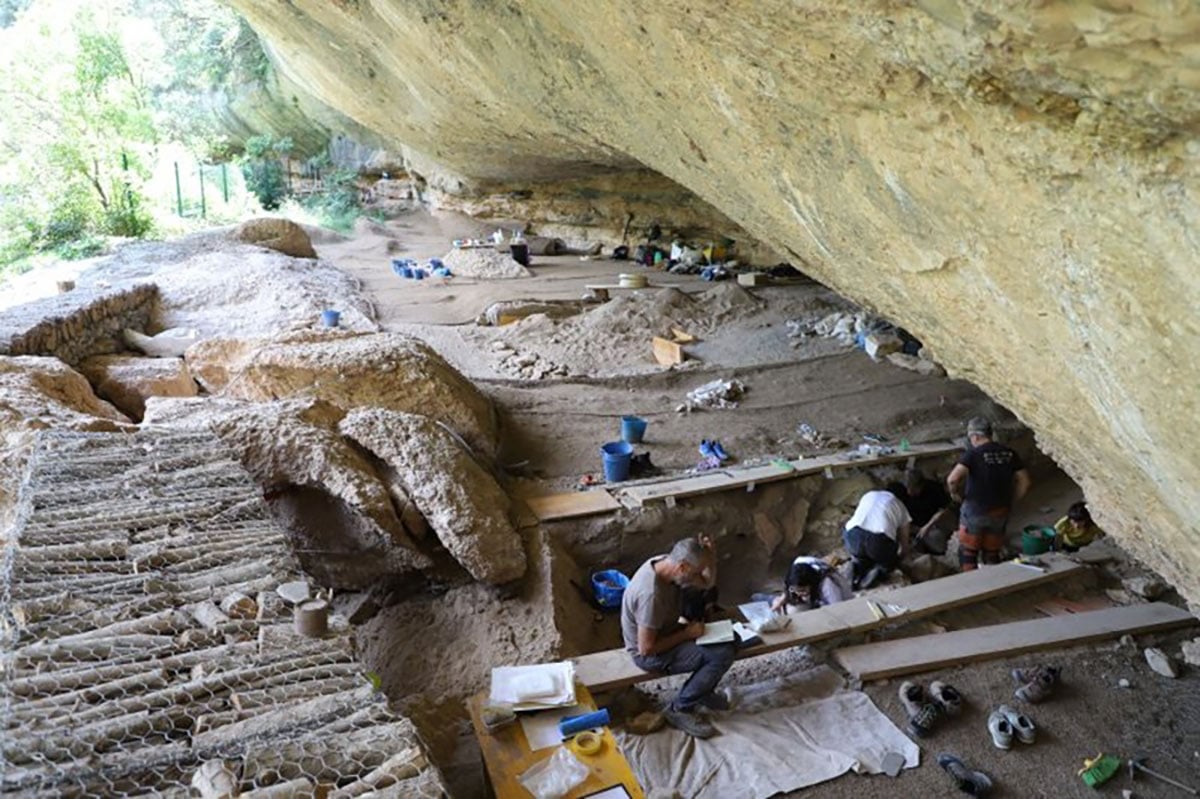
A Catalan rock shelter preserves a rare record of the transition from hunter-gathering to farming.
For thousands of years, people repeatedly returned to a rock shelter above the Montsant River, leaving behind traces of a profound change in human life. Excavations at Coves del Fem (Ulldemolins, Priorat), within Serra de Montsant Natural Park, have now uncovered new evidence that could clarify the prehistory of the northeastern Iberian Peninsula.
The field campaign ran from May 30 to June 28, 2026. Researchers from the Department of Prehistory at the Universitat Autònoma de Barcelona (UAB) and the Milà i Fontanals Institution for Research in the Humanities of the Spanish National Research Council (CSIC-IMF) led the work, supported by the Ulldemolins Town Council and Serra de Montsant Natural Park through the Catalan Ministry for Culture’s four-year archaeology program.
Twenty-five lecturers, researchers, and students took part in the four-week excavation. Archaeology students from UAB also used the dig to complete practical field training for their bachelor’s degree.
Storage pits reveal early farming life
The excavation exposed extensive evidence of occupation from the Early Neolithic Cardial period. Archaeologists documented two hearths and eight pits cut into the ground that appear to have begun as storage silos.
After the pits were no longer used for storage, residents filled them with household waste. Inside, researchers found decorated pottery fragments, flint tools, debris from stone tool production, remains of animals that had been eaten, carbonized seeds and fruits, and other materials connected to the daily lives of the Montsant Valley’s first farming communities.
Together, these remains offer a closer view of how early Neolithic groups organized their economies, obtained and consumed food, and lived. Digging, using, and later abandoning the pits also disturbed older layers without pottery that most likely came from Mesolithic occupations already documented elsewhere at the site.
Mesolithic layers preserve an older world
One of the most important results from the 2026 campaign was the identification of two unusually well-preserved Mesolithic layers, unlike those encountered during earlier excavations. The deposits contain three associated hearths and a rich collection of surviving archaeological material.
Researchers recovered flint artifacts, animal remains, and a substantial group of archaeobotanical remains, which include preserved evidence of ancient plants. These materials could help reconstruct the environment and activities of the final hunter-gatherer communities that occupied the area.
The significance of the Mesolithic layers extends beyond Coves del Fem itself. They offer a rare opportunity to investigate the social and economic changes that occurred when hunter-gatherers gave way to the first farming and herding communities in an inland mountain landscape such as the Montsant massif.
This transformation, known as Neolithization, remains poorly understood in the northeastern Iberian Peninsula. Few sites preserve archaeological layers that are as extensive and well maintained as the sequence at Coves del Fem.
Further analysis of the recovered materials could reveal how these communities obtained food, moved across the landscape, used natural resources, and reorganized social life as agriculture and livestock farming became established.
One shelter records a major transition
Coves del Fem is a large rock shelter covering approximately 300 m² above the Montsant River in the municipality of Ulldemolins. Archaeologists have excavated the site continuously since 2013, and it has become an important location for studying recent prehistory in Catalonia.
Its archaeological record captures a major but still poorly understood period of social and economic change. Materials recovered during recent campaigns strengthen the site’s importance for examining the transition from the last hunter-gatherer societies to the first communities that produced food through farming and herding in the northeastern Iberian Peninsula.
Excavations conducted in recent years have documented nearly continuous human occupation from the Late Mesolithic (around 6000 BC) through the Early Neolithic (around 4500 BC). This sequence begins with the final hunter-gatherer occupations and continues through the arrival and establishment of the region’s first farming communities.
Researchers have also found scattered evidence of earlier activity that may date to the closing stages of the Upper Paleolithic. Other remains come from later periods of prehistory, including the end of the Neolithic and the beginning of the Metal Age.
Such continuity is uncommon among Catalan sites from this period. It makes Coves del Fem an unusually valuable place for tracing the cultural, technological, and economic changes associated with the Neolithization of the northeastern Iberian Peninsula.
The four-week excavation was part of the archaeology and paleontology research project “Coves del Fem: Land Use and Exploitation in the Upper Montsant Basin (8000–2000 BC)” (2026–2029), a four-year project awarded to UAB. Its goal is to better understand the prehistoric communities that lived in the area, including how they used the surrounding landscape, obtained resources, and changed their environment. The work was made possible by the Borrull family, who own Coves del Fem.
Never miss a breakthrough: Join the SciTechDaily newsletter.
Follow us on Google and Google News.
2 Comments
Thank you very much, very interesting.
Excellent information