
Close Menu
    Facebook X (Twitter) Instagram
    SciTechDaily
    • Biology
    • Chemistry
    • Earth
    • Health
    • Physics
    • Science
    • Space
    • Technology
    Facebook X (Twitter) Pinterest YouTube RSS
    SciTechDaily
    Home»Space»Rare Stellar Alignment Provides Opportunity to Search for Earth-Like Planets
    Space

    Rare Stellar Alignment Provides Opportunity to Search for Earth-Like Planets

    By NASAJune 4, 2013No Comments4 Mins Read
    Facebook Twitter Pinterest Telegram LinkedIn WhatsApp Email Reddit
    Share
    Facebook Twitter LinkedIn Pinterest Telegram Email Reddit
    Rare Stellar Alignment Offers Opportunity To Hunt For Planets Around Red Dwarf Proxima Centauri
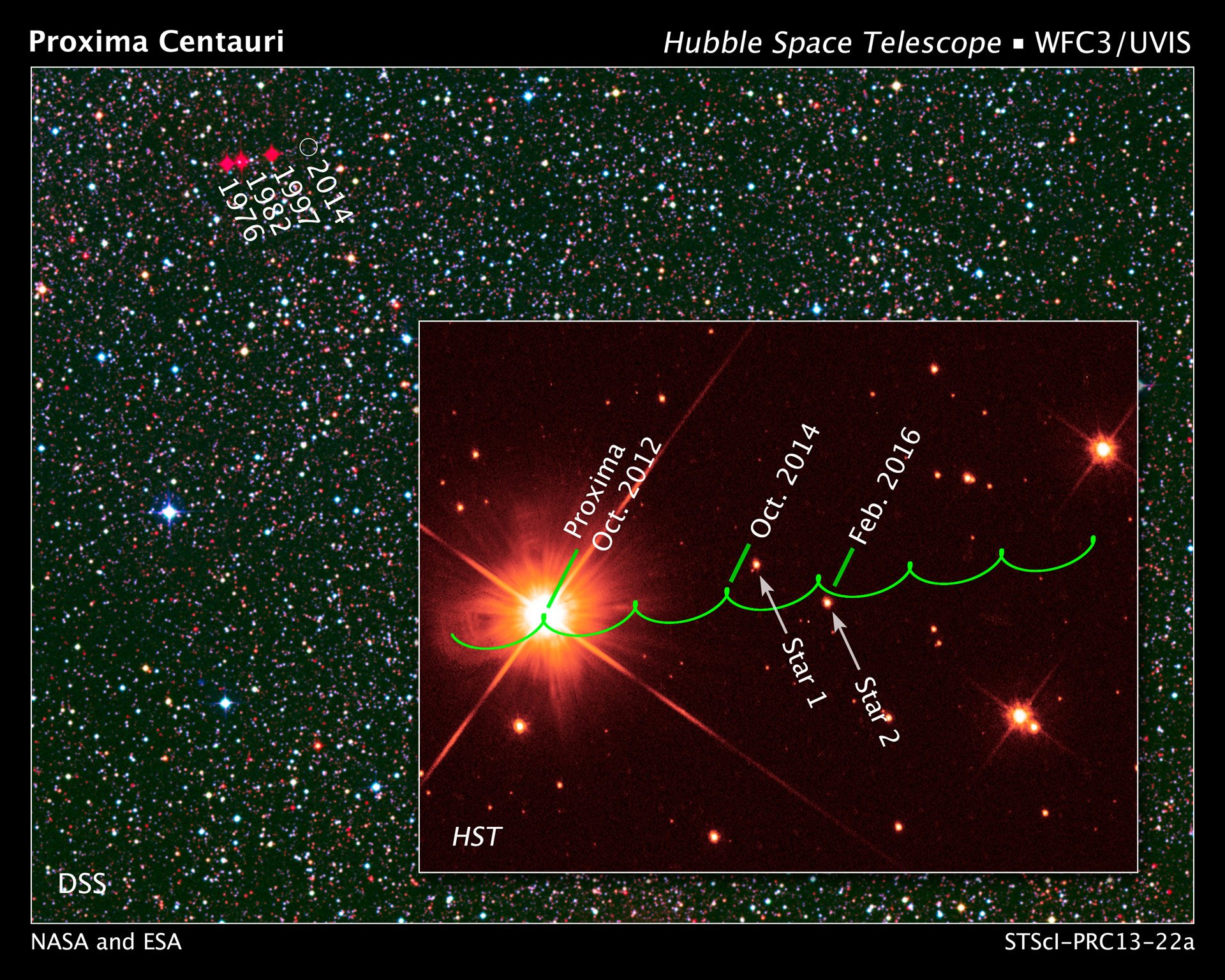
    This plot shows the projected motion of the red dwarf star Proxima Centauri (green line) over the next decade, as plotted from Hubble Space Telescope observations. Because of parallax due to Earth’s motion around the sun, the path appears scalloped. Because Proxima Centauri is the closest star to our sun (distance, 4.2 light-years), its angular motion across the sky is relatively fast compared to much more distant background stars. This means that in 2014 and 2016 Proxima Centauri will pass in front of two background stars that are along its path. The background image shows a wider view of the region of sky in the southern constellation Centaurus that Proxima is traversing. Credit:NASA, ESA, K. Sahu and J. Anderson (STScI), H. Bond (STScI and Pennsylvania State University), M. Dominik (University of St. Andrews), and Digitized Sky Survey (STScI/AURA/UKSTU/AAO)

    A rare stellar alignment will offer astronomers using NASA’s Hubble Space Telescope two opportunities to search for Earth-like planets around the red dwarf Proxima Centauri.

    The opportunities will occur in October 2014 and February 2016 when Proxima Centauri, the star nearest to our sun, passes in front of two other stars. Astronomers plotted Proxima Centauri’s precise path in the heavens and predicted the two close encounters using data from Hubble.

    “Proxima Centauri’s trajectory offers a most interesting opportunity because of its extremely close passage to the two stars,” said Kailash Sahu, an astronomer with the Space Science Telescope Institute in Baltimore, Maryland. Sahu leads a team of scientists whose work he presented Monday at the 222nd meeting of the American Astronomical Society in Indianapolis.

    Red dwarfs are the most common class of stars in our Milky Way galaxy. Any such star ever born is still shining today. There are about 10 red dwarfs for every star like our sun. Red dwarfs are less massive than other stars. Because lower-mass stars tend to have smaller planets, red dwarfs are ideal places to go hunting for Earth-sized planets.

    Previous attempts to detect planets around Proxima Centauri have not been successful. But astronomers believe they may be able to detect smaller terrestrial planets, if they exist, by looking for microlensing effects during the two rare stellar alignments.

    Microlensing occurs when a foreground star passes close to our line of sight to a more distant background star. These images of the background star may be distorted, brightened and multiplied depending on the alignment between the foreground lens and the background source.

    These microlensing events, ranging from a few hours to a few days in duration, will enable astronomers to measure precisely the mass of this isolated red dwarf. Getting a precise determination of mass is critical to understanding a star’s temperature, diameter, intrinsic brightness, and longevity.

    Astronomers will measure the mass by examining images of each of the background stars to see how far the stars are offset from their real positions in the sky. The offsets are the result of Proxima Centauri’s gravitational field warping space. The degree of offset can be used to measure Proxima Centauri’s mass. The greater the offset, the greater the mass of Proxima Centauri. If the red dwarf has any planets, their gravitational fields will produce a second small position shift.

    Because Proxima Centauri is so close to Earth, the area of sky warped by its gravitation field is larger than for more distant stars. This makes it easier to look for shifts in apparent stellar position caused by this effect. However, the position shifts will be too small to be perceived by any but the most sensitive telescopes in space and on the ground. The European Space Agency’s Gaia space telescope and the European Southern Observatory’s Very Large Telescope on Mt. Cerro Paranal in Chile may be able to make measurements comparable to Hubble’s.

    To identify possible alignment events, Sahu’s team searched a catalog of 5,000 stars with a high rate of angular motion across the sky and singled out Proxima Centauri. It crosses a section of sky with the apparent width of the full moon as observed from Earth every 600 years.

    Never miss a breakthrough: Join the SciTechDaily newsletter.
    Follow us on Google and Google News.

    Astronomy Exoplanet NASA Planetary Science
    Share. Facebook Twitter Pinterest LinkedIn Email Reddit

    Related Articles

    How Astronomers Search for Habitable Exoplanets

    Hubble Reveals Actual Visible-Light Color of Exoplanet HD 189733b

    NASA’s Kepler Mission Delivers New Data

    The Wild Weather of Hot Jupiters

    Project 1640 Reveals Precise Composition Information About Four HR 8799 Planets

    Kepler Mission Discovers Two New Planetary Systems With ‘Habitable Zone’ Planets

    New Study Revives Doubted Exoplanet Fomalhaut b

    Volunteer Scientists Aid in Discovery of Four-Star Planet PH1

    “Habitable Zone” Might Help Extreme Life Forms Survive on Exoplanets

    Leave A Reply Cancel Reply

    • Facebook
    • Twitter
    • Pinterest
    • YouTube

    Don't Miss a Discovery

    Subscribe for the Latest in Science & Tech!

    Trending News

    Scientists Uncover Potential Brain Risks of Popular Fish Oil Supplements

    Scientists Discover a Surprising Way To Make Bread Healthier and More Nutritious

    After 60 Years, Scientists Uncover Unexpected Brain Effects of Popular Diabetes Drug Metformin

    New Research Uncovers Hidden Side Effects of Popular Weight-Loss Drugs

    Scientists Rethink Extreme Warming After Surprising Ocean Discovery

    Landmark Study Links Never Marrying to Significantly Higher Cancer Risk

    Researchers Discover Unknown Beetle Species Just Steps From Their Lab

    Largest-Ever Study Finds Medicinal Cannabis Ineffective for Anxiety, Depression, PTSD

    Follow SciTechDaily
    • Facebook
    • Twitter
    • YouTube
    • Pinterest
    • Newsletter
    • RSS
    SciTech News
    • Biology News
    • Chemistry News
    • Earth News
    • Health News
    • Physics News
    • Science News
    • Space News
    • Technology News
    Recent Posts
    • Not Just Alzheimer’s: Scientists Uncover Clues to a Second, Overlooked Disorder
    • Scientists Uncover Dangerous Connection Between Serotonin and Heart Valve Disease
    • Scientists Discover a “Protector” Protein That Could Help Reverse Hair Loss
    • Powerful Lasers Reveal How Matter Becomes Plasma in Trillionths of a Second
    • A Simpler Path to Super-Resolution: Scientists Reinvent Microscopy
    Copyright © 1998 - 2026 SciTechDaily. All Rights Reserved.
    • Science News
    • About
    • Contact
    • Editorial Board
    • Privacy Policy
    • Terms of Use

    Type above and press Enter to search. Press Esc to cancel.