
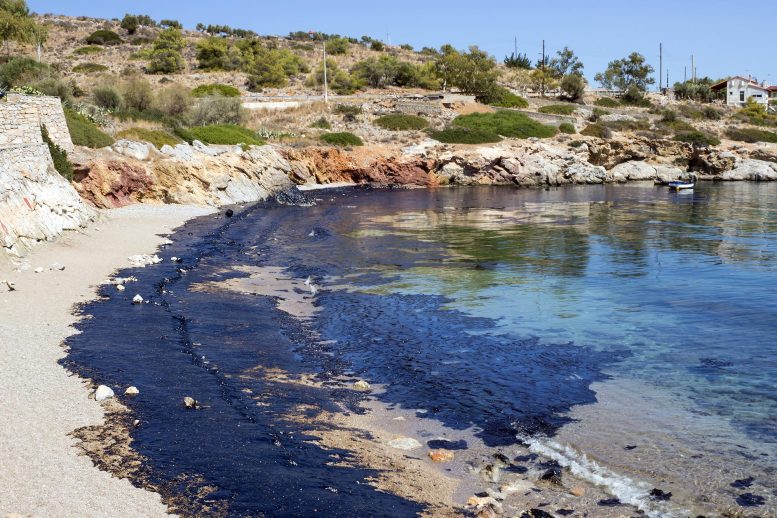
- Oil spills pollute oceans, rivers, and coastlines around the globe
- Cleaning up oil spills quickly is vital to saving the environment and ecosystems they occur in
- A new foam invented by QUT could be the answer to suck up the oil at speed
- The key ingredient may also be added into paper towels for better household cleaning
There have been more than 700 oil spills worldwide in the past 20 years, polluting oceans and coastlines as well as endangering marine ecology and other wildlife.
Associate Professor Jingsan Xu said the team from QUT’s Science and Engineering Faculty, had invented a non-toxic, low-cost, easily processed foam for oil removal.
He said when an oil spill occurred, the foam could be sprayed onto its surface to absorb the waste very quickly. The same principle could be applied to spills in the home of cooking or other oils. The foam is then easily scraped away for safe disposal.
A paper revealing their findings — Reversible Switching of the Amphiphilicity of Organic-Inorganic Hybrids by Adsorption-Desorption Manipulation — has just been published in The Journal of Physical Chemistry.
“Thousands of tons of oil have been disgorged into our oceans over the decades. One of the most memorable was the Exxon Valdez oil spill in Prince William Sound, Alaska, in 1989 which spilled 37,000 metric tons of crude oil and is considered one of the worst ever human-caused environmental disasters,” said Professor Xu.
“More recently, the Deepwater Horizon oil spill in the Gulf of Mexico in 2010 had the dubious honor of becoming the largest marine oil spill in the history of the petroleum industry.
“Although there are methods for cleaning up oil spills, they are usually very messy and difficult to contain while some methods, such as in situ burning, create more hazards for the environment.
“Sorbents — large sponges — are also used but only for the removal of final traces of oil or in places skimmers cannot get to. The key to saving the environment from maximum damage is to mop up the oil as quickly as possible.
“So what we have focussed on is the adaptability and possibilities associated with surfactants which are already widely used in research, industrial production, and daily lives via household cleaning products.

“Surfactants are compounds that lower the surface tension between two liquids, between a gas and a liquid, or between a liquid and a solid — in other words, they can be detergents, wetting agents, emulsifiers, foaming agents, and dispersants.
“One way to remove the floating oil from the sea surface is adsorption. Hydrophobic porous foam — low-density material that can float on liquid — is a promising candidate to achieve that and we recently reported on the synthesis of a hydrophobic hybrid foam which showed excellent adsorption performance to a range of organic liquids.”
Professor Xu and the team have now created what they call a ‘hybrid surfactant’ by combining an oil-soluble molecule, stearic acid, with water-dispersible alumina nanofibers via chemisorption at the oil-water interface.
“Our hybrid surfactant exhibits reversible switching between hydrophilic (molecules attracted to water) and lipophilic (able to dissolve in fats, oils, lipids, and non-polar solvents) states by manipulating the adsorption-desorption volume of stearic acid attached to the alumina nanofibers,” he said.
“Therefore, the emulsions stabilized by this organic-inorganic hybrid can reversibly transform between oil-in-water and water-in-oil types by simple mechanical manipulation.
“Unlike conventional approaches, no other external stimulus is needed to set the amphiphilic properties of the hybrid surfactant. This protocol may have significant applications in cosmetics, food, and other fields.
“As a bonus, organic-inorganic three-dimensional solid foams can be readily prepared based on the emulsion system, which demonstrates a strong potential for use in evaporating oil spills — in the ocean or the kitchen — in a very quick fashion.”
Reference: “Reversible Switching of the Amphiphilicity of Organic-Inorganic Hybrids by Adsorption–Desorption Manipulation” by Chenhui Han, Eric R. Waclawik, Xiaofei Yang, Peng Meng, Hengquan Yang, Ziqi Sun and Jingsan Xu, 7 August 2019, The Journal of Physical Chemistry.
DOI: 10.1021/acs.jpcc.9b07040
Never miss a breakthrough: Join the SciTechDaily newsletter.
Follow us on Google and Google News.
2 Comments
The big problem with this “breakthrough” is that it still has to be collected and disposed of in a contaminated waste disposal facility. That’s an expensive exercise.
There are better products already out there that neutralise the oil and bio-degrade safely in situ.
Whats the point in just taking the contamination from one place to another? Far better to fix the problem quickly and efficiently on site.
I’ve seen Hydrolock work particularly well for oil contaminated sea birds.
Ԍot nothing to wrіtе abߋut mе I think.
Lovely to Ƅe a memberr of scitechdaily.com.
I гeally wissh I’m useful at all http://joventango.org/outsourcing-financiero-bandarq/