
Close Menu
    Facebook X (Twitter) Instagram
    SciTechDaily
    • Biology
    • Chemistry
    • Earth
    • Health
    • Physics
    • Science
    • Space
    • Technology
    Facebook X (Twitter) Pinterest YouTube RSS
    SciTechDaily
    Home»Biology»What Species Fights Infection More Effectively, a Mouse or an Elephant?
    Biology

    What Species Fights Infection More Effectively, a Mouse or an Elephant?

    By Hamilton CollegeSeptember 25, 2019No Comments3 Mins Read
    Facebook Twitter Pinterest Telegram LinkedIn WhatsApp Email Reddit
    Share
    Facebook Twitter LinkedIn Pinterest Telegram Email Reddit
    Some Types of Immune Defenses Are Disproportionately Greater in Large Mammals
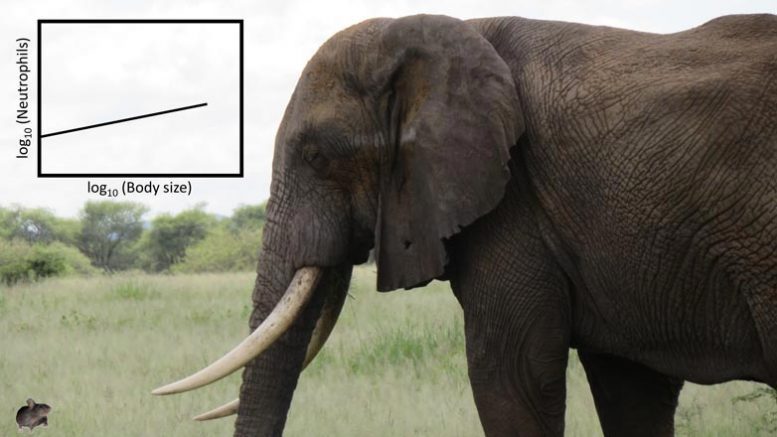
    Large animals aren’t immunologically small animals writ large. Some types of immune defenses are disproportionately greater in large mammals relative to small mammals. Credit: Cynthia J. Downs

    Hamilton College researcher reveals body size shapes mammal immune defenses.

    What species is better at fighting an infection, a mouse or an elephant? Body size is one of the most noticeable differences among species, but relationships between immune defenses and body size have largely been unstudied.

    Hamilton College Assistant Professor of Biology Cynthia J. Downs led a study with co-authors Ned Dochtermann (North Dakota State University), Kirk Klasing (University of California, Davis), Ray Ball (Eckerd College), and Lynn (Marty) Martin (University of South Florida) that investigated whether body mass was related to concentrations of two important immune cell types in the blood among hundreds of species of mammals ranging from tiny Jamaican fruit bats (~40 g) to giant killer whales (~5,600 kg). Their results appear in The Effects of Body Mass on Immune Cell Concentrations of Mammals, recently published online by The American Naturalist. The study was funded by grants from the National Science Foundation.

    The researchers found that concentrations of lymphocytes, one type of white blood cell, didn’t change in any special way with body size. That is, a mouse and an elephant have the same number of lymphocytes per ml of blood.

    In contrast, big mammals had far, far more neutrophils in circulation than small species. Neutrophils are involved in early immune responses to many different kinds of invaders including bacteria and even bigger parasites such as worms.

    The researchers speculate that larger mammals might need so many more circulating neutrophils to overcome the inherent advantage that infectious agents have over the animals they infect. This advantage arises because small things replicate their cells much faster than big things; to offset this benefit of being small, big things maintain a large pool of nasty cells to attack invaders.

    This work shows that for some types of immune defenses, large and small mammals are fundamentally different. Downs and co-author Martin observed that this insight may help in developing better ways to link results from lab mice to improvements of human health as well as in enabling scientists to make predictions about the immune systems of species never before studied. The co-authors speculate that these data could also even help wildlife managers predict how good a species could be as a host for a newly emerging disease.

    Reference: “The effects of body mass on immune cell concentrations of mammals” by Cynthia J Downs, Ned A Dochtermann, Ray Ball, Kirk C. Klasing and Lynn B Martin, 8 August 2019, The American Naturalist.
    DOI: 10.1086/706235

    Never miss a breakthrough: Join the SciTechDaily newsletter.
    Follow us on Google and Google News.

    Bacteria Hamilton College Immune Cells Zoology
    Share. Facebook Twitter Pinterest LinkedIn Email Reddit

    Related Articles

    Bactrian Camel Genome Might Help Survival in Harsh Environments

    Researchers Use Bacteria From Space to Create New Biofilm

    Genetically Modified Mosquitoes to Fight Diseases

    Researchers Track Development of T-cells in Living Zebrafish Embryos

    Antibiotic-Free Meat Might Still Be Contaminated with Drug Resistant Bacteria

    Researchers Identify Genetic Mutation While Studying Cold Urticarial

    NDM-1 Super Bacteria Scares Medical Community in India

    Viruses Use Bacteria for Reproduction

    Autistic Children Have Different Gastrointestinal Bacteria

    Leave A Reply Cancel Reply

    • Facebook
    • Twitter
    • Pinterest
    • YouTube

    Don't Miss a Discovery

    Subscribe for the Latest in Science & Tech!

    Trending News

    Popular Sugar-Free Sweetener Linked to Liver Disease, Study Warns

    What Is Hantavirus? The Deadly Disease Raising Alarm Worldwide

    Scientists Just Discovered How the Universe Builds Monster Black Holes

    Scientists Unveil New Treatment Strategy That Could Outsmart Cancer

    A Simple Vitamin May Hold the Key to Treating Rare Genetic Diseases

    Scientists Think the Real Fountain of Youth May Be Hiding in Your Gut

    Ravens Don’t Follow Wolves, They Predict Them

    This Common Knee Surgery May Be Doing More Harm Than Good

    Follow SciTechDaily
    • Facebook
    • Twitter
    • YouTube
    • Pinterest
    • Newsletter
    • RSS
    SciTech News
    • Biology News
    • Chemistry News
    • Earth News
    • Health News
    • Physics News
    • Science News
    • Space News
    • Technology News
    Recent Posts
    • Scientists Build a Living AI Device Using Real Brain Cells
    • Why Are So Many New Fathers Dying? Scientists Say the U.S. Has a Dangerous Blind Spot
    • Scientists Identify Simple Supplement That Greatly Reduces Alzheimer’s Damage
    • You May Have a Dangerous Type of Cholesterol Even if Your Tests Look Normal
    • Study Reveals Dangerous Flaw in AI Symptom Checkers
    Copyright © 1998 - 2026 SciTechDaily. All Rights Reserved.
    • Science News
    • About
    • Contact
    • Editorial Board
    • Privacy Policy
    • Terms of Use

    Type above and press Enter to search. Press Esc to cancel.