
Close Menu
    Facebook X (Twitter) Instagram
    SciTechDaily
    • Biology
    • Chemistry
    • Earth
    • Health
    • Physics
    • Science
    • Space
    • Technology
    Facebook X (Twitter) Pinterest YouTube RSS
    SciTechDaily
    Home»Space»Stunning New Black Hole Visualization From NASA Illustrates How Its Gravity Distorts Our View
    Space

    Stunning New Black Hole Visualization From NASA Illustrates How Its Gravity Distorts Our View

    By NASA/Goddard Space Flight CenterSeptember 25, 2019No Comments3 Mins Read
    Facebook Twitter Pinterest Telegram LinkedIn WhatsApp Email Reddit
    Share
    Facebook Twitter LinkedIn Pinterest Telegram Email Reddit
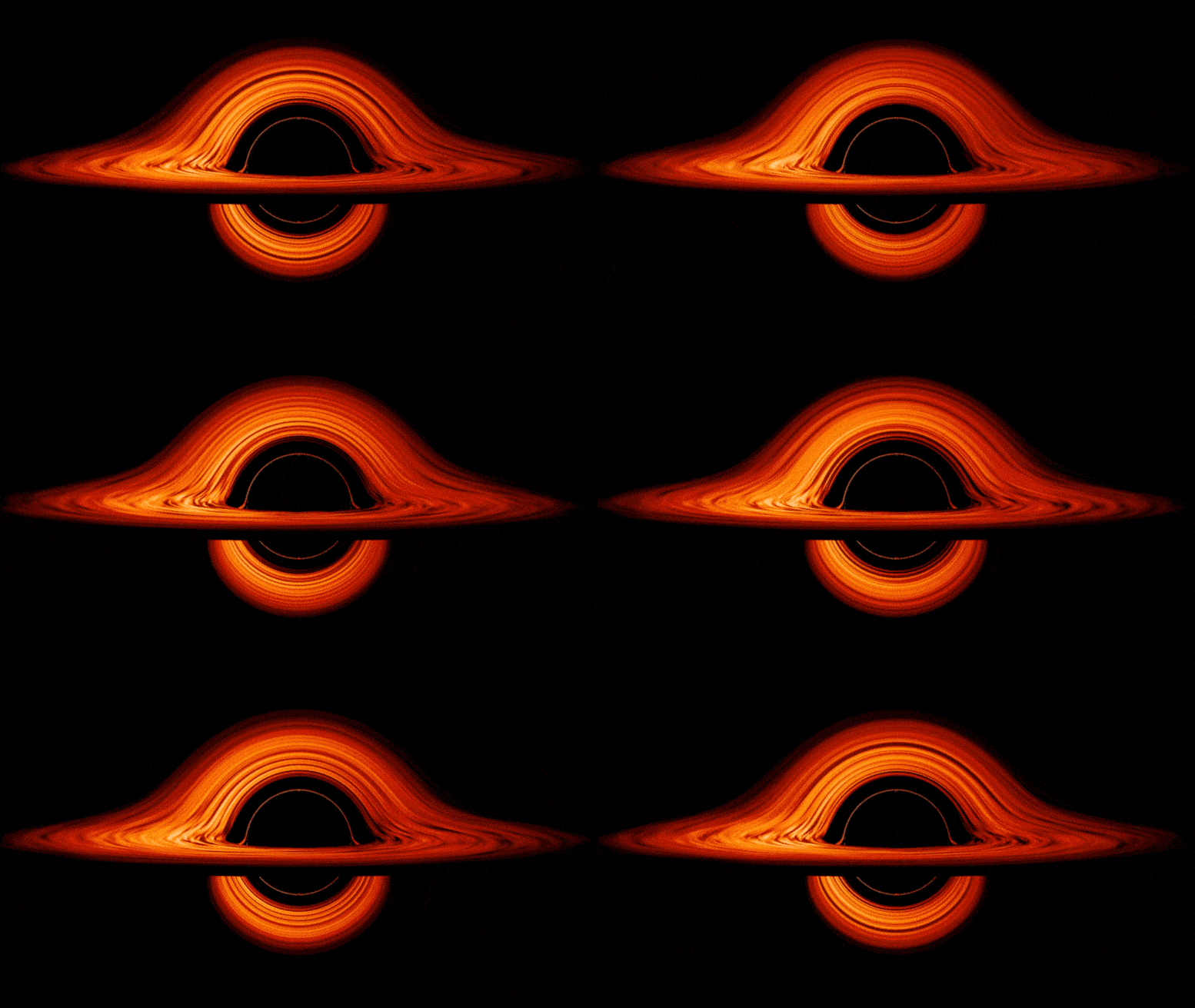
    Black Hole Warped World
    Seen nearly edgewise, the turbulent disk of gas churning around a black hole takes on a crazy double-humped appearance. The black hole’s extreme gravity alters the paths of light coming from different parts of the disk, producing the warped image. The black hole’s extreme gravitational field redirects and distorts light coming from different parts of the disk, but exactly what we see depends on our viewing angle. The greatest distortion occurs when viewing the system nearly edgewise. Credit: NASA’s Goddard Space Flight Center/Jeremy Schnittman

    This new visualization of a black hole illustrates how its gravity distorts our view, warping its surroundings as if seen in a carnival mirror. The visualization simulates the appearance of a black hole where the infalling matter has collected into a thin, hot structure called an accretion disk. The black hole’s extreme gravity skews light emitted by different regions of the disk, producing the misshapen appearance.

    Bright knots constantly form and dissipate in the disk as magnetic fields wind and twist through the churning gas. Nearest the black hole, the gas orbits at close to the speed of light, while the outer portions spin a bit more slowly. This difference stretches and shears the bright knots, producing light and dark lanes in the disk.

    Viewed from the side, the disk looks brighter on the left than it does on the right. Glowing gas on the left side of the disk moves toward us so fast that the effects of Einstein’s relativity give it a boost in brightness; the opposite happens on the right side, where gas moving away from us becomes slightly dimmer. This asymmetry disappears when we see the disk exactly face-on because, from that perspective, none of the material is moving along our line of sight.
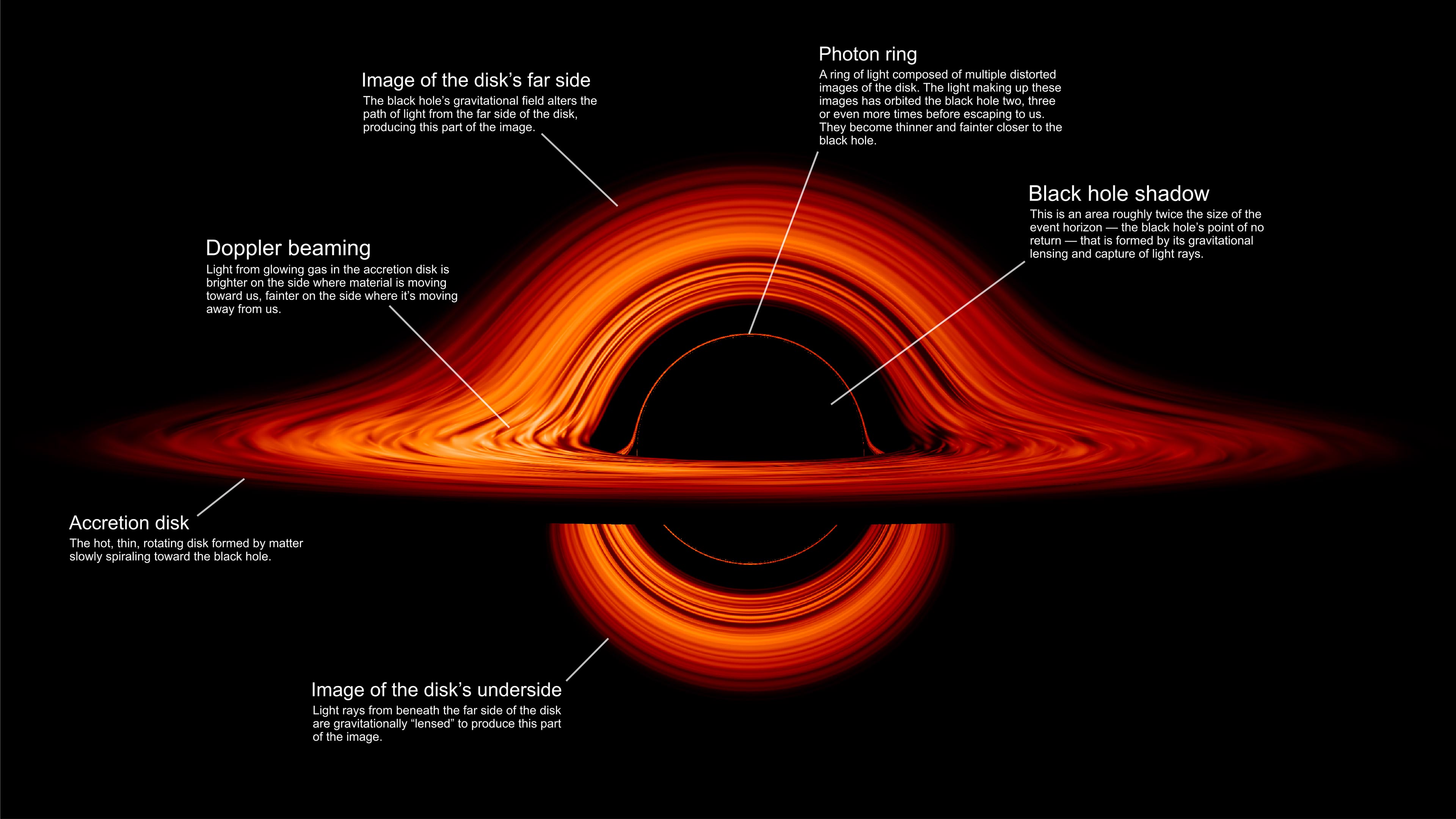
    Black Hole Visualization
    This image highlights and explains various aspects of the black hole visualization. Credit: NASA’s Goddard Space Flight Center/Jeremy Schnittman

    Closest to the black hole, the gravitational light-bending becomes so excessive that we can see the underside of the disk as a bright ring of light seemingly outlining the black hole. This so-called “photon ring” is composed of multiple rings, which grow progressively fainter and thinner, from light that has circled the black hole two, three, or even more times before escaping to reach our eyes. Because the black hole modeled in this visualization is spherical, the photon ring looks nearly circular and identical from any viewing angle. Inside the photon ring is the black hole’s shadow, an area roughly twice the size of the event horizon — its point of no return.

    “Simulations and movies like these really help us visualize what Einstein meant when he said that gravity warps the fabric of space and time,” explains Jeremy Schnittman, who generated these gorgeous images using custom software at NASA’s Goddard Space Flight Center in Greenbelt, Maryland. “Until very recently, these visualizations were limited to our imagination and computer programs. I never thought that it would be possible to see a real black hole.” Yet on April 10, the Event Horizon Telescope team released the first-ever image of a black hole’s shadow using radio observations of the heart of the galaxy M87.

    Never miss a breakthrough: Join the SciTechDaily newsletter.
    Follow us on Google and Google News.

    Astronomy Astrophysics Black Hole NASA NASA Goddard Space Flight Center
    Share. Facebook Twitter Pinterest LinkedIn Email Reddit

    Related Articles

    Every 4.5 Days, This Black Hole Unleashes Explosive X-Ray Blasts – NASA Finally Explains Why

    Twin Titans: NASA Tracks Two Monster Black Holes Tearing Up a Distant Galaxy [Video]

    Echoes of Creation: The Roman Telescope’s Quest for Primordial Black Holes

    NASA’s New $10 Billion Webb Space Telescope Will Reveal the Supermassive Black Hole at the Heart of the Milky Way

    Hypnotic New NASA Visualization Probes the Light-Bending Dance of Binary Black Holes

    NASA Investigates an “Old Faithful” Active Galaxy That Erupts Every 114 Days

    Gas Far Outside of Our Galaxy Illuminated by Enormous Burst of Energy Unleashed by Milky Way’s Black Hole

    NASA’s Webb Telescope Will Penetrate Space Dust to Reveal Milky Way’s Center

    Astronomers Discover X-Ray Echoes from a Black Hole That Shattered a Passing Star

    Leave A Reply Cancel Reply

    • Facebook
    • Twitter
    • Pinterest
    • YouTube

    Don't Miss a Discovery

    Subscribe for the Latest in Science & Tech!

    Trending News

    This Copper Drug Clears Alzheimer’s Brain Toxins and Boosts Memory

    Adults Over 65 Lost Massive Amounts of Weight With Ozempic

    How Flocking Birds “Defy” One of Physics’ Most Fundamental Laws

    Physicists Create a New Kind of Schrödinger’s Cat State From Exotic Quantum Building Blocks

    Your Diet Could Be Missing the Key Ingredient for Heart Protection

    Researchers Warn Widely Prescribed Blood Pressure Drugs Could Be Harming Diabetic Kidneys

    James Webb Spots Something Strange Between Day and Night on an Alien Planet

    How Ancient People Moved a 6-Ton Stone 700 Kilometers to Stonehenge

    Follow SciTechDaily
    • Facebook
    • Twitter
    • YouTube
    • Pinterest
    • Newsletter
    • RSS
    SciTech News
    • Biology News
    • Chemistry News
    • Earth News
    • Health News
    • Physics News
    • Science News
    • Space News
    • Technology News
    Recent Posts
    • The Surprising Reason Swimming Could Be Better for Your Heart Than Running
    • Could Vitamin C Be the Secret to Keeping Your Brain Younger?
    • The Surprising Fix for Robot Traffic Jams
    • Near Absolute Zero, This Transistor Starts Acting Like a Brain Cell
    • Beyond DNA: Scientists Discover Inheritance That Breaks the Rules of Genetics
    Copyright © 1998 - 2026 SciTechDaily. All Rights Reserved.
    • Science News
    • About
    • Contact
    • Editorial Board
    • Privacy Policy
    • Terms of Use

    Type above and press Enter to search. Press Esc to cancel.