
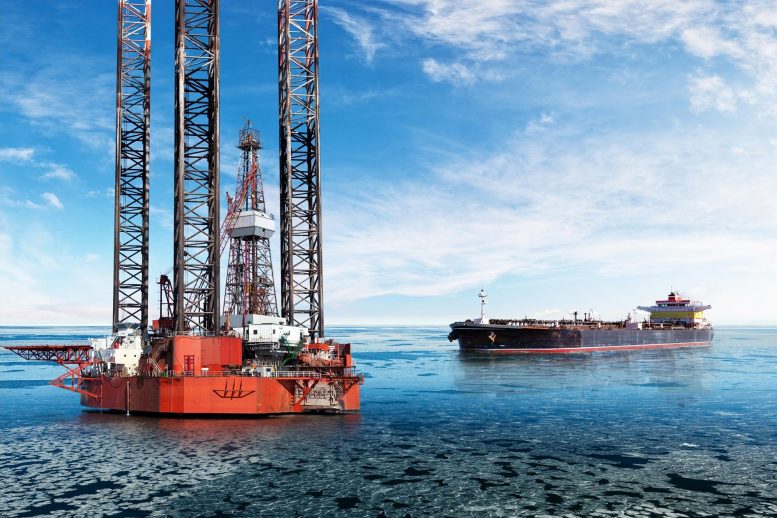
As melting sea ice brings more ships through the Northwest Passage, new research shows that Canada must prepare for the costs and consequences of an Arctic oil spill.
The growing rate of ice melt in the Arctic due to rising global temperatures has opened up the Northwest Passage (NWP) to more ship traffic, increasing the potential risk of an oil spill and other environmental disasters. A new study published in the journal Risk Analysis suggests that an oil spill in the Canadian Arctic could be devastating—especially for vulnerable indigenous communities.
“Infrastructure along the NWP in Canada’s Arctic is almost non-existent. This presents major challenges to any response efforts in the case of a natural disaster,” says Mawuli Afenyo, lead author, University of Manitoba researcher, and expert on the risks of Arctic shipping.
Afenyo and his colleagues have developed a new method that could help managers predict the risk of pollutants from increased shipping activity. The paper describes how they used it to assess the socio-economic impacts of a potential oil spill in the Rankin Inlet region of the Canadian Arctic. This area is a critical regional hub for Arctic shipping where traffic has been increasing since 2010. For their analysis, the researchers simulated the conditions of the Exxon Valdez disaster in 1989, when an oil tanker released 11 million gallons of oil into Alaska’s Prince William Sound. It should be noted that an oil spill of the magnitude of the Exxon Valdez has not occurred in the Rankin Inlet; this study is a simulation to project the potential impact of such a spill.
Cultural and Social Impacts on Indigenous Communities
“One of our key findings was that the negative socio-economic impact of an oil spill in the Arctic accelerates quickly with time if there is no intervention,” says Afenyo. “Our study also showed that an oil spill in this region has serious social impacts—affecting the family dynamics, hunting traditions, and culture of vulnerable indigenous communities.”
Cleaning up a spill in the Arctic is different from that in other parts of the ocean due to the harsh nature of the environment and the remoteness of the region. Oil from a spill can move under the ice, between ice, get absorbed by snow, and become encapsulated in ice. This makes response efforts and long-term monitoring difficult and expensive.
Using two different risk assessment models, the researchers evaluated the probability and consequences of an oil spill in the Rankin Inlet. To estimate the probability, they reviewed past incidents and scientific reports about oil spills and also surveyed scientists, government workers, insurance specialists, and rights holders who live or work in the Arctic.
To estimate the consequences of a spill, they used a multi-period model to predict the socio-economic impacts over a period of five years if no recovery efforts were conducted—one of the most probable scenarios for this area based on current conditions. “This worse-case scenario analysis gives decision-makers the opportunity to put into place intervention that will help mitigate risks to a bare minimum,” Afenyo explained.
All of the consequences of a potential spill were incorporated into an influence diagram to help managers assess the risk of a spill in terms of U.S. dollars. It includes such impacts as the destruction of flora and fauna and the disruption of hunting and culture for indigenous communities in the region. In the first year following the spill in the Rankin Inlet, the cost with no intervention was estimated to be $500 million. By the fifth year, this figure rose to $7.5 billion.
“Our method is very comprehensive as it uses both qualitative and quantitative inputs and can be used to assess not only the socio-economic impacts but also the environmental consequences,” says Afenyo. He adds that it can serve as a decision-making tool for policy makers, insurance companies, and government institutions responsible for risk assessment and emergency response.
Collaboration and Risk Communication
In their analysis, the researchers identified an urgent need to develop a good communication network between indigenous nations within the region, the Canadian federal government, and companies looking to work there. “The challenge will be determining how the Canadian federal government should collaborate with indigenous people to respond rapidly to an oil spill,” says Afenyo.
In future research, the team plans to develop an app to help decision-makers assess the socio-economic impacts of shipping spills in the Arctic and examine how different policy responses could minimize the negative impacts of those spills. This would help marine insurers develop practical tools to help accurately calculate risk and insurance premiums for ships traveling through the Arctic. The newly constructed Churchill Marine Observatory will be an important source of data to further improve the accuracy of the model.
Reference: “A Multiperiod Model for Assessing the Socioeconomic Impacts of Oil Spills during Arctic Shipping” by Mawuli Afenyo, Adolf K.Y. Ng and Changmin Jiang, 7 July 2021, Risk Analysis.
DOI: 10.1111/risa.13773
The paper is co-authored by Changmin Jiang of the Asper School of Business at the University of Manitoba and Adolf K.Y. Ng in the Division of Business and Management at Beijing Normal University-Hong Kong Baptist University United International College (China). The joint Sino-Canadian research is part of the GENICE project (Microbial Genomics for Oil Spill Preparedness in Canada’s Arctic Marine Environment) led by the University of Manitoba and the University of Calgary.
Never miss a breakthrough: Join the SciTechDaily newsletter.
Follow us on Google and Google News.