
Close Menu
    Facebook X (Twitter) Instagram
    SciTechDaily
    • Biology
    • Chemistry
    • Earth
    • Health
    • Physics
    • Science
    • Space
    • Technology
    Facebook X (Twitter) Pinterest YouTube RSS
    SciTechDaily
    Home»Biology»Researchers Calculate That DNA Has a 521 Year Half-Life
    Biology

    Researchers Calculate That DNA Has a 521 Year Half-Life

    By SciTechDailyOctober 11, 20121 Comment3 Mins Read
    Facebook Twitter Pinterest Telegram LinkedIn WhatsApp Email Reddit
    Share
    Facebook Twitter LinkedIn Pinterest Telegram Email Reddit
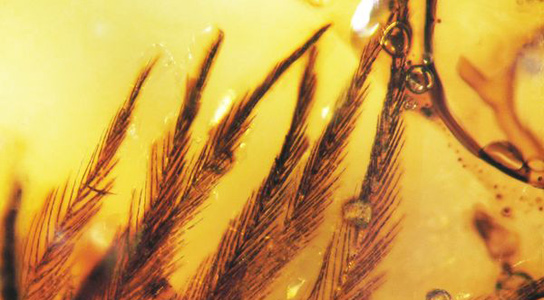
    dino-feathers-clumped-barbs-amber
    Preserved for 70 to 85 million years, these feathers are part of a newly revealed trove of likely dinosaur and bird plumage found trapped in amber in Alberta, Canada. Credit: Photograph courtesy Science/AAAS

    A new study of fossils in New Zealand has discovered that cloning dinosaurs or organisms that have been extinct for millions of years is highly improbable, since the half-life of DNA is 521 years.

    The scientists published their findings in the journal Proceedings of the Royal Society B. After cell death, enzymes start to break down the bonds between the nucleotides which form DNA. Micro-organisms speed up the decay and in the long run, reactions with water are thought to be most responsible for bond degradation. In theory, since DNA is buried in bone samples, which are found in the ground, there should be a set rate of degradation.
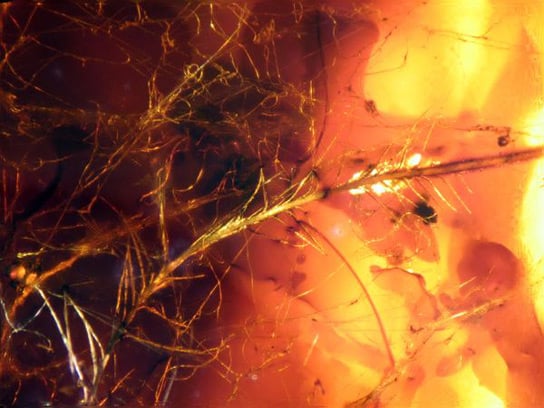
    dinosaur-feathers-clumped-amber
    Credit: Photograph courtesy Science/AAAS

    It’s been difficult to determine this rate, as it’s rare to find large sets of DNA-containing fossils to make comparisons. Environmental factors such as temperature, the degree of microbial attack and oxygenation alter the speed of decay.

    Palaeogeneticists led by Morten Allentoft at the University of Copenhagen and Michael Bunce at Murdoch University in Perth, Australia, examined 158 DNA containing leg bones belonging to three species of moa, an extinct species of giant birds, The bones were between 600 and 8,000 years old, had been recovered from three sites within 5 km of each other and were in nearly identical preservation conditions.

    The specimens’ ages and degrees of DNA degradation were compared and the researchers calculated that DNA has a half-life of 521 years. At an ideal preservation temperature of −5 ºC (21 ºF), every bond in DNA would be destroyed after 6.8 million years. DNA would cease to be readable after 1.5 million years.

    This confirms that DNA from dinosaurs and ancient insects trapped in amber isn’t viable for cloning purposes. The researchers found that age differences only accounted for 38.6% of the variation in DNA degradation between the moa-bone samples, which means that there are other contributing factors.

    Reference: “The half-life of DNA in bone: measuring decay kinetics in 158 dated fossils” by Morten E. Allentoft, Matthew Collins, David Harker, James Haile, Charlotte L. Oskam, Marie L. Hale, Paula F. Campos, Jose A. Samaniego, M. Thomas P. Gilbert, Eske Willerslev, Guojie Zhang, R. Paul Scofield, Richard N. Holdaway and Michael Bunce, 10 October 2012, Proceedings of the Royal Society B.
    DOI: 10.1098/rspb.2012.1745

    Never miss a breakthrough: Join the SciTechDaily newsletter.
    Follow us on Google and Google News.

    DNA Evolutionary Biology Genetics Paleontology
    Share. Facebook Twitter Pinterest LinkedIn Email Reddit

    Related Articles

    Harvard Study Offers New Insight on Height and Arthritis

    DNA Study Reveals Clues about Primate Evolution

    Ancient DNA Reveals Link between Early Humans & Present-Day Asians and Native Americans

    Geneticists Grow Fish with Limbs to Duplicate Evolutionary Pressure

    Genetic Variability Helps Sea Urchins Cope with Environmental Changes

    DNA Could Predate Existence of Life As We Know It

    Rare Example of Bacterial Gene Transfer Providing Evolutionary Benefit

    Human Y-Chromosome Has Enough Genes to Stay for Millions of Years

    Researchers Complete Genome Sequence of a Denisovan Human Finger Bone

    1 Comment

    1. Madanagopal.V.C. on October 11, 2012 9:34 am

      Hurrah! Jurassic Park Experiment with 25 million year old DNA of Dinosaurs trapped in amber, though may be preserved well will be of no use for cloning since 6.8 million years is enough to dissolve bonds of ACTG. 521 year half life is poor indeed. It doesn`t matter. We can make another film Jurassic Park X to satisfy our wishes. We have to stop with cloning Dolly , Calf , etc upto Man if permitted. Or we can try only extinct animals of the present era. Thak You.

      Reply
    Leave A Reply Cancel Reply

    • Facebook
    • Twitter
    • Pinterest
    • YouTube

    Don't Miss a Discovery

    Subscribe for the Latest in Science & Tech!

    Trending News

    Mezcal “Worm” in a Bottle Mystery: DNA Testing Reveals a Surprise

    New Research Reveals That Your Morning Coffee Activates an Ancient Longevity Switch

    This Is What Makes You Irresistible to Mosquitoes

    Shockingly Powerful Giant Octopuses Ruled the Seas 100 Million Years Ago

    Scientists Stunned by New Organic Molecules Found on Mars

    Rewriting Dinosaur Evolution: Scientists Unearth Remarkable 150-Million-Year-Old Stegosaur Skull

    Omega-3 Supplements Linked to Cognitive Decline in Surprising New Study

    First-of-Its-Kind Discovery: Homer’s Iliad Found Embedded in a 1,600-Year-Old Egyptian Mummy

    Follow SciTechDaily
    • Facebook
    • Twitter
    • YouTube
    • Pinterest
    • Newsletter
    • RSS
    SciTech News
    • Biology News
    • Chemistry News
    • Earth News
    • Health News
    • Physics News
    • Science News
    • Space News
    • Technology News
    Recent Posts
    • These Simple Daily Habits Can Quickly Improve Blood Pressure and Heart Risk Factors
    • A Common Nutrient May Play a Surprising Role in Anxiety
    • Doing This After 9 p.m. Could Double Your Risk of Gut Issues
    • New Research Challenges Long-Held Beliefs About How the Brain Makes Decisions
    • Breakthrough Technology Reveals New Treatment Targets for Cancer
    Copyright © 1998 - 2026 SciTechDaily. All Rights Reserved.
    • Science News
    • About
    • Contact
    • Editorial Board
    • Privacy Policy
    • Terms of Use

    Type above and press Enter to search. Press Esc to cancel.