
Close Menu
    Facebook X (Twitter) Instagram
    SciTechDaily
    • Biology
    • Chemistry
    • Earth
    • Health
    • Physics
    • Science
    • Space
    • Technology
    Facebook X (Twitter) Pinterest YouTube RSS
    SciTechDaily
    Home»Biology»Humans Are Less in Control of Their Brains Than Previously Thought
    Biology

    Humans Are Less in Control of Their Brains Than Previously Thought

    By SciTechDailyOctober 11, 20121 Comment3 Mins Read
    Facebook Twitter Pinterest Telegram LinkedIn WhatsApp Email Reddit
    Share
    Facebook Twitter LinkedIn Pinterest Telegram Email Reddit

    figure-study-perception-haptic-information

    Most of the actions that people take for granted are the result of a set of complex decisions that the brain deals with. The decisions about how to aim the body, how hard to hold handles, and how to raise cups are something that no one often consciously thinks of, yet the brain does all of these without missing a beat. A new Northwestern University study shows that not only does the brain handle such complex decisions, it also hides this information from the conscious mind.

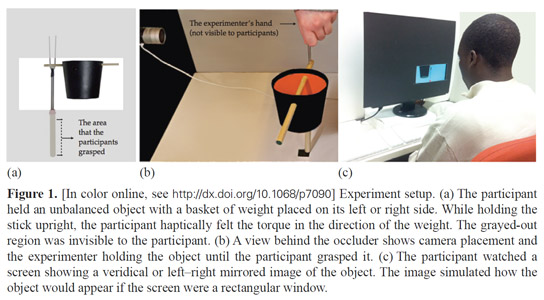
    The scientists published their findings in the journal Perception. When you pick up an object, your brain automatically decides how to control your muscles based on what your eyes see, states Yangqing Xu, lead author of the study and doctoral candidate in psychology at Northwestern. When you pick up a mug with your right hand, you need to add a clockwise twist to your grip in order to compensate for the extra weight you see on the left side of the mug, she continues.
    brain-processes-visual-information
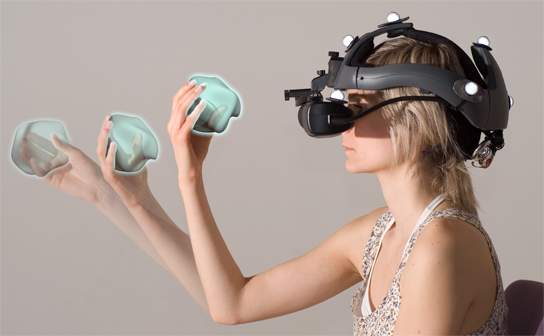
    We explore objects to familiarize ourselves with their visual aspects.

    The researchers showed that the use of this visual information is so powerful and automatic, that humans cannot turn it off. When people see an object weighted in one direction, they can’t help but feel the weight in that direction, even when the researchers tricked them.

    In the scientists’ first experiment, people were asked to grasp a vertical stick with a weight hanging from its left or right side. People easily reported which side they felt the weight was on, even when they closed their eyes. Then, the researchers used a set of mirrors to occasionally flip the view of the object, so that it looked like the weight was on the other side. Although people were able to report on which side they felt the weight, the visual image strongly influenced the direction they felt that the weight was coming from, especially with lighter objects.

    While researchers experimented with trying to convince their subjects the nature of the trick, people could still not ignore the visual information. It even worked on the researchers themselves, who designed the experiment.

    The brain is constantly making decisions that people don’t know about or don’t understand. The decisions are logical and based on vast experience.

    Reference: “Visual Influence on Haptic Torque Perception” by Yangqing Xu, Shélan O’Keefe, Satoru Suzuki and Steven L Franconeri, 1 January 2012, Perception.
    DOI: 10.1068/p7090

    Never miss a breakthrough: Join the SciTechDaily newsletter.
    Follow us on Google and Google News.

    Brain Brain Activity Decision Neuroscience Psychiatry
    Share. Facebook Twitter Pinterest LinkedIn Email Reddit

    Related Articles

    Locomotion Restored in Mice With Huntington’s-Like Condition

    “Area X” of Zebra Finch May Provide Insights to Human Speech Disorders

    Scientists Discover Link Between TBI and PTSD

    Researchers Use FDDNP–PET Scanning to Predict Cognitive Decline

    Neuroscientists Create Model to Study Burst Suppression and Brain States

    Researchers Record Detailed Live Images Inside the Brain of a Living Mouse

    Synchronized Brain Oscillations Crucial for Short-Term Memory

    Researchers Use fMRI to Study How Humor Activates Kids’ Brain Regions

    Neuroscientists Study Cortical Areas Specialized in Processing Visual Inputs in Mice

    1 Comment

    1. Cornfield on October 27, 2025 8:26 pm

      Whatever is responsible for consciousness must be a relative small part of the brain, possibly even widely distributed. Thus, most of what goes on in our brain happens outside (besides) conscious awareness. Relatively little directly interfaces to consciousness and so we literally have only very limited self awareness of the rest going on in our brains which altogether determines total mental life. Get over it.

      Reply
    Leave A Reply Cancel Reply

    • Facebook
    • Twitter
    • Pinterest
    • YouTube

    Don't Miss a Discovery

    Subscribe for the Latest in Science & Tech!

    Trending News

    Popular Sugar-Free Sweetener Linked to Liver Disease, Study Warns

    What Is Hantavirus? The Deadly Disease Raising Alarm Worldwide

    Scientists Just Discovered How the Universe Builds Monster Black Holes

    Scientists Unveil New Treatment Strategy That Could Outsmart Cancer

    A Simple Vitamin May Hold the Key to Treating Rare Genetic Diseases

    Scientists Think the Real Fountain of Youth May Be Hiding in Your Gut

    Ravens Don’t Follow Wolves, They Predict Them

    This Common Knee Surgery May Be Doing More Harm Than Good

    Follow SciTechDaily
    • Facebook
    • Twitter
    • YouTube
    • Pinterest
    • Newsletter
    • RSS
    SciTech News
    • Biology News
    • Chemistry News
    • Earth News
    • Health News
    • Physics News
    • Science News
    • Space News
    • Technology News
    Recent Posts
    • Scientists Just Found a Surprising Way To Destroy “Forever Chemicals”
    • Popular Supplement Ingredient Linked to Shorter Lifespan in Men
    • Scientists May Have Found a Way To Repair Nerve Damage in Multiple Sclerosis
    • GLP-1 Weight Loss Linked To Dramatically Lower Risk of Sleep Apnea, Kidney Disease and More
    • Scientists Uncover the Surprising Source of Strange Clouds Near the Milky Way’s Supermassive Black Hole
    Copyright © 1998 - 2026 SciTechDaily. All Rights Reserved.
    • Science News
    • About
    • Contact
    • Editorial Board
    • Privacy Policy
    • Terms of Use

    Type above and press Enter to search. Press Esc to cancel.