
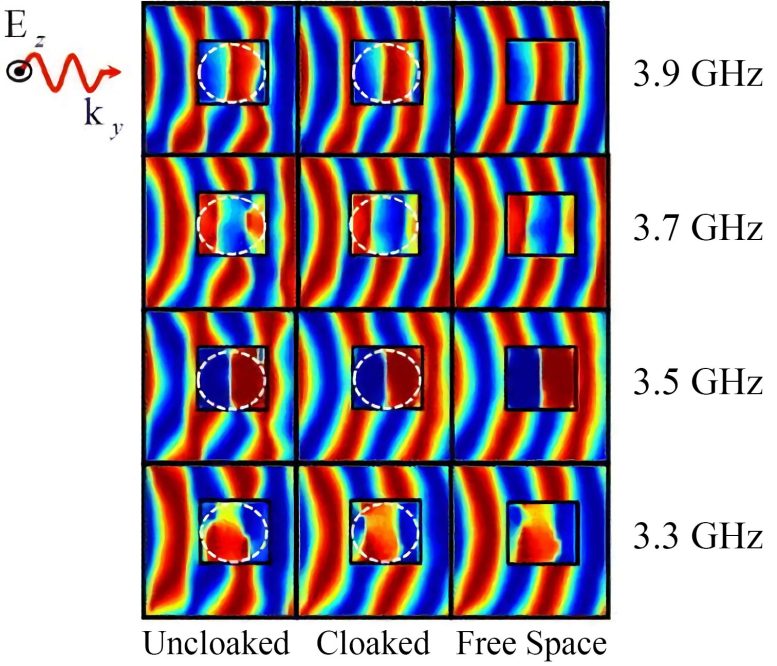
In a newly published study, scientists from the University of Texas at Austin detail a “metascreen” cloak that is ultra-thin and can hide three-dimensional objects from microwaves in their natural environment.
Until now, the invisibility cloaks put forward by scientists have been bulky devices — an obvious flaw for those interested in Harry Potter-style applications.
However, researchers at the University of Texas at Austin have developed a cloak that is just micrometers thick and can hide three-dimensional objects from microwaves in their natural environment, in all directions, and from all of the observers’ positions.
Presenting their study in the Institute of Physics and German Physical Society’s New Journal of Physics, the researchers from the Cockrell School of Engineering’s Department of Electrical and Computer Engineering have used a new, ultrathin layer called a “metascreen.”
The metascreen cloak was made by attaching thin strips of copper tape to a flexible polycarbonate film, which is a fraction of a millimeter thick, in a fishnet design. It was used to cloak an 18 cm (7 in) cylindrical rod from microwaves and showed optimal functionality when the microwaves were at a frequency of 3.6 GHz and over a moderately broad bandwidth.
The researchers also predict that because of the inherent conformability of the metascreen and the robustness of the proposed cloaking technique, oddly shaped and asymmetrical objects can be cloaked with the same principles.
Objects are detected when waves — whether they are sound, light, X-rays, or microwaves — rebound off their surfaces. The reason we see objects is because light rays bounce off their surfaces toward our eyes, and our eyes are able to process the information.
Unlike previous cloaking studies that have used metamaterials to divert, or bend, the incoming waves around an object, this new method, which the researchers dub “mantle cloaking,” uses an ultrathin metallic metascreen to cancel out the waves as they are scattered off the cloaked object.
“When the scattered fields from the cloak and the object interfere, they cancel each other out, and the overall effect is transparency and invisibility at all angles of observation,” said Andrea Alú, a co-author and an assistant professor in the Department of Electrical and Computer Engineering.
“The advantages of the mantle cloaking over existing techniques are its conformability, ease of manufacturing, and improved bandwidth,” Alú said. “We have shown that you don’t need a bulk metamaterial to cancel the scattering from an object — a simple patterned surface that is conformal to the object may be sufficient and, in many regards, even better than a bulk metamaterial.”
Last year, the same researchers were the first to successfully cloak a 3-D object — described in another paper published in New Journal of Physics — using a method called “plasmonic cloaking,” which used more bulky materials to cancel out the scattering of waves.
Moving forward, one of the key challenges for the researchers will be to use “mantle cloaking” to hide an object from visible light.
“In principle, this technique could also be used to cloak light. In fact, metascreens are easier to realize at visible frequencies than bulk metamaterials, and this concept could put us closer to a practical realization,” Alú said. “However, the size of the objects that can be efficiently cloaked with this method scales with the wavelength of operation, so when applied to optical frequencies, we may be able to efficiently stop the scattering of micrometer-sized objects.
“Still,” Alú said, “we have envisioned other exciting applications using the mantle cloak and visible light, such as realizing optical nanotags and nanoswitches and noninvasive sensing devices, which may provide several benefits for biomedical and optical instrumentation.”
Reference: “Demonstration of an ultralow profile cloak for scattering suppression of a finite-length rod in free space” by J C Soric, P Y Chen, A Kerkhoff, D Rainwater, K Melin and A Alù, 25 March 2013, New Journal of Physics.
DOI: 10.1088/1367-2630/15/3/033037
Never miss a breakthrough: Join the SciTechDaily newsletter.
Follow us on Google and Google News.
1 Comment
hi I was looking at this a couple of years ago and came to the conclusion
that if you look at the technology being used on mobile phones it should shure be possible……….obviously the angel of reflection would have to be overcome…………also ive seen it acoumplished with the use of four mirrors…………are you intending to make garments from it or just a panel ??