
Close Menu
    Facebook X (Twitter) Instagram
    SciTechDaily
    • Biology
    • Chemistry
    • Earth
    • Health
    • Physics
    • Science
    • Space
    • Technology
    Facebook X (Twitter) Pinterest YouTube RSS
    SciTechDaily
    Home»Biology»Researchers Discover a Previously Unknown Cellular Component Inside Neurons That We Use To Perceive Smell
    Biology

    Researchers Discover a Previously Unknown Cellular Component Inside Neurons That We Use To Perceive Smell

    By Umea UniversityFebruary 7, 2023No Comments3 Mins Read
    Facebook Twitter Pinterest Telegram LinkedIn WhatsApp Email Reddit
    Share
    Facebook Twitter LinkedIn Pinterest Telegram Email Reddit
    Release of Vesicles
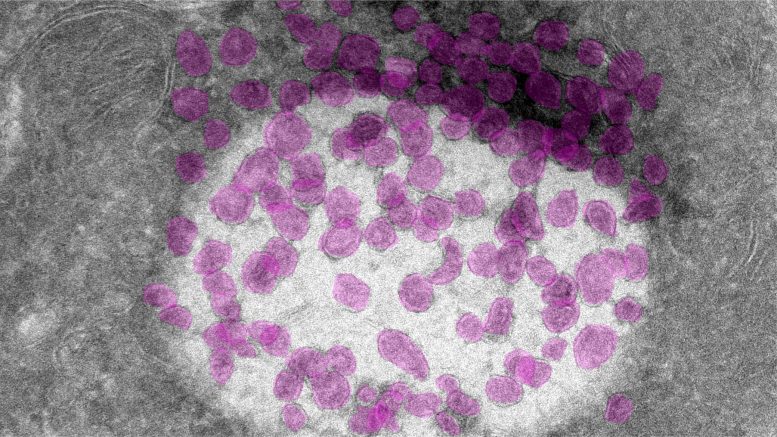
    Release of vesicles with transduction proteins in electron microscope magnification. Credit: Devendra Kumar Maurya

    A New Organelle, the Transducosome, Reveals Insights Into Smell Perception and Sensory Disorders

    Umeå University researchers in Sweden have uncovered a previously unidentified cellular component, an organelle, within neurons that play a role in our sense of smell. This discovery could have implications for future studies on the diminished sense of smell, a common symptom of COVID-19.

    “A prerequisite for finding a treatment for an impaired sense of smell is to first understand how the sense of smell works,” says Staffan Bohm, Professor at the Department of Molecular Biology at Umeå University.

    What the researchers have discovered is a so-called organelle inside nerve cells, that has not previously been observed. The newly discovered organelle has been given the name multivesicular transducosome by the researchers. The discovery was made possible thanks to Umeå University’s unique microscopy infrastructure.

    Devendra Kumar Maurya
    The discovery was possible thanks to Devendra Kumar Maurya, who used a new technique called correlative microscopy that combines electron microscopy and confocal microscopy so that a cell’s internal structures and the location of different proteins can be imaged. Credit: Mattias Pettersson

    How the Transducosome Functions in Smell Perception

    Organelles are distinct ’workstations’ inside cells that can be compared to the different organs of the body, i.e. different organelles have different functions in the cell. Most organelles are common to different cell types, but there are also organelles with specific functions that only occur in certain cell types. Olfactory nerve cells have long projections, i.e. cilia, that protrude into the nasal cavity and contain the proteins that bind odorous substances and thus initiate nerve impulses to the brain. The conversion of odor into nerve impulses is called transduction and the newly discovered organelle contains only transduction proteins.

    Staffan Bohm
    Staffan Bohm, Professor at the Department of Molecular Biology, Umeå University. Credit: Private

    The role of the transductosome is to both store and keep transduction proteins separate from each other until they are needed. Upon olfactory stimulation, the outer membrane of the organelle ruptures, releasing the transduction proteins so that they can reach the cilia of the neuron, and smell is perceived.

    Potential Implications Beyond the Sense of Smell

    The researchers also discovered that the transductosome carries a protein called retinitis pigmentosa 2, RP2, which is otherwise known to regulate transduction in the eye’s photoreceptor cells. If the RP2 gene is mutated, it can cause a variant of the eye disease retinitis pigmentosa that damages the eye’s light-sensitive cells.

    “A question for further research is whether the transductosome has a role in vision and whether it is present in brain neurons that are activated by neurotransmitters and not light and smell. If so, the discovery may prove even more significant,” says Staffan Bohm.

    The transducosome was discovered when researcher Devendra Kumar Maurya used a new technique called correlative microscopy. The technique combines electron microscopy and confocal microscopy so that a cell’s internal structures and the location of different proteins can be imaged simultaneously. Crucial to the discovery was Devendra’s method development, which enabled the technique to be used to analyze intact neurons in tissue sections.

    Reference: “A multivesicular body-like organelle mediates stimulus-regulated trafficking of olfactory ciliary transduction proteins” by Devendra Kumar Maurya, Anna Berghard and Staffan Bohm, 12 November 2022, Nature Communications.
    DOI: 10.1038/s41467-022-34604-y

    Never miss a breakthrough: Join the SciTechDaily newsletter.
    Follow us on Google and Google News.

    Brain Cell Biology Cells Umea University
    Share. Facebook Twitter Pinterest LinkedIn Email Reddit

    Related Articles

    Scientists Reveal 3D Structure of the Molecular Transporter TSPO

    Scientists Grow Human Brain Tissue in a 3D Culture System

    New Analysis on Iceman Ötzi Opens Up New Research Possibilities for Mummies

    Chemical Model Shows How First Life Forms Might Have Packaged RNA

    Optogenetics Regulates Metabolic Activity in the Membranes of Cells

    Evolutionary Changes Surrounding the NOS1 Gene

    New DNA Entity in Mammalian Cells

    Scientists Create Brain Cells from Skin Cells

    Researchers Record Detailed Live Images Inside the Brain of a Living Mouse

    Leave A Reply Cancel Reply

    • Facebook
    • Twitter
    • Pinterest
    • YouTube

    Don't Miss a Discovery

    Subscribe for the Latest in Science & Tech!

    Trending News

    Researchers Have Found a Dietary Compound That Increases Longevity

    Scientists Baffled by Bizarre “Living Fossil” From 275 Million Years Ago

    Your IQ at 23 Could Predict Your Wealth at 27, Study Finds

    320 Light-Years Away, a Planet Confirms a Fundamental Cosmic Assumption

    The Crown Jewel of Dentistry? Breakthrough Tech Could Transform Tooth Repair

    Python Blood Could Hold the Secret to Weight Loss Without Side Effects

    Naturally Occurring Bacteria Completely Eradicate Tumors in Mice With a Single Dose

    New “Nanozyme Hypothesis” Could Rewrite the Story of Life’s Origins

    Follow SciTechDaily
    • Facebook
    • Twitter
    • YouTube
    • Pinterest
    • Newsletter
    • RSS
    SciTech News
    • Biology News
    • Chemistry News
    • Earth News
    • Health News
    • Physics News
    • Science News
    • Space News
    • Technology News
    Recent Posts
    • 34-Million-Year-Old Snake Found in Wyoming Rewrites Our Understanding of Evolution
    • Prehistoric “Vomit Fossil” Reveals Never-Before-Seen Flying Reptile
    • Scientists Discover Bizarre Crocodile Relative That Walked on Two Legs
    • How Quantum Mechanics Went From Baffling Theory to Revolutionizing Modern Technology
    • Scientists May Have Found the Key to Jupiter and Saturn’s Moon Mystery
    Copyright © 1998 - 2026 SciTechDaily. All Rights Reserved.
    • Science News
    • About
    • Contact
    • Editorial Board
    • Privacy Policy
    • Terms of Use

    Type above and press Enter to search. Press Esc to cancel.