

A new approach reveals genetic interactions that contribute to heart defects.
Scientists at the Icahn School of Medicine at Mount Sinai, in collaboration with others, have discovered new genetic interactions that may play a role in congenital heart disease (CHD), one of the most common birth defects. Their findings were recently published online in The American Journal of Human Genetics.
“Our research reveals the potential for digenic inheritance—where two genes work together to cause disease—expanding our understanding of the genetic underpinnings of congenital heart disease,” says co-corresponding senior author Yuval Itan, PhD, Associate Professor of Genetics and Genomic Sciences, a core member of The Charles Bronfman Institute for Personalized Medicine, and a member of The Mindich Child Health and Development Institute at the Icahn School of Medicine at Mount Sinai.
He co-supervised the study with Bruce Gelb, MD, Gogel Family Professor and Director of The Mindich Institute. “By identifying these gene pairs and their combined effects, we uncover previously hidden genetic risks, which could improve diagnostic precision and open new avenues for personalized treatment strategies.”
A New Approach to Understanding CHD Genetics
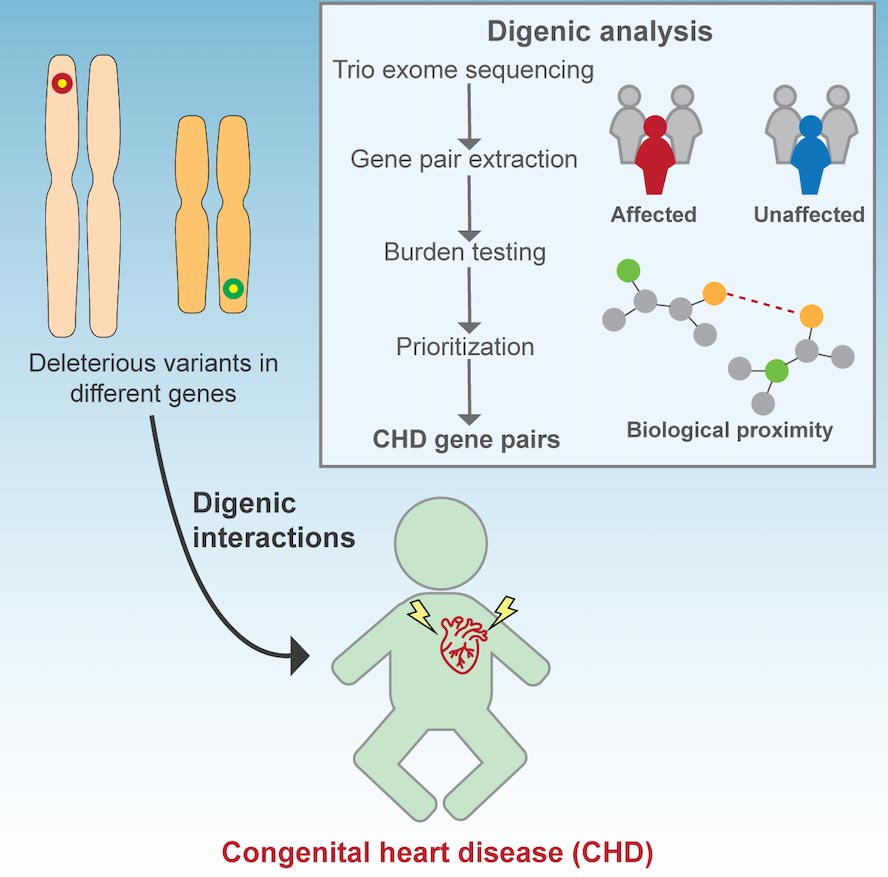
Congenital heart disease is the most common congenital anomaly, affecting millions worldwide. Despite decades of research, more than half of CHD cases still lack a molecular diagnosis. By analyzing trio exome sequencing data from affected and unaffected children in the Pediatric Genomic Consortium (PCGC), the team identified 10 novel gene pairs potentially linked to the development of CHD.
“Our work demonstrates that genetic interactions, rather than single-gene causes alone, could play a significant role in congenital heart disease. By developing a method to uncover these interactions, we are broadening the scope of genetic research, which could lead to improved diagnosis, enhanced risk assessment, and more informed genetic counseling,” says first author Meltem Ece Kars, MD, PhD, a postdoctoral fellow in The Bronfman Institute. “As clinical genetic testing advances, integrating digenic models could significantly improve diagnostic yield, offering patients and their families greater clarity about their condition and guiding the development of targeted therapies and interventions.”
Innovative Computational Methods for Genetic Research
The research team used a robust computational method to identify gene pairs that may act together to cause CHD. This innovative approach could transform how genetic studies are conducted for complex diseases, providing deeper insights into the role of genetics in disease development, say the investigators.
The study also paves the way for advancing genetic diagnoses in other complex disorders. “With the tools we’ve developed, our research provides a framework for future studies into genetic interactions that could affect a wide range of human diseases,” says Dr. Itan.
Next, the researchers plan to apply the digenic approach to other disease groups that have traditionally been studied using the monogenic model, potentially explaining some of the missing heritability in these disorders. Ultimately, they aim to extend the digenic approach into a robust polygenic framework capable of identifying multiple disease-causing variants and genes in patients.
“Our findings hold promise for improving genetic diagnoses, offering better risk assessments, and ultimately guiding more personalized treatments for individuals with congenital heart disease,” says Dr. Kars.
Reference: “Deciphering the digenic architecture of congenital heart disease using trio exome sequencing data” by Meltem Ece Kars, David Stein, Peter D. Stenson, David N. Cooper, Wendy K. Chung, Peter J. Gruber, Christine E. Seidman, Yufeng Shen, Martin Tristani-Firouzi, Bruce D. Gelb and Yuval Itan, 20 February 2025, The American Journal of Human Genetics.
DOI: 10.1016/j.ajhg.2025.01.024
This research is supported by the National Heart, Lung, and Blood Institute of the National Institutes of Health and the U.S. Department of Health and Human Services through grants UM1HL128711, UM1HL098162, UM1HL098147, UM1HL098123, UM1HL128761, and U01HL131003. Additional support was provided by Clinical and Translational Science Awards (CTSA) grant UL1TR004419 from the National Center for Advancing Translational Sciences.
Never miss a breakthrough: Join the SciTechDaily newsletter.
Follow us on Google and Google News.