
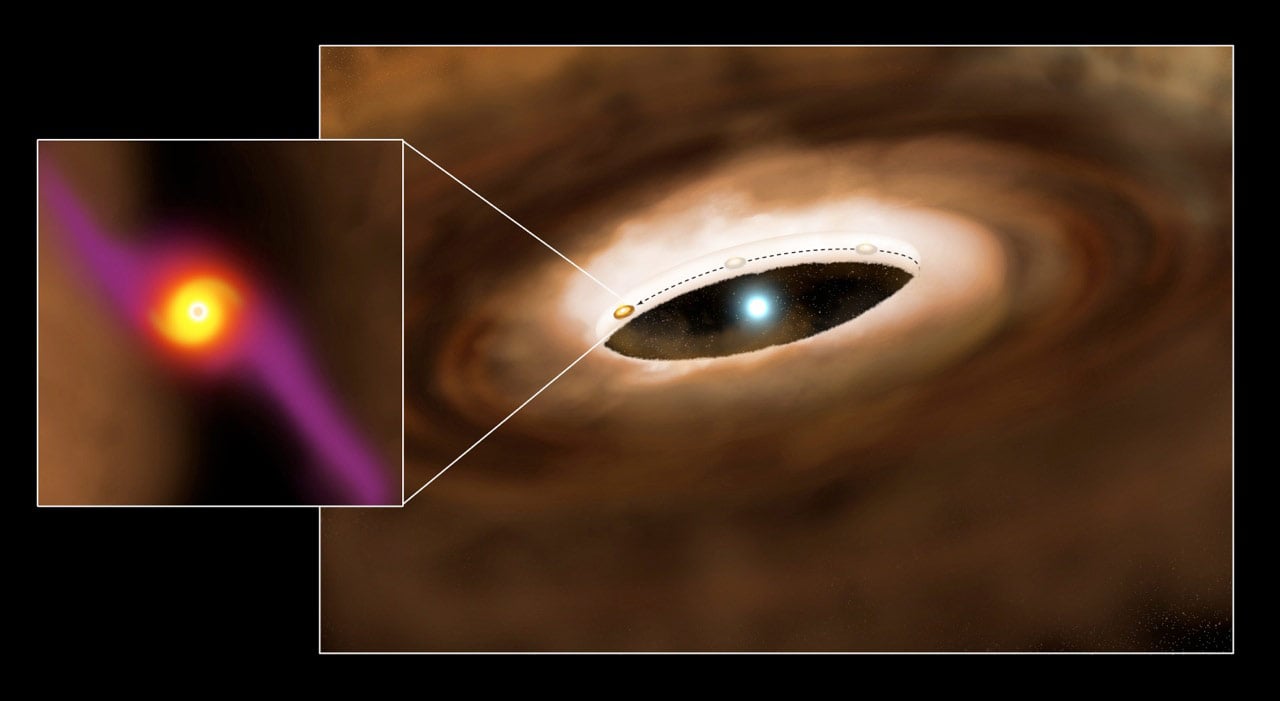
Using a technique called “spectro-astrometry,” which enables small changes in the position of the carbon monoxide emission to be measured, astronomers have discovered new evidence of a second candidate planet forming around star HD100546.
An international team of scientists led by a Clemson University astrophysicist has discovered new evidence that planets are forming around a star about 335 light-years from Earth.
The team found carbon monoxide emission that strongly suggests a planet is orbiting a relatively young star known as HD100546. The candidate planet is the second that astronomers have discovered orbiting the star.
Theories of how planets form are well-developed. But if the new study’s findings are confirmed, the activity around HD100546 would mark one of the first times astronomers have been able to directly observe planet formation happening.
New discoveries from the star could allow astronomers to test their theories and learn more about the formation of solar systems, including our own, said Sean Brittain, an associate professor of astronomy and astrophysics at Clemson.
“This system is very close to Earth relative to other disk systems,” he said. “We’re able to study it at a level of detail that you can’t do with more distant stars. This is the first system where we’ve been able to do this.
“Once we really understand what’s going on, the tools that we are developing can then be applied to a larger number of systems that are more distant and harder to see.”
For more than a decade, the team has focused some of Earth’s most powerful telescopes on a disk-shaped cloud of gas and dust that surrounds HD100546.
The star is about 2.5 times larger and 30 times brighter than the sun, Brittain said. It’s in the constellation Musca, or The Fly, and can only be seen from the Southern Hemisphere.
Brittain made three trips to Chile as far back as 2003 to gather data for the research. He used telescopes at the Gemini Observatory and the European Southern Observatory.
The new planet astronomers believe they have found what would be an uninhabitable gas giant at least three times the size of Jupiter, Brittain said. Its distance from the star would be about the same distance that Saturn is from the sun.
The team used a technique called “spectro-astrometry,” which enables small changes in the position of the carbon monoxide emission to be measured. A source of excess carbon monoxide emission was detected that appears to vary in position and velocity. The varying position and velocity are consistent with orbital motion around the star.
The favored hypothesis is that emission comes from a “circumplanetary” disk of gas orbiting a giant planet, Brittain said.
“Another possibility is that we’re seeing the wake from tidal interactions between the object and the circumstellar disk of gas and dust orbiting the star,” he said.
Members of the team reported their findings in a recent edition of The Astrophysical Journal.
The name of the article is “NIR Spectroscopy of the HAeBe Star 100546. III. Further Evidence of an Orbiting Companion?” The authors are Brittain; John S. Carr of the Naval Research Laboratory in Washington, D.C.; Joan R. Najita of the National Optical Astronomy Observatory in Tucson, Arizona; and Sascha P. Quanz and Michael R. Meyer, both of ETH Zurich, Institute for Astronomy.
The next step in the study would be to take a picture using the new high-contrast imagers on the European Southern Observatory’s Very Large Telescope or Gemini South Telescope, Brittain said.
Circumplanetary disks of rotating viscous material have long been thought to surround giant planets at birth, but little observational evidence for their existence has been found outside the solar system. They are believed to be the birthplaces of planetary moons, such as those that orbit Jupiter.
“There are different models of circumplanetary disks, but we’ve never seen one,” Brittain said.
Disks form in all kinds of environments in the universe as a consequence of a fundamental law of physics known as “the conservation of angular momentum.”
The law states that a spinning object will keep spinning just as hard unless a force acts on it. If the object gets smaller, it will spin faster and vice versa.
The same principle that causes ice skaters to speed up when they pull in their arms and legs also causes disks to form around objects as material falls onto them. This is true for disks around supermassive black holes at the center of galaxies, circumstellar disks around young stars, and circumplanetary disks around forming planets.
Mark Leising, the chair of Clemson’s astronomy and astrophysics department, said Brittain’s work will raise the department’s international profile.
“I congratulate Dr. Brittain and his team on their excellent work,” Leising said. “Astronomers are now very good at finding already-formed planets around many nearby stars, but it has been difficult to watch the planets in the process of forming.
“Using very clever techniques and the most advanced telescopes on Earth, they have accomplished that. It’s great to see our faculty working with leading institutions around the world to make discoveries at the forefront of astronomy.”
Evidence of another planet forming was previously found farther out from HD100546. A blob of gas and dust that has grown denser over time was discovered about the distance Pluto is from the sun.
“It is in the process of collapsing,” Brittain said. “Maybe in a million years you’ll have another planet and disk.”
The outer candidate planet would be a gas-giant planet about the size of Jupiter. It’s among the evidence that points to multiple and perhaps sequential planet formation.
A team that was led by Quanz and included Meyer reported the discovery of the outer candidate planet last year in The Astrophysical Journal Letters.
Reference: “NIR Spectroscopy of the HAeBe Star HD 100546. III. Further Evidence of an Orbiting Companion?” by Sean D. Brittain, John S. Carr, Joan R. Najita, Sascha P. Quanz and Michael R. Meyer, 6 August 2014, The Astrophysical Journal.
DOI: 10.1088/0004-637X/791/2/136
arXiv: 1409.0804
Never miss a breakthrough: Join the SciTechDaily newsletter.
Follow us on Google and Google News.