
Close Menu
    Facebook X (Twitter) Instagram
    SciTechDaily
    • Biology
    • Chemistry
    • Earth
    • Health
    • Physics
    • Science
    • Space
    • Technology
    Facebook X (Twitter) Pinterest YouTube RSS
    SciTechDaily
    Home»Science»Researchers Discover Tunnels From Tiny Boring Microorganisms in Garnet Crystals
    Science

    Researchers Discover Tunnels From Tiny Boring Microorganisms in Garnet Crystals

    By Magnus Ivarsson, University Of Southern Denmark UniversityAugust 9, 2018No Comments2 Mins Read
    Facebook Twitter Pinterest Telegram LinkedIn WhatsApp Email Reddit
    Share
    Facebook Twitter LinkedIn Pinterest Telegram Email Reddit
    Researchers Discover Tiny Boring Microorganisms in Crystals
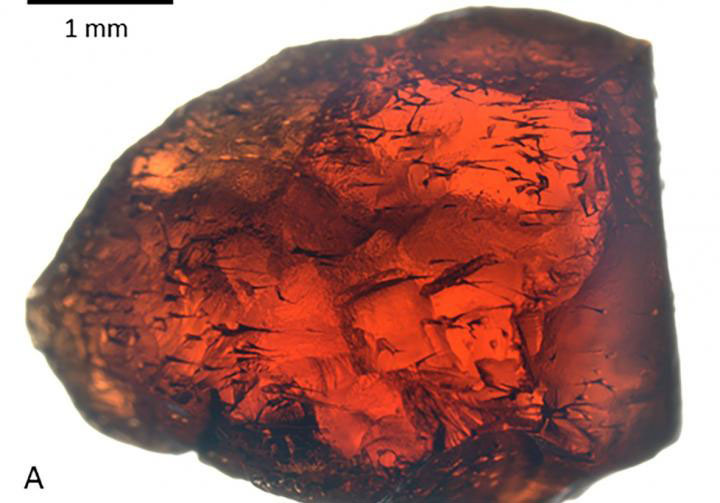
    Garnet crystal with distinct tubular structures. Ivarsson et al, 2018

    Complex systems of microscopic tunnels found inside garnet crystals from Thailand are most likely the result of microorganisms making their homes inside these minerals, according to a study published August 8, 2018, in the open-access journal PLOS ONE by Magnus Ivarsson of the University of Southern Denmark and colleagues.

    Endolithic organisms are those that live inside a substrate, be it mineral, wood, bone, or some other material. Some microbes move into pre-existing cavities while others dig their own way in, but this behavior is unexpected in highly resistant minerals like garnet. In this study, Ivarsson and colleagues examined the structure and content of intricately branching tunnels inside garnet crystals from river sediments and soils in Thailand to determine whether they were formed by abiotic or biotic processes.
    Tiny Boring Microorganisms in Garnet Crystals
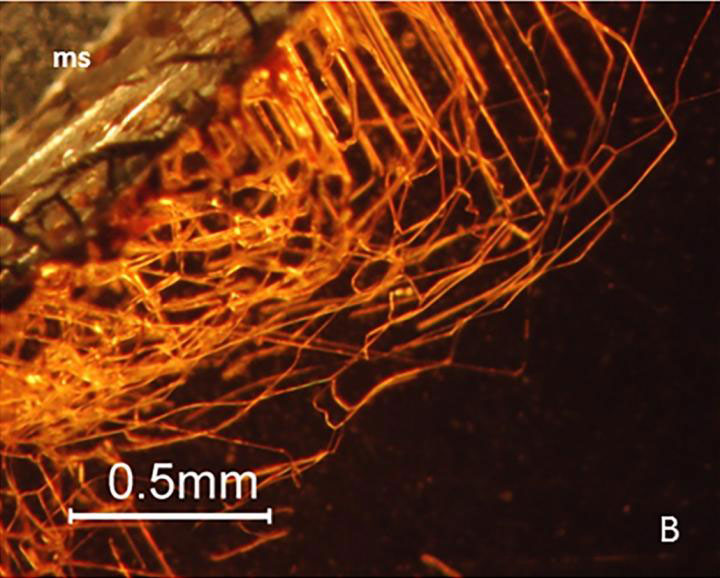
    Microphotograph of network of tubular structures originating at garnet surface. Ivarsson et al, 2018

    Chemical analysis of the tunnels found lingering organic compounds and filament-like structures reminiscent of bacteria and fungi, strongly suggesting that microbes once lived inside. Whether or not these organisms excavated the tunnels is less clear. The shape of the tunnels, examined under microscopy, doesn’t completely rule out an abiotic origin, but certain features characteristic of endolithic lairs, such as anastomoses (connecting passages between adjacent tunnels) suggest the tunnels were at least partially formed by endolithic microbes.

    These tunnels were originally noted because they “significantly decrease the quality and value of the garnets as gems,” but this study has shown that they also represent a previously unrecognized habitat for endolithic organisms. In iron-poor sediments like those studied here, garnets represent a rare source of iron for iron-oxidizing microbes, but confirming the identity of the tunnel-borers will require observations of live organisms in a laboratory setting.

    Ivarsson notes: “The reported tunnel system in garnets represents a new endolithic habitat in a hard silicate mineral otherwise known to be resistant to abrasion and chemical attack.”

    Reference: “Intricate tunnels in garnets from soils and river sediments in Thailand – Possible endolithic microborings” by Magnus Ivarsson, Henrik Skogby, Bongkot Phichaikamjornwut, Stefan Bengtson, Sandra Siljeström, Prayote Ounchanum, Apichet Boonsoong, Mingkhwan Kruachanta, Federica Marone, Veneta Belivanova, Sara Holmström, 8 August 2018, PLOS One.
    DOI: 10.1371/journal.pone.0200351

    Never miss a breakthrough: Join the SciTechDaily newsletter.
    Follow us on Google and Google News.

    Microorganisms University of Southern Denmark
    Share. Facebook Twitter Pinterest LinkedIn Email Reddit

    Related Articles

    Melodic Muscles: The Impact of Daily Singing on Songbird Attractiveness

    Scientists Shocked by First-Ever Observation of a Virus Latching Onto Another – “I Can’t Believe This”

    Illuminating the Carbon Cycle: Coccolithophores’ Ability To Absorb Organic Carbon

    Wired for Climate Control: Microbes, Nanowires, and Methane’s Big Role

    Scientists Investigate the Believed Remains of Two Christian Apostles – Here’s What They Found

    Chemical Analysis of a Black Spot in a Diary Sheds New Light on Legendary Polar Explorer’s Final Hours

    Archaeologists Discover 1.6 Billion Years Old Fossilized Oxygen Bubbles

    Physicists Work on New Approach to Detect Dark Matter

    Scientists Discover Processes Similar to the Ones That Possibly Sparked Life

    Leave A Reply Cancel Reply

    • Facebook
    • Twitter
    • Pinterest
    • YouTube

    Don't Miss a Discovery

    Subscribe for the Latest in Science & Tech!

    Trending News

    Your Blood Pressure Reading Could Be Wrong Because of One Simple Mistake

    Astronomers Stunned by Ancient Galaxy With No Spin

    Physicists May Be on the Verge of Discovering “New Physics” at CERN

    Scientists Solve 320-Million-Year Mystery of Reptile Skin Armor

    Scientists Say This Daily Walking Habit May Be the Secret to Keeping Weight Off After Dieting

    New Therapy Rewires the Brain To Restore Joy in Depression Patients

    Giant Squid Detected off Western Australia in Stunning Deep-Sea Discovery

    Popular Sugar-Free Sweetener Linked to Liver Disease, Study Warns

    Follow SciTechDaily
    • Facebook
    • Twitter
    • YouTube
    • Pinterest
    • Newsletter
    • RSS
    SciTech News
    • Biology News
    • Chemistry News
    • Earth News
    • Health News
    • Physics News
    • Science News
    • Space News
    • Technology News
    Recent Posts
    • Hidden Warm Water Beneath Antarctica Could Rapidly Raise Global Sea Levels
    • Scientists Revive Ancient Chemistry Trick To Engineer Next-Generation Glass
    • Scientists Use AI To Supercharge Ultrafast Laser Simulations by More Than 250x
    • Scientists Just Found a Surprising Way To Destroy “Forever Chemicals”
    • Popular Supplement Ingredient Linked to Shorter Lifespan in Men
    Copyright © 1998 - 2026 SciTechDaily. All Rights Reserved.
    • Science News
    • About
    • Contact
    • Editorial Board
    • Privacy Policy
    • Terms of Use

    Type above and press Enter to search. Press Esc to cancel.