
Close Menu
    Facebook X (Twitter) Instagram
    SciTechDaily
    • Biology
    • Chemistry
    • Earth
    • Health
    • Physics
    • Science
    • Space
    • Technology
    Facebook X (Twitter) Pinterest YouTube RSS
    SciTechDaily
    Home»Technology»UC Researchers Make Magnetic Graphene
    Technology

    UC Researchers Make Magnetic Graphene

    By Iqbal Pittalwala, University of California RiversideJanuary 26, 2015No Comments3 Mins Read
    Facebook Twitter Pinterest Telegram LinkedIn WhatsApp Email Reddit
    Share
    Facebook Twitter LinkedIn Pinterest Telegram Email Reddit
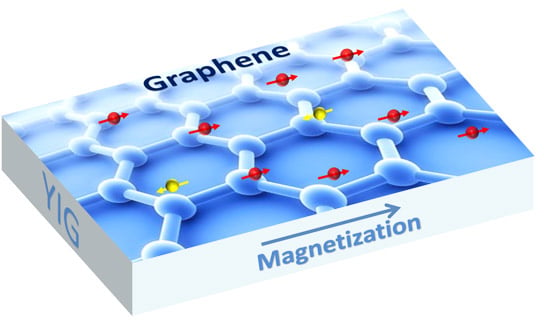
    Magnetic Graphene
    Physicists induced magnetism in graphene while preserving its electronic properties by closely aligning it with a magnetic insulator. Credit: Shi Lab, UC Riverside

    Physicists from the University of California – Riverside have found a way to induce magnetism in graphene while also preserving graphene’s electronic properties.

    Riverside, California – Graphene, a one-atom-thick sheet of carbon atoms arranged in a hexagonal lattice, has many desirable properties. Magnetism alas is not one of them. Magnetism can be induced in graphene by doping it with magnetic impurities, but this doping tends to disrupt graphene’s electronic properties.

    Now a team of physicists at the University of California, Riverside has found an ingenious way to induce magnetism in graphene while also preserving graphene’s electronic properties. They have accomplished this by bringing a graphene sheet very close to a magnetic insulator – an electrical insulator with magnetic properties.

    “This is the first time that graphene has been made magnetic this way,” said Jing Shi, a professor of physics and astronomy, whose lab led the research. “The magnetic graphene acquires new electronic properties so that new quantum phenomena can arise. These properties can lead to new electronic devices that are more robust and multi-functional.”

    The finding has the potential to increase graphene’s use in computers, as in computer chips that use electronic spin to store data.

    Study results appeared online earlier this month in Physical Review Letters.

    The magnetic insulator Shi and his team used was yttrium iron garnet grown by laser molecular beam epitaxy in his lab. The researchers placed a single-layer graphene sheet on an atomically smooth layer of yttrium iron garnet. They found that yttrium iron garnet magnetized the graphene sheet. In other words, graphene simply borrows the magnetic properties from yttrium iron garnet.

    Magnetic substances like iron tend to interfere with graphene’s electrical conduction. The researchers avoided those substances and chose yttrium iron garnet because they knew it worked as an electric insulator, which meant that it would not disrupt graphene’s electrical transport properties. By not doping the graphene sheet but simply placing it on the layer of yttrium iron garnet, they ensured that graphene’s excellent electrical transport properties remained unchanged.

    In their experiments, Shi and his team exposed the graphene to an external magnetic field. They found that graphene’s Hall voltage – a voltage in the perpendicular direction to the current flow – depended linearly on the magnetization of yttrium iron garnet (a phenomenon known as the anomalous Hall effect, seen in magnetic materials like iron and cobalt). This confirmed that their graphene sheet had turned magnetic.

    Shi was joined in the study by UC Riverside’s Zhiyong Wang (first author of the research paper), Chi Tang, Raymond Sachs, and Yafis Barlas.

    Grants to Shi and his team members from the U.S. Department of Energy and the National Science Foundation supported the research.

    Reference: “Proximity-Induced Ferromagnetism in Graphene Revealed by the Anomalous Hall Effect” by Zhiyong Wang, Chi Tang, Raymond Sachs, Yafis Barlas and Jing Shi, 7 January 2015, Physical Review Letters.
    DOI: 10.1103/PhysRevLett.114.016603


    Never miss a breakthrough: Join the SciTechDaily newsletter.
    Follow us on Google and Google News.

    Graphene Nanotechnology UC Riverside
    Share. Facebook Twitter Pinterest LinkedIn Email Reddit

    Related Articles

    “Closed-Edge Graphene Nanoribbons”

    Graphene Hot Electron Bolometer May Outperform Existing Technologies

    Multi-Walled Carbon Nanotubes May Eventually Replace Expensive Platinum Catalysts

    Graphene Based Composite Being Developed as Rust Proofing Alternative

    Balancing Between Life and Research

    Exploring Graphene-Based THz Devices

    Graphene Center Laboratory is State of the Art “Nano-Factory”

    2-D Boron has Potential Advantages over Carbon Nanotubes

    “Designer Electrons” Have Tunable Properties

    Leave A Reply Cancel Reply

    • Facebook
    • Twitter
    • Pinterest
    • YouTube

    Don't Miss a Discovery

    Subscribe for the Latest in Science & Tech!

    Trending News

    Scientists Uncover Potential Brain Risks of Popular Fish Oil Supplements

    Scientists Discover a Surprising Way To Make Bread Healthier and More Nutritious

    After 60 Years, Scientists Uncover Unexpected Brain Effects of Popular Diabetes Drug Metformin

    New Research Uncovers Hidden Side Effects of Popular Weight-Loss Drugs

    Scientists Rethink Extreme Warming After Surprising Ocean Discovery

    Landmark Study Links Never Marrying to Significantly Higher Cancer Risk

    Researchers Discover Unknown Beetle Species Just Steps From Their Lab

    Largest-Ever Study Finds Medicinal Cannabis Ineffective for Anxiety, Depression, PTSD

    Follow SciTechDaily
    • Facebook
    • Twitter
    • YouTube
    • Pinterest
    • Newsletter
    • RSS
    SciTech News
    • Biology News
    • Chemistry News
    • Earth News
    • Health News
    • Physics News
    • Science News
    • Space News
    • Technology News
    Recent Posts
    • Students Build Dark Matter Detector and Set New Experimental Limits
    • Scientists Discover Caffeine Can Repair Key Memory Circuits After Sleep Loss
    • Strange 65-Foot Dinosaur Discovered in Argentina
    • Researchers Uncover Source of Strange Deformation in Earth’s Largest Continental Rift
    • Scientists Solve Mystery of Where the Colorado River Vanished Millions of Years Ago
    Copyright © 1998 - 2026 SciTechDaily. All Rights Reserved.
    • Science News
    • About
    • Contact
    • Editorial Board
    • Privacy Policy
    • Terms of Use

    Type above and press Enter to search. Press Esc to cancel.