
Close Menu
    Facebook X (Twitter) Instagram
    SciTechDaily
    • Biology
    • Chemistry
    • Earth
    • Health
    • Physics
    • Science
    • Space
    • Technology
    Facebook X (Twitter) Pinterest YouTube RSS
    SciTechDaily
    Home»Health»Researchers Uncover New Causes for ALS
    Health

    Researchers Uncover New Causes for ALS

    By Max Planck InstituteAugust 12, 2014No Comments3 Mins Read
    Facebook Twitter Pinterest Telegram LinkedIn WhatsApp Email Reddit
    Share
    Facebook Twitter LinkedIn Pinterest Telegram Email Reddit
    Researchers Uncover New Causes for ALS
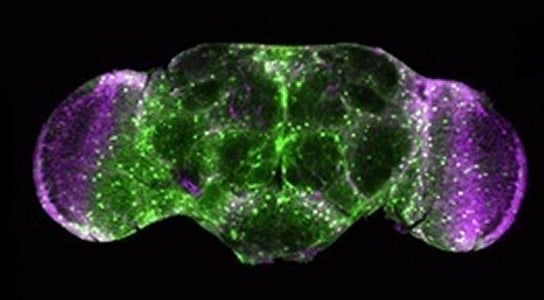
    In the fruit fly Drosophila melanogaster, scientists in basic biomedical research can study very well how neurodegeneration works and how nerve cells are damaged. The picture shows the brain of an adult fly (glial cells are stained green, cell nuclei purple). Credit: Dr. Teresa Niccoli, University College London, UK

    Researchers from the Max Planck Institute for Biology and University College London have uncovered new causes for ALS and a specific form of dementia.

    Scientists at the Max Planck Institute for Biology of Ageing in Cologne and University College London have now unearthed the way in which a specific genetic mutation leads to neuronal damage in two serious afflictions. In rare cases, patients may even suffer from these two diseases, amyotrophic lateral sclerosis and frontotemporal dementia, at the same time.

    Amyotrophic lateral sclerosis is a devastating type of motor neuron disease that causes rapid weakening of muscles and death. Frontotemporal dementia is the second most common cause of dementia in people under 65. It causes distressing symptoms, including changes in personality and behavior and problems with language and thinking. The DNA of affected patients contains a mutation of the gene C9orf72: There are thousands of repeats of a specific short segment of genetic material, whereas in unaffected persons, there are only up to thirty copies of this segment. This specific genetic alteration is the cause of illness in around eight percent of patients with this type of motor neuron disease or dementia. Eight percent is a relatively high proportion. For instance, less than one percent of the causes in Alzheimer’s disease are genetic.

    Researchers at the Max Planck Institute for Biology of Ageing, the Institute of Neurology, and Institute for Healthy Ageing at University College London have now discovered that the repeats in the mutant gene cause neurodegeneration by making toxic proteins.

    Fruitflies can undergo neurodegeneration in a similar way to humans

    Previously it was thought that the problem could be a consequence of disruption of the gene by the inserted repeats. Another theory was that the repeats produce a different type of toxic RNA molecule. It now turns out that the repeats in the mutant gene can produce a variety of proteins and that two of these are extremely toxic to nerve cells. Both are highly enriched in arginine, an amino acid.

    To pinpoint the role of the toxic proteins, the researchers produced artificial repeat segments that could produce potentially toxic RNA and protein or only toxic RNA or only protein. They then introduced them into the nerve cells of fruit flies, which can undergo neurodegeneration in a similar way to humans. Repeat segments that made both RNA and protein caused striking neurodegeneration and reduced the lifespan of the flies, showing that they are a good organism in which to study these diseases. Interestingly, the protein-only repeat segments caused just as bad a neurodegeneration. In contrast, the RNA-only segments were harmless, pinpointing the role of toxic proteins in these diseases. The proteins that contained arginine were the most toxic.

    Reference: “C9orf72 repeat expansions cause neurodegeneration in Drosophila through arginine-rich proteins” by Sarah Mizielinska, Sebastian Grönke, Teresa Niccoli, Charlotte E. Ridler, Emma L. Clayton, Anny Devoy, Thomas Moens, Frances E. Norona, Ione O. C. Woollacott, Julian Pietrzyk, Karen Cleverley, Andrew J. Nicoll, Stuart Pickering-Brown, Jacqueline Dols, Melissa Cabecinha, Oliver Hendrich, Pietro Fratta, Elizabeth M. C. Fisher, Linda Partridge and Adrian M. Isaacs, 7 August 2014, Science.
    DOI: 10.1126/science.1256800


    Never miss a breakthrough: Join the SciTechDaily newsletter.
    Follow us on Google and Google News.

    Max Planck Institute Neurology
    Share. Facebook Twitter Pinterest LinkedIn Email Reddit

    Related Articles

    Study Shows Parkinson’s Disease Involves Degeneration of the Olfactory System

    Max Planck Scientists Discover a New Genetic Disease Mechanism

    Biochemists Identify Another Piece of the Parkinson’s Disease Pathology Puzzle

    Researchers Discover New Link between Processes Associated with a Parkinson’s Related Gene Defect

    Controlled Trial Shows Cannabis Reduces Some Symptoms of MS

    Custom Tailored Brain Cancer Vaccine Proves Effective

    DnaK Identified as Key Player of Protein Folding

    Nose Spray for Panic Attacks? Intranasal Neuropeptide S Lowers Anxiety

    Researchers Find Possible Link Between Diet Soda and Vascular Risks

    Leave A Reply Cancel Reply

    • Facebook
    • Twitter
    • Pinterest
    • YouTube

    Don't Miss a Discovery

    Subscribe for the Latest in Science & Tech!

    Trending News

    Massive Study Warns Marijuana Use in Teens Is Linked to Serious Mental Illness

    Scientists Discover a Completely Unexpected Way T Cells Kill Cancer

    Scientists Just Found the Solar System’s Original “Planet Factory”

    Study Warns Widely Used Food Preservatives Linked to High Blood Pressure and Heart Disease

    New Treatment Could Reverse Osteoarthritis Within Weeks

    Physicists Have Measured “Negative Time” in Bizarre Quantum Experiment

    The Deadly Tapeworm Spreading Across America Has Reached the Pacific Northwest

    Could Low Vitamin D Be Making Your Pain Worse?

    Follow SciTechDaily
    • Facebook
    • Twitter
    • YouTube
    • Pinterest
    • Newsletter
    • RSS
    SciTech News
    • Biology News
    • Chemistry News
    • Earth News
    • Health News
    • Physics News
    • Science News
    • Space News
    • Technology News
    Recent Posts
    • Stanford’s Revolutionary New Microscope Reveals Living Cells in Stunning Detail
    • Scientists Discover a Sea Slug Smaller Than a Sesame Seed in Taiwan
    • Wasp Colonies Explode Into Violence After Losing Their Queen
    • Antarctica Suddenly Became Far More Sensitive to Climate Change 1 Million Years Ago
    • A Hidden Arctic Ocean Crisis Is Unfolding Beneath the Melting Ice
    Copyright © 1998 - 2026 SciTechDaily. All Rights Reserved.
    • Science News
    • About
    • Contact
    • Editorial Board
    • Privacy Policy
    • Terms of Use

    Type above and press Enter to search. Press Esc to cancel.