
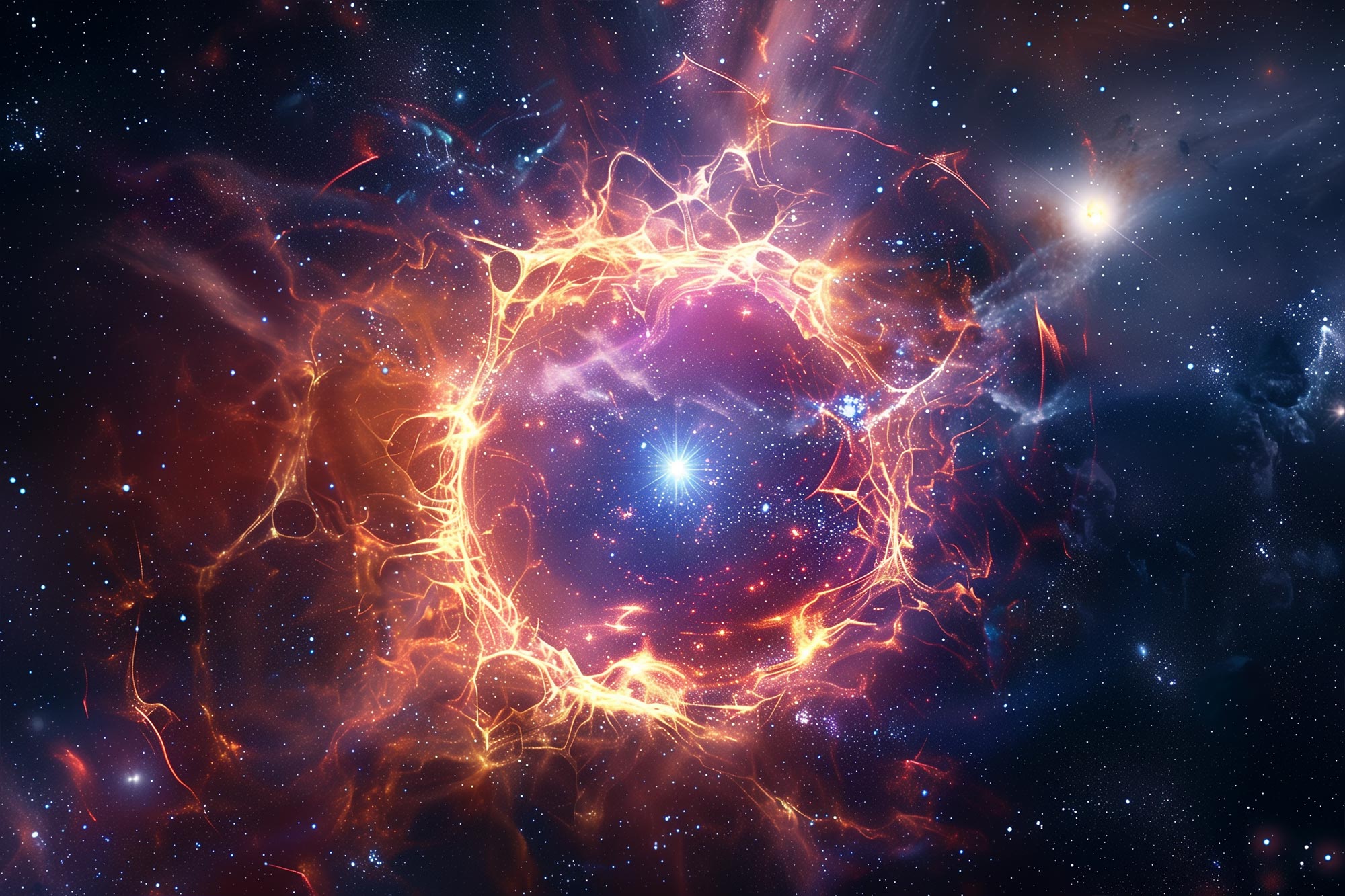
Elusive temporary star described in historical documents recreated using new computer model, shows it may have recently started generating stellar winds.
A supernova remnant from 1181, resulting from two colliding white dwarfs, was analyzed using historical records and modern astronomy. The discovery in the constellation Cassiopeia reveals a complex structure with new stellar winds, possibly indicating a reignition of the remnant star. This interdisciplinary approach provides deeper insights into the dynamics of stellar phenomena.
Artist’s impression of two white dwarf stars merging and creating a Type Ia supernova. Type Ia supernovas are similar to type Iax supernovas, as they occur when two white dwarfs collide, but are brighter and the explosion completely destroys the stars. Type Iax supernovas, like SN 1181 where a remnant white dwarf is left behind, are more rare. Credit: ESO/L. Calçada
Supernova Mystery Unveiled
For the first time, a mysterious remnant from a rare type of supernova recorded in 1181 has been explained. Two white dwarf stars collided, creating a temporary “guest star,” now labeled supernova (SN) 1181, which was recorded in historical documents in Japan and elsewhere in Asia. However, after the star dimmed, its location and structure remained a mystery until a team pinpointed its location in 2021.
Now, through computer modeling and observational analysis, researchers have recreated the structure of the remnant white dwarf, a rare occurrence, explaining its double shock formation. They also discovered that high-speed stellar winds may have started blowing from its surface within just the past 20-30 years. This finding improves our understanding of the diversity of supernova explosions, and highlights the benefits of interdisciplinary research, combining history with modern astronomy to enable new discoveries about our galaxy.
Historical Context and Observations
It is the year 1181 and in Japan the Genpei War (1180-1185) has recently begun. It will lead to a shift in political power from aristocratic families to the new military-based shogunate, which will establish itself in the coastal city of Kamakura near modern-day Tokyo. A record of this tumultuous period was compiled in a diary format in the Azuma Kagami. It chronicled not only people’s lives and key events (with varying accuracy), but other daily observations, including the appearance of a new star.
“There are many accounts of this temporary guest star in historical records from Japan, China and Korea. At its peak, the star’s brightness was comparable to Saturn’s. It remained visible to the naked eye for about 180 days, until it gradually dimmed out of sight. The remnant of the SN 1181 explosion is now very old, so it is dark and difficult to find,” explained lead author Takatoshi Ko, a doctoral student from the Department of Astronomy at the University of Tokyo.
Discovery and Analysis of SNR 1181
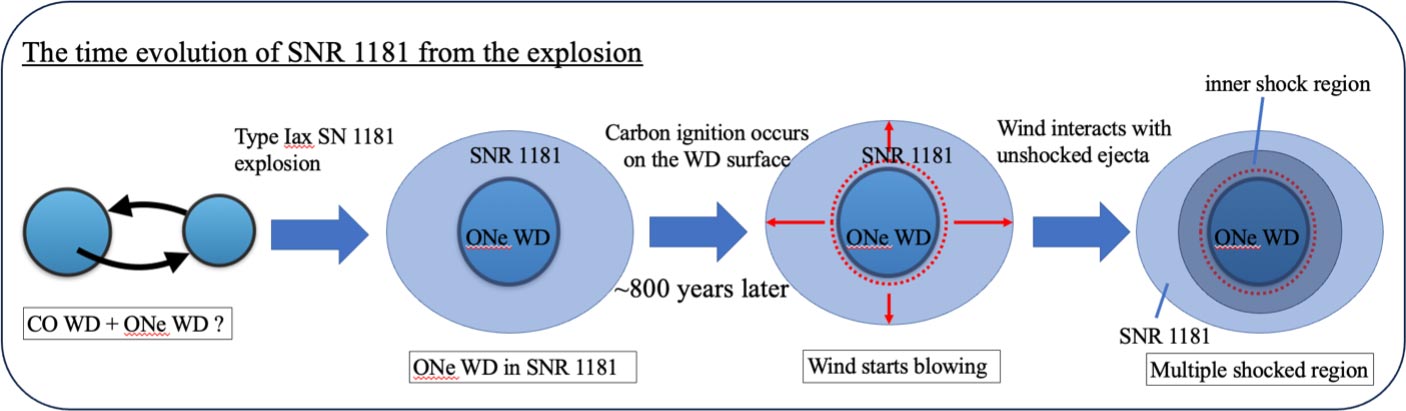
The remnant of this guest star, labeled supernova remnant (SNR) 1181, was found to have been created when two extremely dense, Earth-sized stars, called white dwarfs, collided. This created a rare type of supernova, called a Type Iax supernova, which left behind a single, bright and fast-rotating white dwarf. Aided by observations on its position noted in the historical document, modern astrophysicists finally pinpointed its location in 2021 in a nebula towards the constellation Cassiopeia.
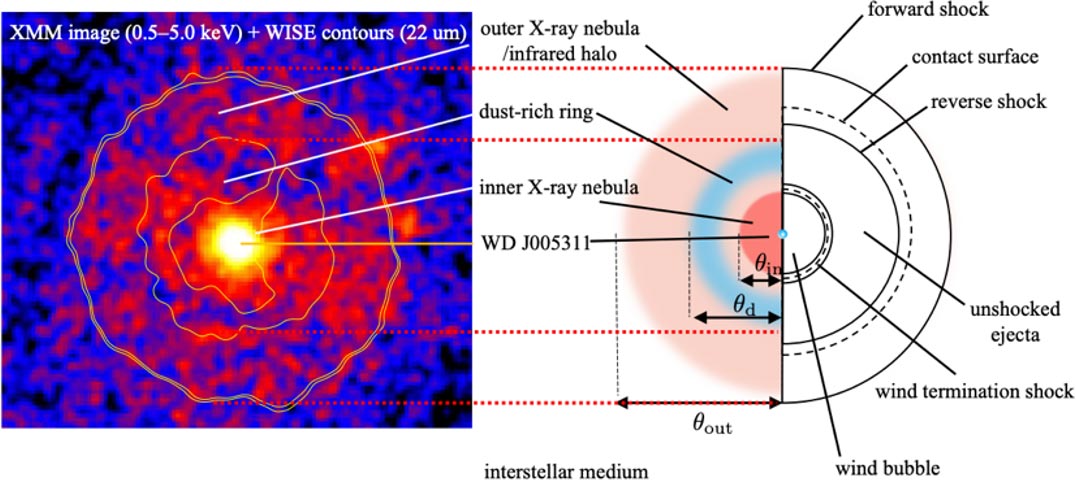
Due to its rare nature and location within our galaxy, SNR 1181 has been the subject of much observational research. This suggested that SNR 1181 is made up of two shock regions, an outer region and an inner one. In this new study, the research group analyzed the latest X-ray data to construct a theoretical computer model to explain these observations, and which has recreated the previously unexplained structure of this supernova remnant.
Challenges in Understanding Supernova Properties
The main challenge was that according to conventional understanding, when two white dwarfs collide like this, they should explode and disappear. However, this merger left behind a white dwarf. The spinning white dwarf was expected to create a stellar wind (a fast-flowing stream of particles) immediately after its formation. However, what the researchers found was something else.
“If the wind had started blowing immediately after SNR 1181’s formation, we couldn’t reproduce the observed size of the inner shock region,” said Ko. “However, by treating the wind’s onset time as variable, we succeeded in explaining all of the observed features of SNR 1181 accurately and unraveling the mysterious properties of this high-speed wind. We were also able to simultaneously track the time evolution of each shock region, using numerical calculations.”
Future Research and Interdisciplinary Contributions
The team was very surprised to find that according to their calculations, the wind may have started blowing only very recently, within the past 20-30 years. They suggest this may indicate that the white dwarf has started to burn again, possibly due to some of the matter thrown out by the explosion witnessed in 1181 falling back to its surface, increasing its density and temperature over a threshold to restart burning.
To validate their computer model, the team is now preparing to further observe SNR 1181 using the Very Large Array (VLA) radio telescope based in central New Mexico and the 8.2-meter-class Subaru Telescope in Hawaii.
“The ability to determine the age of supernova remnants or the brightness at the time of their explosion through archaeological perspectives is a rare and invaluable asset to modern astronomy,” said Ko. “Such interdisciplinary research is both exciting and highlights the immense potential for combining diverse fields to uncover new dimensions of astronomical phenomena.”
Reference: “A Dynamical Model for IRAS 00500+6713: The Remnant of a Type Iax Supernova SN 1181 Hosting a Double Degenerate Merger Product WD J005311” by Takatoshi Ko, Hiromasa Suzuki, Kazumi Kashiyama, Hiroyuki Uchida, Takaaki Tanaka, Daichi Tsuna, Kotaro Fujisawa, Aya Bamba and Toshikazu Shigeyama, 5 July 2024, The Astrophysical Journal.
DOI: 10.3847/1538-4357/ad4d99
Funding: This research has made use of data and software provided by the High Energy Astrophysics Science Archive Research Center (HEASARC), which is a service of the Astrophysics Science Division at NASA/GSFC. This work was financially supported by Japan Society for the Promotion of Science Grants-in-Aid for Scientific Research (KAKENHI) Grant Numbers JP24KJ0672(TK), JP21J00031 (HS), JP24K00668 (KK), JP20K04010 (KK), JP20H01904 (KK), JP22H00130 (KK), JP22H01265 (HU), JP19H01936 (TT), JP21H04493 (TT), JP20K14512 (KF), JP23H01211 (AB), JP22K03688 (TS), JP22K03671 (TS), and JP20H05639 (TS). DT is supported by the Sherman Fairchild Postdoctoral Fellowship at the California Institute of Technology. TK is supported by RIKEN Junior Research Associate Program.
Never miss a breakthrough: Join the SciTechDaily newsletter.
Follow us on Google and Google News.