
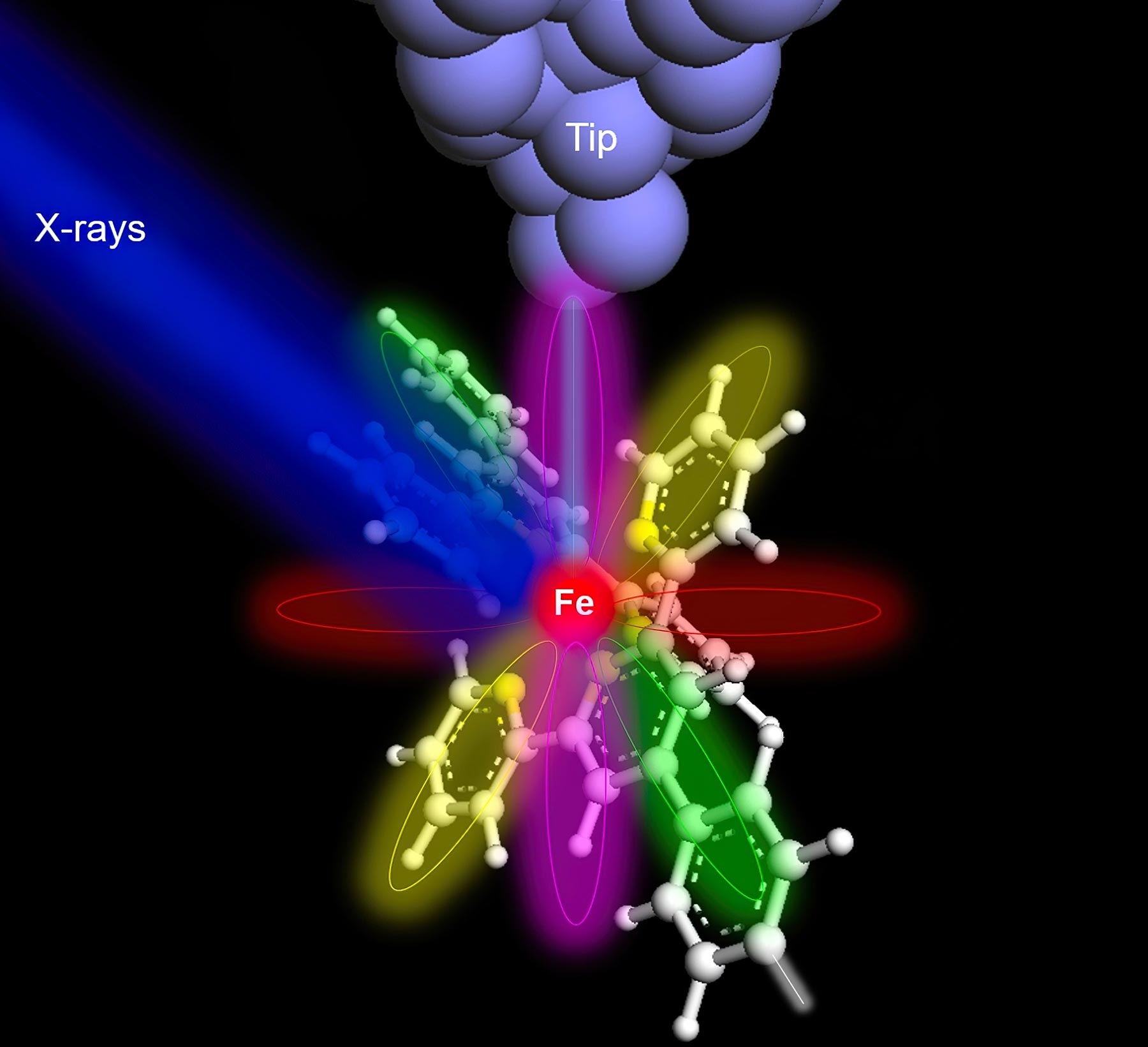
Scientists have successfully detected the X-ray signature of a single atom for the first time. Using a pioneering technique known as synchrotron X-ray scanning tunneling microscopy (SX-STM), the team was able to identify and characterize individual atoms, opening new possibilities in environmental, medical, and quantum research.
A team of scientists from Ohio University, Argonne National Laboratory, the University of Illinois-Chicago, and others, led by Ohio University Professor of Physics, and Argonne National Laboratory scientist, Saw Wai Hla, has taken the world’s first X-ray SIGNAL (or SIGNATURE) of just one atom. This groundbreaking achievement was funded by the U.S. Department of Energy, Office of Basic Energy Sciences, and could revolutionize the way scientists detect materials.
Since its discovery by Roentgen in 1895, X-rays have been used everywhere, from medical examinations to security screenings in airports. Even Curiosity, NASA’s Mars rover, is equipped with an X-ray device to examine the material composition of the rocks on Mars. An important usage of X-rays in science is to identify the type of materials in a sample. Over the years, the quantity of materials in a sample required for X-ray detection has been greatly reduced thanks to the development of synchrotron X-ray sources and new instruments. To date, the smallest amount one can X-ray a sample is in attogram, that is about 10,000 atoms or more. This is due to the X-ray signal produced by an atom being extremely weak so that the conventional X-ray detectors cannot be used to detect it. According to Hla, it is a long-standing dream of scientists to X-ray just one atom, which is now being realized by the research team led by him.
“Atoms can be routinely imaged with scanning probe microscopes, but without X-rays, one cannot tell what they are made of. We can now detect exactly the type of a particular atom, one atom-at-a-time, and can simultaneously measure its chemical state,” explained Hla, who is also the director of the Nanoscale and Quantum Phenomena Institute at Ohio University. “Once we are able to do that, we can trace the materials down to the ultimate limit of just one atom. This will have a great impact on environmental and medical sciences and maybe even find a cure that can have a huge impact for humankind. This discovery will transform the world.”

Revolutionary Synchrotron X-Ray Technique
Their paper, published in the scientific journal Nature on May 31, 2023, and gracing the cover of the print version of the scientific journal on June 1, 2023, details how Hla and several other physicists and chemists, including Ph.D. students at OHIO, used a purpose-built synchrotron X-ray instrument at the XTIP beamline of Advanced Photon Source and the Center for Nanoscale Materials at Argonne National Laboratory.
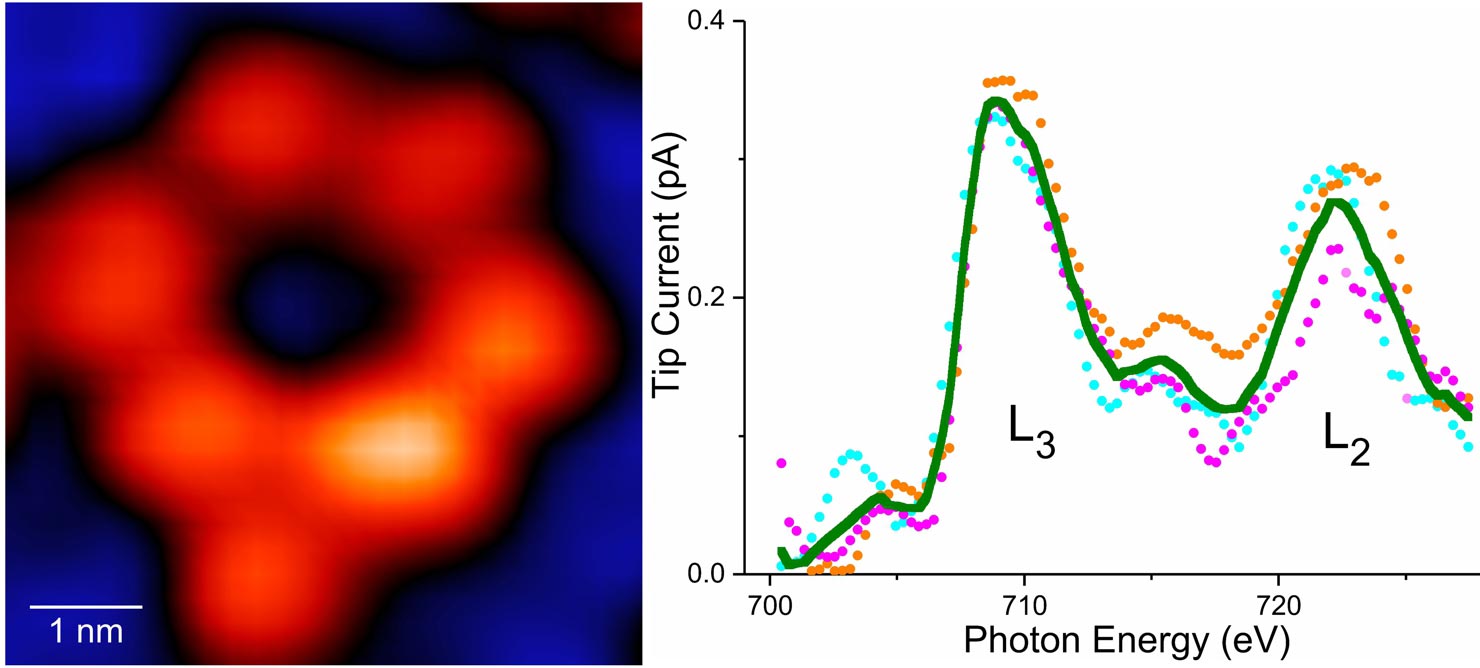
For demonstration, the team chose an iron atom and a terbium atom, both inserted in respective molecular hosts. To detect X-ray signal of one atom, the research team supplemented conventional detectors in X-rays with a specialized detector made of a sharp metal tip positioned at extreme proximity to the sample to collect X-ray excited electrons – a technique known as synchrotron X-ray scanning tunneling microscopy or SX-STM. X-ray spectroscopy in SX-STM is triggered by photoabsorption of core level electrons, which constitutes elemental fingerprints and is effective in identifying the elemental type of the materials directly.
According to Hla, the spectrums are like fingerprints, each one being unique and able to detect exactly what it is.
“The technique used, and concept proven in this study, broke new ground in X-ray science and nanoscale studies,” said Tolulope Michael Ajayi, who is the first author of the paper and doing this work as part of his Ph.D. thesis. “More so, using X-rays to detect and characterize individual atoms could revolutionize research and give birth to new technologies in areas such as quantum information and the detection of trace elements in environmental and medical research, to name a few. This achievement also opens the road for advanced materials science instrumentation.”
For the last 12 years, Hla has been involved in the development of an SX-STM instrument and its measurement methods together with Volker Rose, a scientist at the Advanced Photon Source at Argonne National Laboratory.
“I have been able to successfully supervise four OHIO graduate students for their Ph.D. theses related to SX-STM method development over a 12-year period. We have come a long way to achieve the detection of a single atom X-ray signature,” Hla said.
Hla’s study is focused on nano and quantum sciences with a particular emphasis on understanding materials’ chemical and physical properties at the fundamental level – on an individual atom basis. In addition to achieving X-ray signature of one atom, the team’s key goal was to use this technique to investigate the environmental effect on a single rare-earth atom.
Rare-Earth Metals and Their Technological Significance
“We have detected the chemical states of individual atoms as well,” Hla explained. “By comparing the chemical states of an iron atom and a terbium atom inside respective molecular hosts, we find that the terbium atom, a rare-earth metal, is rather isolated and does not change its chemical state while the iron atom strongly interacts with its surrounding.”
Many rare-earth materials are used in everyday devices, such as cell phones, computers and televisions, to name a few, and are extremely important in creating and advancing technology. Through this discovery, scientists can now identify not only the type of element but its chemical state as well, which will allow them to better manipulate the atoms inside different material hosts to meet the ever-changing needs in various fields. Moreover, they have also developed a new method called “X-ray excited resonance tunneling or X-ERT” that allows them to detect how orbitals of a single molecule orient on a material surface using synchrotron X-rays.
“This achievement connects synchrotron X-rays with quantum tunneling process to detect X-ray signature of an individual atom and opens many exciting research directions including the research on quantum and spin (magnetic) properties of just one atom using synchrotron X-rays,” Hla said.
In addition to Ajayi, several other OHIO graduate students including current Ph.D. students Sineth Premarathna in Physics and Xinyue Cheng in Chemistry, as well as Ph.D. in Physics alumni Sanjoy Sarkar, Shaoze Wang, Kyaw Zin Latt, Tomas Rojas, and Anh T. Ngo, currently an Associate Professor of Chemical Engineering at the University of Illinois-Chicago, were involved in this research. College of Arts and Sciences Roenigk Chair and Professor of Chemistry Eric Masson designed and synthesized the rare earth molecule used in this study.
Going forward, Hla and his research team will continue to use X-rays to detect properties of just one atom and find ways to further revolutionize their applications for use in gathering critical materials research and more.
Reference: “Characterization of just one atom using synchrotron X-rays” by Tolulope M. Ajayi, Nozomi Shirato, Tomas Rojas, Sarah Wieghold, Xinyue Cheng, Kyaw Zin Latt, Daniel J. Trainer, Naveen K. Dandu, Yiming Li, Sineth Premarathna, Sanjoy Sarkar, Daniel Rosenmann, Yuzi Liu, Nathalie Kyritsakas, Shaoze Wang, Eric Masson, Volker Rose, Xiaopeng Li, Anh T. Ngo and Saw-Wai Hla, 31 May 2023, Nature.
DOI: 10.1038/s41586-023-06011-w
Never miss a breakthrough: Join the SciTechDaily newsletter.
Follow us on Google and Google News.
1 Comment
Headline: “First-Ever X-Ray of a Single Atom …” vs. Actual science: “Scientists have successfully detected the X-ray signature of a single atom …”
When someone a says they’ve taken an X-Ray of their bones, they know what you get is a photographic image. Your headline will make people think the same thing has happened with an atom. That’s not the case, and for a site that supposedly understands and promotes science, you need to do better.