
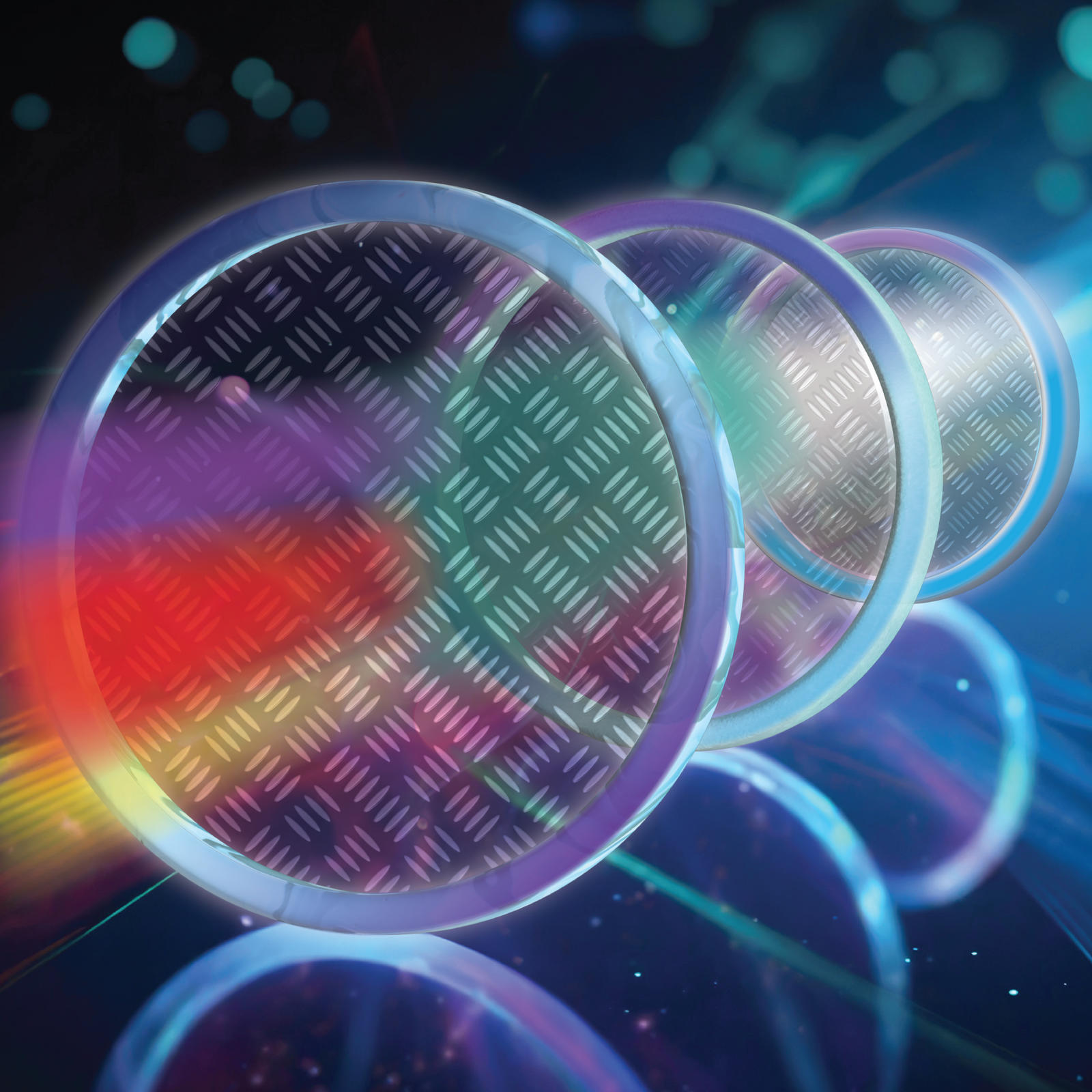
By gathering more intricate thermal data, this novel method could enhance autonomous navigation, material recognition, security, and other applications.
Researchers have created a novel technology utilizing meta-optical devices for thermal imaging. This method offers more detailed information about the objects being imaged, potentially expanding thermal imaging applications in autonomous navigation, security, thermography, medical imaging, and remote sensing.
“Our method overcomes the challenges of traditional spectral thermal imagers, which are often bulky and delicate due to their reliance on large filter wheels or interferometers,” said research team leader Zubin Jacob from Purdue University. “We combined meta-optical devices and cutting-edge computational imaging algorithms to create a system that is both compact and robust while also having a large field of view.”
In Optica, Optica Publishing Group’s journal for high-impact research, the authors describe their new spectro-polarimetric decomposition system, which uses a stack of spinning metasurfaces to break down thermal light into its spectral and polarimetric components. This allows the imaging system to capture the spectral and polarization details of thermal radiation in addition to the intensity information that is acquired with traditional thermal imaging.
The researchers showed that the new system can be used with a commercial thermal camera to successfully classify various materials, a task that is typically challenging for conventional thermal cameras. The method’s ability to distinguish temperature variations and identify materials based on spectro-polarimetric signatures could help boost safety and efficiency for a variety of applications, including autonomous navigation.
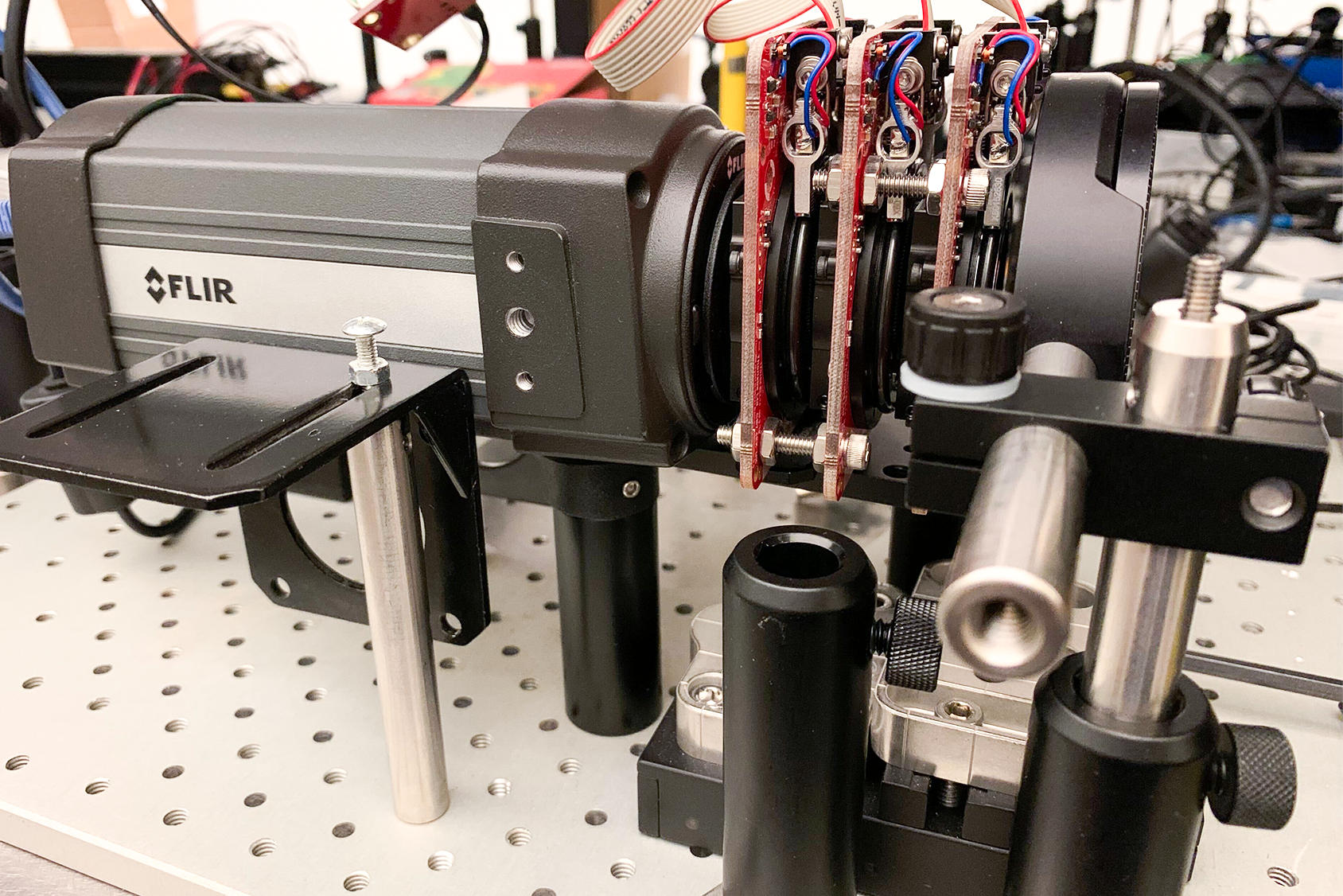
Xueji Wang, Purdue University
“Traditional autonomous navigation approaches rely heavily on RGB cameras, which struggle in challenging conditions like low light or bad weather,” said the paper’s first author Xueji Wang, a postdoctoral researcher at Purdue University. “When integrated with heat-assisted detection and ranging technology, our spectro-polarimetric thermal camera can provide vital information in these difficult scenarios, offering clearer images than RGB or conventional thermal cameras. Once we achieve real-time video capture, the technology could significantly enhance scene perception and overall safety.”
Doing more with a smaller imager
Spectro-polarimetric imaging in the long-wave infrared is crucial for applications such as night vision, machine vision, trace gas sensing, and thermography. However, today’s spectro-polarimetric long-wave infrared imagers are bulky and limited in spectral resolution and field of view.
To overcome these limitations the researchers turned to large-area metasurfaces — ultra-thin structured surfaces that can manipulate light in complex ways. After engineering spinning dispersive metasurfaces with tailored infrared responses, they developed a fabrication process that allowed these metasurfaces to be used to create large-area (2.5-cm diameter) spinning devices suitable for imaging applications. The resulting spinning stack measures less than 10 x 10 x 10 cm and can be used with a traditional infrared camera.
“Integrating these large-area meta-optical devices with computational imaging algorithms facilitated the efficient reconstruction of the thermal radiation spectrum,” said Wang. “This enabled a more compact, robust, and effective spectro-polarimetric thermal imaging system than was previously achievable.”
Classifying materials with thermal imaging
To evaluate their new system, the researchers spelled out “Purdue” using various materials and microstructures, each with unique spectro-polarimetric properties. Using the spectro-polarimetric information acquired with the system, they accurately distinguished the different materials and objects. They also demonstrated a three-fold increase in material classification accuracy compared to traditional thermal imaging methods, highlighting the system’s effectiveness and versatility.
The researchers say that the new method could be especially useful for applications that require detailed thermal imaging. “In security, for example, it could revolutionize airport systems by detecting concealed items or substances on people,” said Wang. “Moreover, its compact and robust design enhances its suitability for diverse environmental conditions, making it particularly beneficial for applications such as autonomous navigation.”
In addition to working to achieve video capture with the system, the researchers are trying to enhance the technique’s spectral resolution, transmission efficiency, and speed of image capture and processing. They also plan to improve the metasurface design to enable more complex light manipulation for higher spectral resolution. Additionally, they want to extend the method to room-temperature imaging since the use of metasurface stacks restricted the method to high-temperature objects. They plan to do this using improved materials, metasurface designs, and techniques like anti-reflection coatings.
Reference: “Spinning metasurface stack for spectro-polarimetric thermal imaging” by Fanglin Bao, Zubin Jacob, Xueji Wang, Tyler Sentz and Ziyi Yang, 19 January 2024, Optica.
DOI: 10.1364/OPTICA.506813
Never miss a breakthrough: Join the SciTechDaily newsletter.
Follow us on Google and Google News.