
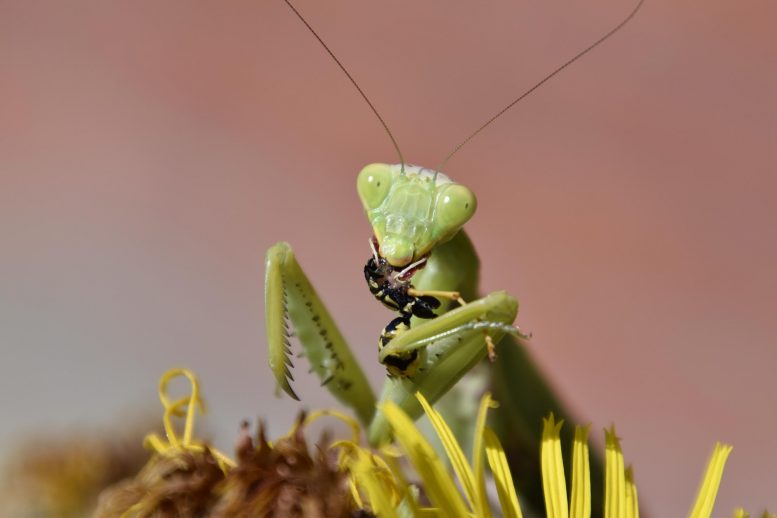
We might not notice them, but the crops farmers grow are protected by scores of tiny invertebrate bodyguards. Naturally occurring arthropods like spiders and lady beetles patrol crop fields looking for insects to eat. These natural enemies keep pests under control, making it easier to grow the crops we depend on.
New research from Michigan State University by Nate Haan, Yajun Zhang, and Doug Landis shed light on how these natural enemies respond to large-scale spatial patterns in agricultural landscapes. These areas are made up of crop fields, forests, and grasslands. It turns out their configuration, or spatial arrangement, can go a long way in determining how many natural enemies show up in a field to eat pests.
A new review article published in Trends in Ecology and Evolution on November 4, 2019, summarizes recent research into ways landscape configuration affects natural enemies and pest suppression.
“One of the take-homes from our review is that natural enemies can be more abundant when agricultural landscapes are made up of smaller farm fields,” said Haan, MSU postdoctoral researcher in the Department of Entomology and one of the study’s authors. “Some natural enemies need resources found in other habitats or in crop field edges. We think when habitat patches are small, they are more likely to find their way back and forth between these habitats and crop fields, or from one crop field into another.”
Haan emphasizes that the exact effects of landscape configuration depend on the natural history of the critter in question.
“A predator that finds everything it needs to survive within a single crop field might not need natural habitats outside that crop field, but there are lots of other insects that need to find nectar or shelter in other places,” Haan said. “For these insects, the spatial arrangement of crop fields and those other habitats can become very important.”
This research will help scientists predict how future changes to farming landscapes will affect insect diversity and pest suppression, a service that is estimated to save farmers billions of dollars every year.
One expected change to landscapes in the Midwest will occur as farmers begin to grow more bioenergy crops. This is a key interest to the Great Lakes Bioenergy Research Center, or GLBRC, which funded the study. Farmers are likely to grow more crops that can be processed and used as substitutes for petroleum; these crops could be traditional crops like corn, but switchgrass, poplar trees, and native prairie are promising alternatives. Depending on which crops are used and where they are planted, future landscapes will contain new habitats and will likely be in new spatial arrangements.
The next steps for this research include learning more about whether the life-history traits of beneficial arthropods predict how they will respond to landscape change. Insects have different food requirements and strategies for moving around the landscape, Haan and colleagues are excited to learn how these differences can be used to predict how the insects will respond to future landscape changes.
Reference: “Predicting Landscape Configuration Effects on Agricultural Pest Suppression” by Nathan L. Haan, Yajun Zhang and Douglas A. Landis, 4 November 2019, Trends in Ecology and Evolution.
DOI: 10.1016/j.tree.2019.10.003
Never miss a breakthrough: Join the SciTechDaily newsletter.
Follow us on Google and Google News.