
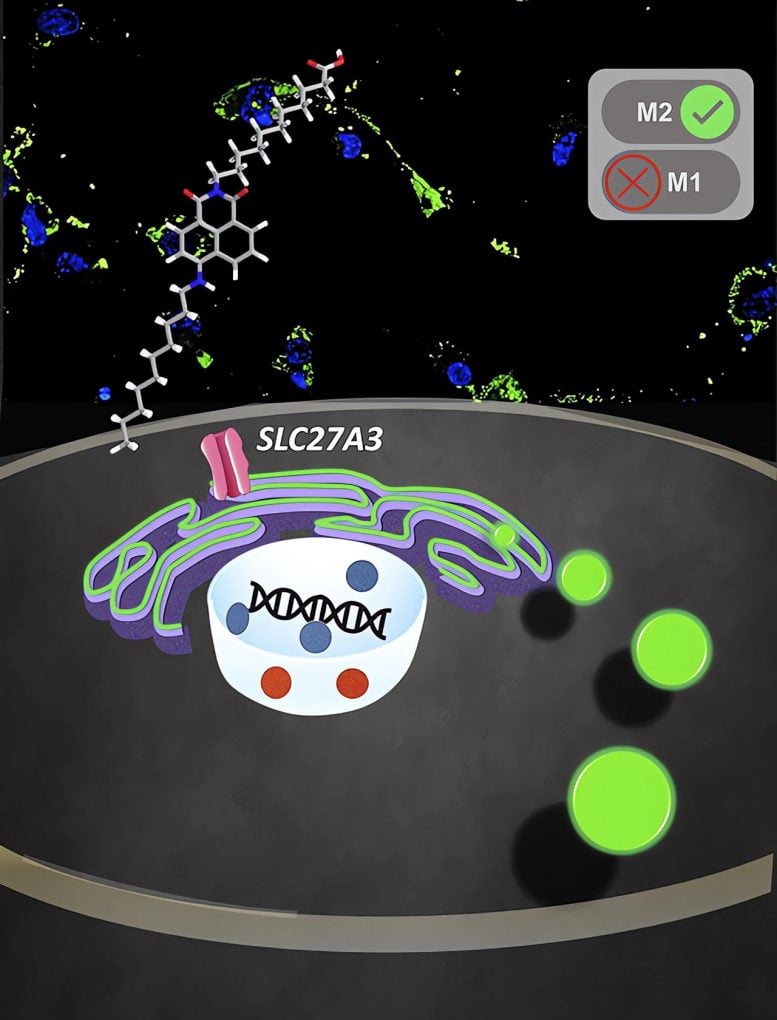
POSTECH research team led by Professor Young-Tae Chang develops fluorescent probe for M2 macrophages via gating-oriented live-cell distinction (GOLD).
M1 and M2 are activated macrophages that protect our immune system and maintain homeostasis. Interestingly, they are characterized by distinct and opposing phenotypes. M1 macrophages are known for their bactericidal and tumoricidal properties by secreting pro-inflammatory cytokines, while M2 macrophages facilitate immunosuppressive responses and help cancer progression. As such, reprogramming macrophages from M2 to M1 phenotype has been regarded as a significant interest in the view of potential cancer treatment methods. Though it has been challenging to distinguish between living M1 and M2 using fluorescent molecules until now, a research team at POSTECH developed a novel probe, selectively dyeing M2 over M1 for the first time.
The work of the team, comprised of Professor Young-Tae Chang (Department of Chemistry), Professor Nam-Young Kang (Department of Convergence IT Engineering), Professor Haw-Young Kwon, Heewon Cho, and Sun Hyeok Lee from the Department of Interdisciplinary Bioscience & Bioengineering at POSTECH, has developed the first M2 selective probe CDg18 with a novel mechanism. The research findings were recently published in the Journal of the American Chemical Society, one of the most renowned journals in the field of chemistry.
Fluorescent probes are chemical compounds that are able to emit light upon recognition of specific ions or materials. The discrimination of living human cells is of importance, not only in clinical diagnosis but the pursuit of effective treatment strategies for infections or inflammatory conditions.
Macrophages are specialized immune cells, exhibiting remarkable plasticity in response to environmental stimuli. The activated macrophages broadly categorize into two different subsets, M1 and M2. M1 macrophages have aggressive functions against invaders such as bacteria and tumors while M2 macrophages are anti-inflammatory cells, which promote tumor immunity.
Tumor-associated macrophages represent a critical determinant to form tumor microenvironment, which is a typical example of M2 cells. Despite the evident importance of M2 macrophages, real-time monitoring of M2 had remained a challenge.
Real-Time Monitoring of Macrophage Reprogramming
The team developed a novel M2 probe, CDg18, by employing a unique mechanism of Gating-Oriented Live-cell Distinction (GOLD) through the specific overexpressed fatty acid transporter in M2. To demonstrate the potential of CDg18, the team visualized the phenotypic shift of M2 toward M1 using a resveratrol analog HS-1973 as a reprogramming effector.
The simultaneous use of both CDg18 and the M1 probe, CDr17, facilitated dual-color monitoring macrophage reprogramming in real-time which was defined by the diminishing M2 character and emergence of M1 markers.
Professor Young-Tae Chang who led the team explained, “The M2 probe (and the M1 probe previously developed) developed by the team in this research enables the monitoring of M1 and M2 distribution in cancerous tissues as well as their changes over time.” He added, “This represents a novel technological approach in addressing the existing limitations in this field.”
Reference: “Development of a Fluorescent Probe for M2 Macrophages via Gating-Oriented Live-Cell Distinction” by Heewon Cho, Haw-Young Kwon, Sun Hyeok Lee, Hong-Guen Lee, Nam-Young Kang and Young-Tae Chang, 27 January 2023, Journal of the American Chemical Society.
DOI: 10.1021/jacs.2c11393
This study was sponsored by the Institute for Basic Science, the Ministry of Science and ICT, and the Hyundai Motor Chung Mong-Koo Foundation.
Never miss a breakthrough: Join the SciTechDaily newsletter.
Follow us on Google and Google News.