
Close Menu
    Facebook X (Twitter) Instagram
    SciTechDaily
    • Biology
    • Chemistry
    • Earth
    • Health
    • Physics
    • Science
    • Space
    • Technology
    Facebook X (Twitter) Pinterest YouTube RSS
    SciTechDaily
    Home»Technology»Revolutionizing Medical Research: Scientists Develop Groundbreaking Privacy-Preserving AI
    Technology

    Revolutionizing Medical Research: Scientists Develop Groundbreaking Privacy-Preserving AI

    By King Abdullah University of Science & Technology (KAUST)March 5, 2024No Comments3 Mins Read
    Facebook Twitter Pinterest Telegram LinkedIn WhatsApp Email Reddit
    Share
    Facebook Twitter LinkedIn Pinterest Telegram Email Reddit
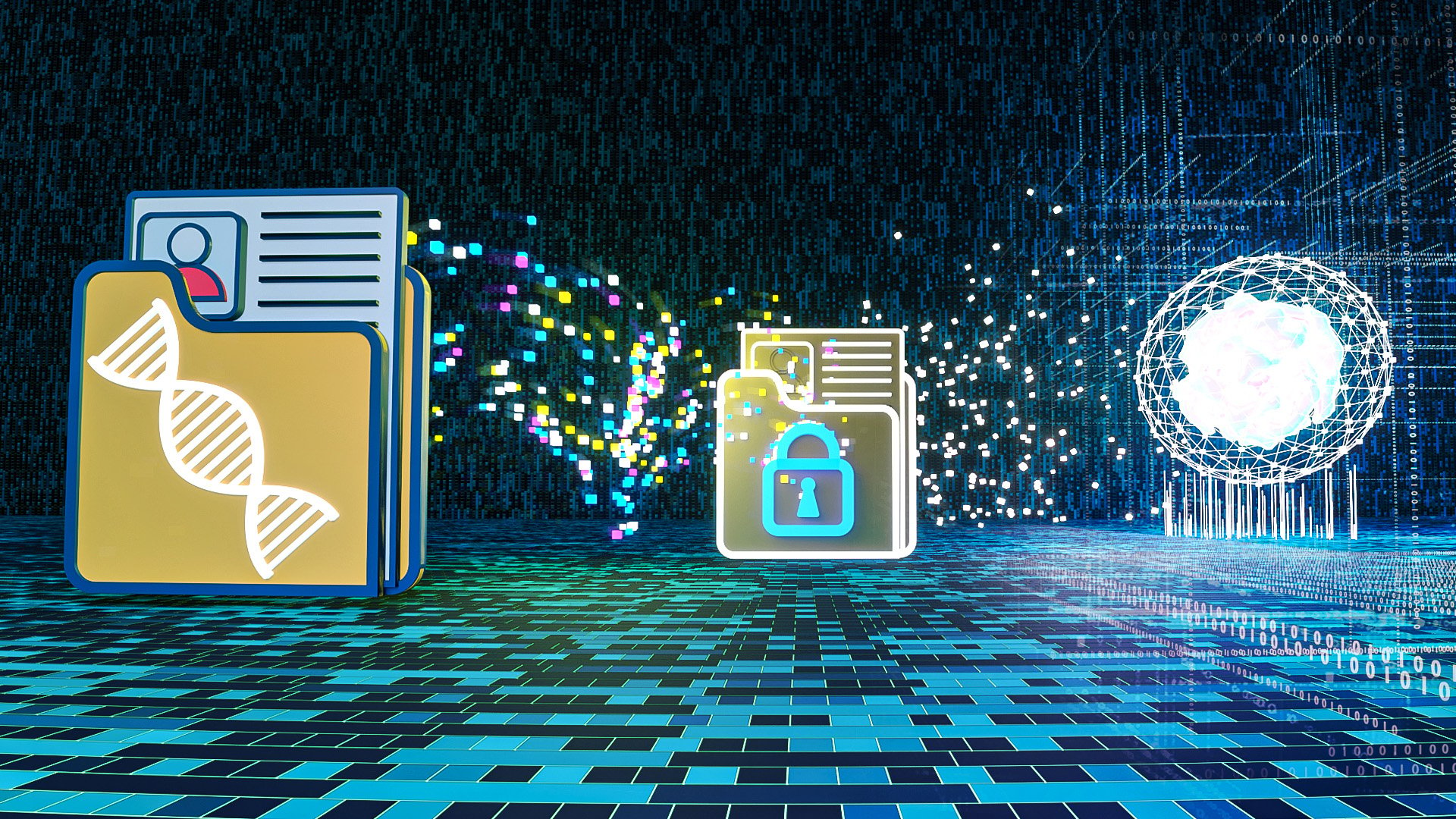
    Shuffling the Deck for Privacy Graphic
    Researchers have innovated a privacy-preserving machine-learning method for genomic research, balancing data privacy with AI model performance. Their approach, using a decentralized shuffling algorithm, showcases enhanced efficiency and security, underscoring the critical need for privacy in biomedical data analysis.Credit: 2024 KAUST; Heno Hwang

    A research team at KAUST has created a machine-learning method that utilizes a collection of algorithms focused on preserving privacy. This approach tackles a critical issue in medical research: leveraging artificial intelligence (AI) to expedite discoveries from genomic data without compromising individual privacy.

    “Omics data usually contains a lot of private information, such as gene expression and cell composition, which could often be related to a person’s disease or health status,” says KAUST’s Xin Gao. “AI models trained on this data – particularly deep learning models – have the potential to retain private details about individuals. Our primary focus is finding an improved balance between preserving privacy and optimizing model performance.”

    Traditional Privacy Preservation Techniques

    The traditional approach to preserving privacy is to encrypt the data. However, this requires the data to be decrypted for training, which introduces a heavy computational overhead. The trained model also still retains private information and so can only be used in secure environments.

    Another way to preserve privacy is to break the data into smaller packets and train the model separately on each packet using a team of local training algorithms, an approach known as local training or federated learning. However, on its own, this approach still has the potential to leak private information into the trained model. A method called differential privacy can be used to break up the data in a way that guarantees privacy, but this results in a “noisy” model that limits its utility for precise gene-based research.

    Enhancing Privacy with Differential Privacy

    “Using the differential privacy framework, adding a shuffler can achieve better model performance while keeping the same level of privacy protection; but the previous approach of using a centralized third-party shuffler that introduces a critical security flaw in that the shuffler could be dishonest,” says Juexiao Zhou, lead author of the paper and a Ph.D. student in Gao’s group. “The key advance of our approach is the integration of a decentralized shuffling algorithm.” He explains that the shuffler not only resolves this trust issue but achieves a better trade-off between privacy preservation and model capability, while ensuring perfect privacy protection.

    The team demonstrated their privacy-preserving machine-learning approach (called PPML-Omics) by training three representative deep-learning models on three challenging multi-omics tasks. Not only did PPML-Omics produce optimized models with greater efficiency than other approaches, it also proved to be robust against state-of-the-art cyberattacks.

    “It is important to be aware that proficiently trained deep-learning models possess the ability to retain significant amounts of private information from the training data, such as patients’ characteristic genes,” says Gao. “As deep learning is being increasingly applied to analyze biological and biomedical data, the importance of privacy protection is greater than ever.”

    Reference: “PPML-Omics: A privacy-preserving federated machine learning method protects patients’ privacy in omic data” by Juexiao Zhou, Siyuan Chen, Yulian Wu, Haoyang Li, Bin Zhang, Longxi Zhou, Yan Hu, Zihang Xiang, Zhongxiao Li, Ningning Chen, Wenkai Han, Chencheng Xu, Di Wang and Xin Gao, 31 January 2024, Science Advances.
    DOI: 10.1126/sciadv.adh8601

    Never miss a breakthrough: Join the SciTechDaily newsletter.
    Follow us on Google and Google News.

    Artificial Intelligence KAUST Machine Learning
    Share. Facebook Twitter Pinterest LinkedIn Email Reddit

    Related Articles

    Machine Learning at Speed: Optimization Code Increases Performance by 5x

    Engineers Create Smart Robodog With AI Brain [Video]

    Artificial Intelligence Helps Track Mysterious Cosmic Radio Bursts

    Artificial Intelligence Uses “Self-Learning” to Make Cancer Treatment Less Toxic

    New AI System Identifies Personality Traits from Eye Movements

    New Artificial Intelligence Device Identifies Objects at the Speed of Light

    Machine-Learning Models Capture Subtle Variations in Facial Expressions

    ‘Deep Learning’ Algorithm Brings New Tools to Astronomy

    Machine-Learning System Uses Physics to Identify Habitable Planets

    Leave A Reply Cancel Reply

    • Facebook
    • Twitter
    • Pinterest
    • YouTube

    Don't Miss a Discovery

    Subscribe for the Latest in Science & Tech!

    Trending News

    AI Could Detect Early Signs of Alzheimer’s in Under a Minute – Far Before Traditional Tests

    What if Dark Matter Has Two Forms? Bold New Hypothesis Could Explain a Cosmic Mystery

    This Metal Melts in Your Hand – and Scientists Just Discovered Something Strange

    Beef vs. Chicken: Surprising Results From New Prediabetes Study

    Alzheimer’s Breakthrough: Scientists Discover Key Protein May Prevent Toxic Protein Clumps in the Brain

    Quantum Reality Gets Stranger: Physicists Put a Lump of Metal in Two Places at Once

    Scientists May Have Found the Key to Jupiter and Saturn’s Moon Mystery

    Scientists Uncover Brain Changes That Link Pain to Depression

    Follow SciTechDaily
    • Facebook
    • Twitter
    • YouTube
    • Pinterest
    • Newsletter
    • RSS
    SciTech News
    • Biology News
    • Chemistry News
    • Earth News
    • Health News
    • Physics News
    • Science News
    • Space News
    • Technology News
    Recent Posts
    • What if Your Memories Never Happened? Physicists Take a New Look at the Boltzmann Brain Paradox
    • Students Found an Ancient Star That Shouldn’t Be in the Milky Way
    • Astronomers Solve 50-Year Mystery and Reveal Hidden Culprit Behind Strange X-Ray Emissions
    • One of the Universe’s Largest Stars May Be Getting Ready To Explode
    • Scientists Discover Enzyme That Could Supercharge Ozempic-Like Weight Loss Drugs
    Copyright © 1998 - 2026 SciTechDaily. All Rights Reserved.
    • Science News
    • About
    • Contact
    • Editorial Board
    • Privacy Policy
    • Terms of Use

    Type above and press Enter to search. Press Esc to cancel.