

Scientists from the Technical University of Munich (TUM) have achieved a significant advancement in measuring the Earth’s rotation with unprecedented precision. The ring laser at the Geodetic Observatory Wettzell can now be used to capture data at a quality level unsurpassed anywhere in the world. These measurements are crucial for determining Earth’s position in space, aiding climate research, and enhancing the reliability of climate models.
Advanced Ring Laser Technology
Care to take a quick step down to the basement and see how fast the earth has been turning in the last few hours? Now you can at the Geodetic Observatory Wettzell. TUM researchers have improved the ring laser there so that it can provide daily current data, which until now has not been possible at comparable quality levels.
What exactly does the ring laser measure? On its journey through space the earth rotates on its axis at slightly varying speeds. In addition, the axis around which the planet spins is not completely static, it wobbles a bit. This is because our planet is not completely solid, but is made up of various component parts, some solid, some liquid. So the insides of the earth itself are constantly in motion. These shifts in mass accelerate or brake the planet’s rotation, differences which can be detected using measurement systems like the TUM ring laser.
“Fluctuations in rotation are not only important for astronomy, we also urgently need them to create accurate climate models and to better understand weather phenomena like El Niño. And the more precise the data, the more accurate the predictions,” says Prof. Ulrich Schreiber, who led the project at the Observatory for TUM.
Technical Refinements and Challenges
When overhauling the ring laser system, the team gave priority to finding a good balance between size and mechanical stability, since the larger such a device is, the more sensitive the measurements it can make. However, size means compromises in terms of stability and thus precision.
Another challenge was the symmetry of the two opposed laser beams, the heart of the Wettzell system. Exact measurement is only possible when the wave forms of the two counter-propagating laser beams are nearly identical. However, the device’s design means a certain amount of asymmetry is always present. Over the last four years geodesists have used a theoretical model for laser oscillations to successfully capture these systematic effects to the extent that they can be precisely calculated over a long period of time and thus can be eliminated from the measurements.
Enhanced Precision and Applications
The device can use this new corrective algorithm to measure the earth’s rotation precisely down to 9 decimal places, corresponding to a fraction of a millisecond per day. In terms of the laser beams that’s equivalent to an uncertainty starting at only the 20th decimal place of the light frequency and stable for several months. On the whole, the observed up and down fluctuations reached values of as much as 6 milliseconds over periods of approximately two weeks.
The improvements in the laser have now made significantly shorter measurement periods possible as well. The newly developed corrective programs let the team capture current data every three hours. Urs Hugentobler, Professor for Satellite Geodesy at TUM, says: “In geosciences, time resolution levels this high are absolutely novel for standalone ring lasers. In contrast to other systems, the laser functions completely independently and doesn’t require reference points in space. With conventional systems, these reference points are created by observing the stars or using satellite data. But we’re independent of that kind of thing and also extremely precise.” Data captured independent of stellar observation can help identify and compensate for systematic errors in other measurement methods. Using a variety of methods helps make work particularly meticulous, especially when accuracy requirements are high, as is the case with the ring laser. Further improvement of the system which will enable even shorter measurement periods is planned for the future.
Understanding Ring Lasers
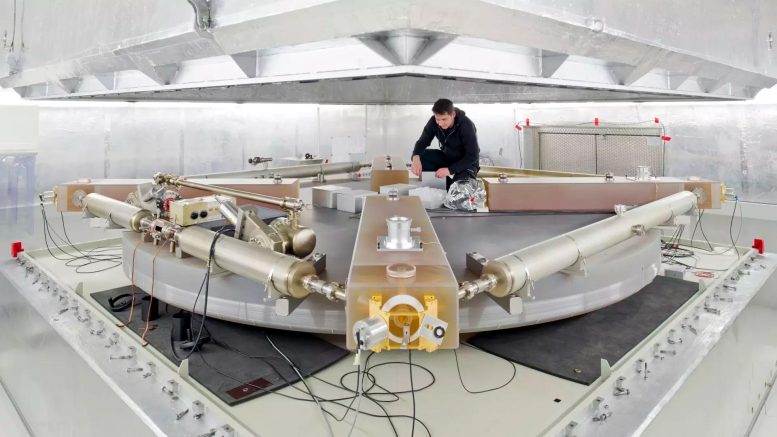
Ring lasers consist of a closed, square beam path with four mirrors completely enclosed in a Ceran glass-ceramic body, referred to as the resonator. This keeps the length of the path from changing due to temperature fluctuations. A helium / neon gas mixture inside the resonator enables laser beam excitation, one clockwise and one counterclockwise.
Without the earth’s movement the light would travel the same distance in both directions. But since the device moves together with the earth, the distance for one of the laser beams is shorter, since the earth’s rotation moves the mirrors closer to the beam. In the opposite direction the light travels a correspondingly longer distance. This effect creates a difference in the frequencies of the two light waves the superposition of which generates a beat note that can be measured very exactly. The higher the speed at which the earth turns, the greater the difference between the two optical frequencies. At the equator, the earth turns 15 degrees to the east every hour. This generates a signal of 348.5 Hz in the TUM device. Fluctuations in the length of a day manifest with values of from 1 to 3 millionths of a Hz (1 – 3 microhertz).
Robust and Precise Infrastructure
Each of the sides of the ring laser in the basement of the Observatory in Wettzell measures four meters. This construction is then anchored to a solid concrete column which rests on the solid bedrock of the earth’s crust at a depth of about six meters. This makes sure that the earth’s rotation is the only factor impacting the laser beams and excludes other environmental factors. The construction is protected by a pressurized chamber which compensates changes in air pressure or in the desired temperature of 12 degrees centigrade and compensates for these changes automatically. In order to minimize such influencing factors, the laboratory is located at a depth of five meters under an artificial hill. Almost 20 years of research work have gone into the development of the measuring system.
Reference: “Variations in the Earth’s rotation rate measured with a ring laser interferometer” by K. Ulrich Schreiber, Jan Kodet, Urs Hugentobler, Thomas Klügel and Jon-Paul R. Wells, 18 September 2023, Nature Photonics.
DOI: 10.1038/s41566-023-01286-x
Never miss a breakthrough: Join the SciTechDaily newsletter.
Follow us on Google and Google News.
2 Comments
I thought this had something to do with Ring cameras….lol.
“At the equator, the earth turns 15 degrees to the east every hour.” So why would it be different at any other latitude? I suspect you’re confusing this with the behavior of a Foucault pendulum, whose precession is latitude-related.