
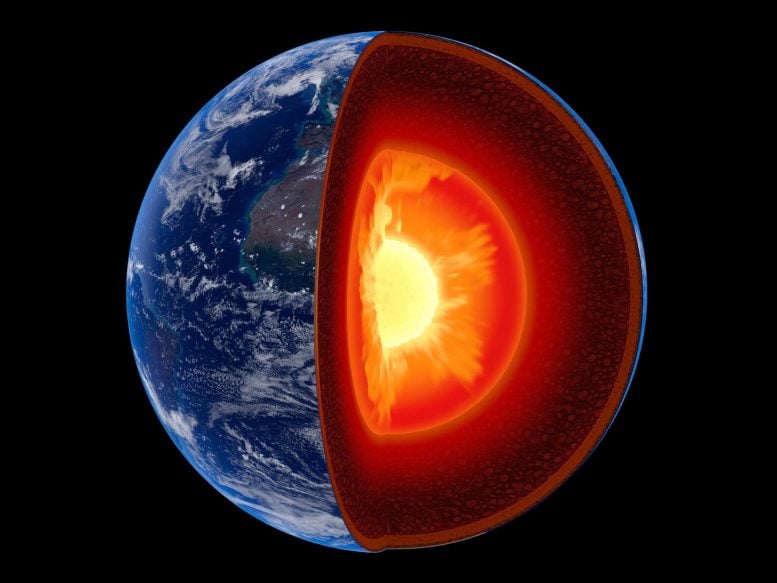
Prof. Dr. Tomoo Katsura and his international research team at the Bavarian Research Institute of Experimental Geochemistry and Geophysics, University of Bayreuth, have discovered why rocks in the Earth’s interior suddenly become more viscous at depths of 800 to 1,200 kilometers.
The cause of this change is the bridgmanite-enriched rocks that make up most of the Earth’s lower mantle below about 1,000 kilometers. These rocks have a much larger grain size than the rocks above them, resulting in high viscosity. Their findings have been published in the journal Nature. MLZ scientist Dr. Nicolas Walte was part of the successful collaboration and is co-author of the publication.
Lower Mantle Enriched in Bridgmanite
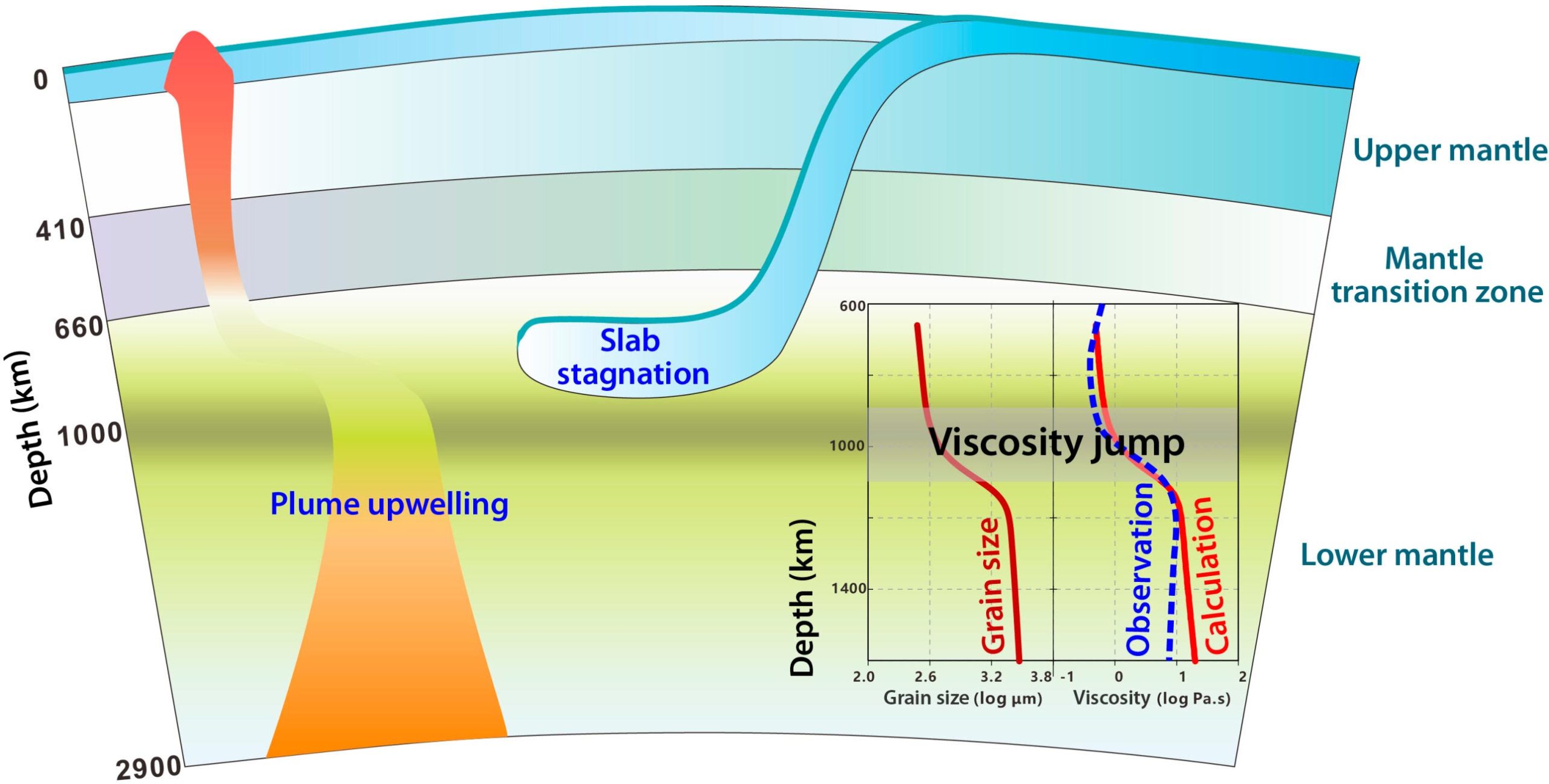
Bridgmanite is named after the Nobel Prize in Physics Winner Percy Bridgman. It is the most abundant mineral in the Earth’s lower mantle, which extends from a depth of 660 kilometers to 2,900 kilometers and occupies about half of the entire Earth. Scientists from Germany, China, France, the UK, and the USA have discovered that the grain size of bridgmanite increases at around 1,000 km depth, as lower-mantle rocks become bridgmanite-enriched with increasing depth.
As a result, there is a marked increase in viscosity in the shallower part of the lower mantle because viscosity has positive grain size dependence. The shallower part of the lower mantle consists of pyrolite. This rock contains 20 vol% of secondary minerals. These secondary minerals prevent the grain growth of bridgmanite. On the other hand, there are much smaller proportions of secondary minerals in the bridgmanite-enriched rocks, where bridgmanite can grow freely to large grains.
Puzzling Phenomena of Billion-Years-Old Structures Deep in the Earth
The resulting viscosity jump affects a wide range of geophysical and geochemical processes. “Although subducted plates sink rather smoothly into the lower mantle, their sinking is slowed down in the shallow part of the lower mantle. On the other hand, the upwelling of mantle plumes, which produce volcanoes in different areas of the Earth’s surface, seems to become rapid above 1,000 km of depth. Although these observations were difficult to understand, we can now explain them rationally.” mentions the first author, Dr. Hongzhan Fei, who was a researcher at the Bavarian Geoinstitute (BGI) and now a professor at one of the top universities in China, Zhejiang University in Hangzhou.
The highly viscous bridgmanite-enriched rocks were formed early in the history of the Earth. Because they are so viscous, mantle convection cannot mix them with other components of the mantle. As a result, the bridgmanite-enriched rocks have been preserved in the deep lower mantle for billions of years.
Correlating Findings With Seismic Observations
Prof. Dr. Tomoo Katsura, Chair of Structure and Dynamics of Earth Material at the BGI relates the new research results to seismic observations. “Seismologists have shown that many subducted slabs are stagnant in the layer between 600 and 1,500 kilometers deep. They have also shown that, although plumes rise vertically and can be clearly imaged below a depth of 1,000 kilometers, they become difficult to image above this depth.
“Our new theory can explain these observations. Because the viscosity increases with depth, the slabs are difficult to penetrate in regions deeper than 1,000 kilometers. On the other hand, the plumes rise faster at this depth, and so plumes become thinner and hard to image.” Katsura explains.
Reference: “Variation in bridgmanite grain size accounts for the mid-mantle viscosity jump” by Hongzhan Fei, Maxim D. Ballmer, Ulrich Faul, Nicolas Walte, Weiwei Cao and Tomoo Katsura, 5 July 2023, Nature.
DOI: 10.1038/s41586-023-06215-0
The study, published in Nature, resulted from a close collaboration between Prof. Dr. Tomoo Katsura (the University of Bayreuth) and Prof. Dr. Hongzhan Fei (the University of Bayreuth and Zhejiang University/China) with Dr. Nicolas Walte (Technical University of Munich), Prof. Dr. Maxim Ballmer (University College London/UK), Dr. Ulrich Faul (Massachusetts Institute of Technology, Cambridge/USA) and Dr. Weiwei Cao (Extreme Conditions and Materials: High Temperature and Irradiation (CEMHTI), Orléans/France).
Never miss a breakthrough: Join the SciTechDaily newsletter.
Follow us on Google and Google News.