
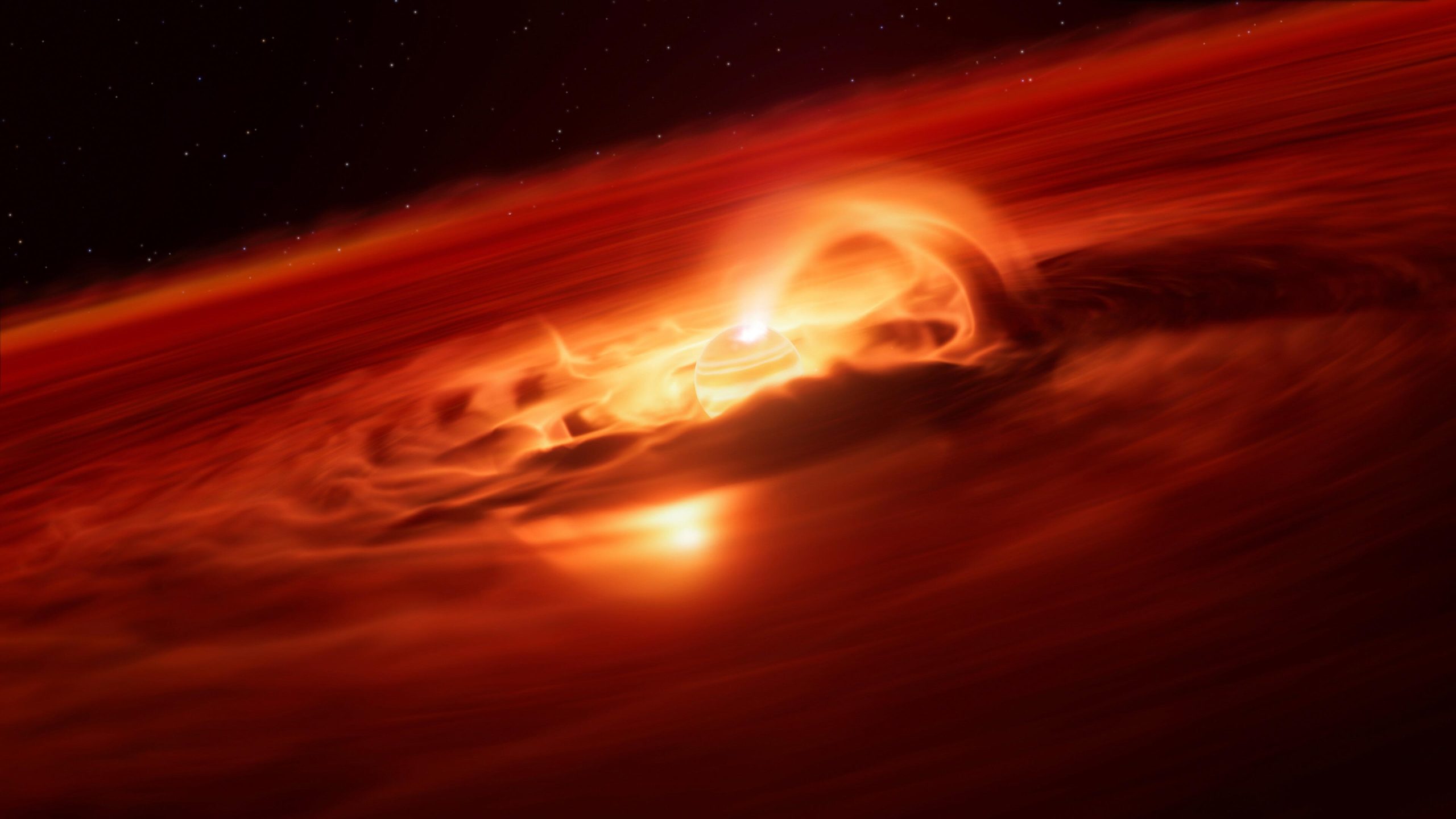
A runaway “rogue planet” is gorging on space dust at a rate of six billion tonnes per second.
The event marks the fastest planetary growth ever observed, hinting that some planets form more like stars.
Rogue Planet in a Runaway Growth Spurt
Astronomers have spotted a massive “growth spurt” taking place in a rare type of world known as a rogue planet. Unlike the familiar planets that circle stars, these cosmic wanderers drift freely through space. Using the European Southern Observatory’s Very Large Telescope (ESO’s VLT), researchers discovered that one such planet is rapidly consuming gas and dust from its surroundings—about six billion tonnes every second. This is the fastest growth ever observed in a rogue planet, or any planet, offering new clues about how these isolated worlds form and evolve.
“People may think of planets as quiet and stable worlds, but with this discovery we see that planetary-mass objects freely floating in space can be exciting places,” says Víctor Almendros-Abad, an astronomer at the Astronomical Observatory of Palermo, National Institute for Astrophysics (INAF), Italy and lead author of the new study.
The Giant in Chamaeleon
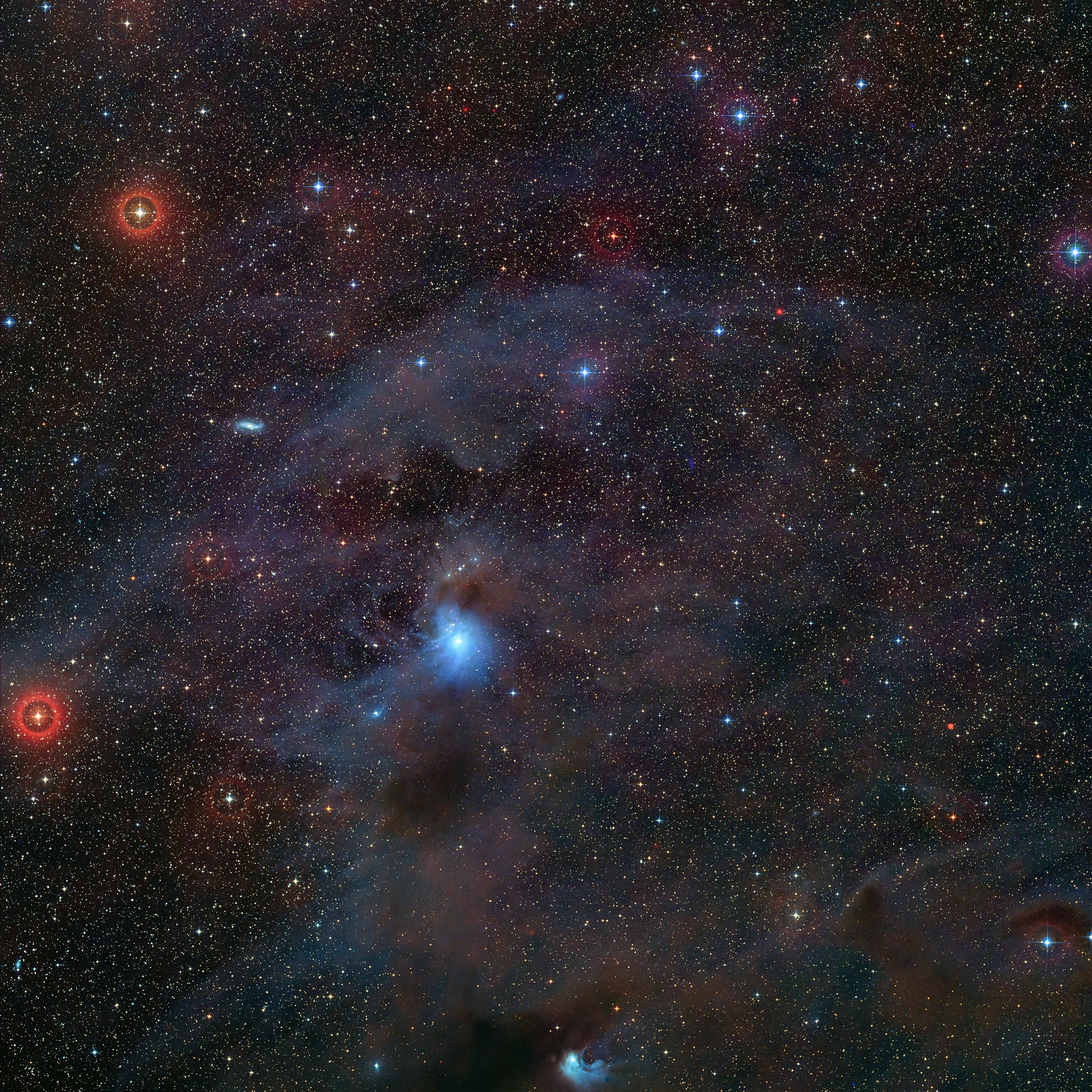
The object, officially called Cha 1107-7626, lies about 620 light-years from Earth in the constellation Chamaeleon and has a mass between five and ten times that of Jupiter. It is still in the process of forming, surrounded by a swirling disc of gas and dust that continues to fall onto the young planet in a process known as accretion. Almendros-Abad and his colleagues found that this feeding process is far from steady, showing dramatic bursts of activity.
By August 2025, the planet’s accretion rate had surged to roughly eight times what it had been only a few months earlier, reaching six billion tonnes per second. “This is the strongest accretion episode ever recorded for a planetary-mass object,” says Almendros-Abad. The finding, reported in The Astrophysical Journal Letters, was made using the X-shooter spectrograph on ESO’s VLT in Chile’s Atacama Desert. The researchers also incorporated data from the James Webb Space Telescope, operated by the US, European, and Canadian space agencies, and archival observations from the SINFONI spectrograph on ESO’s VLT.
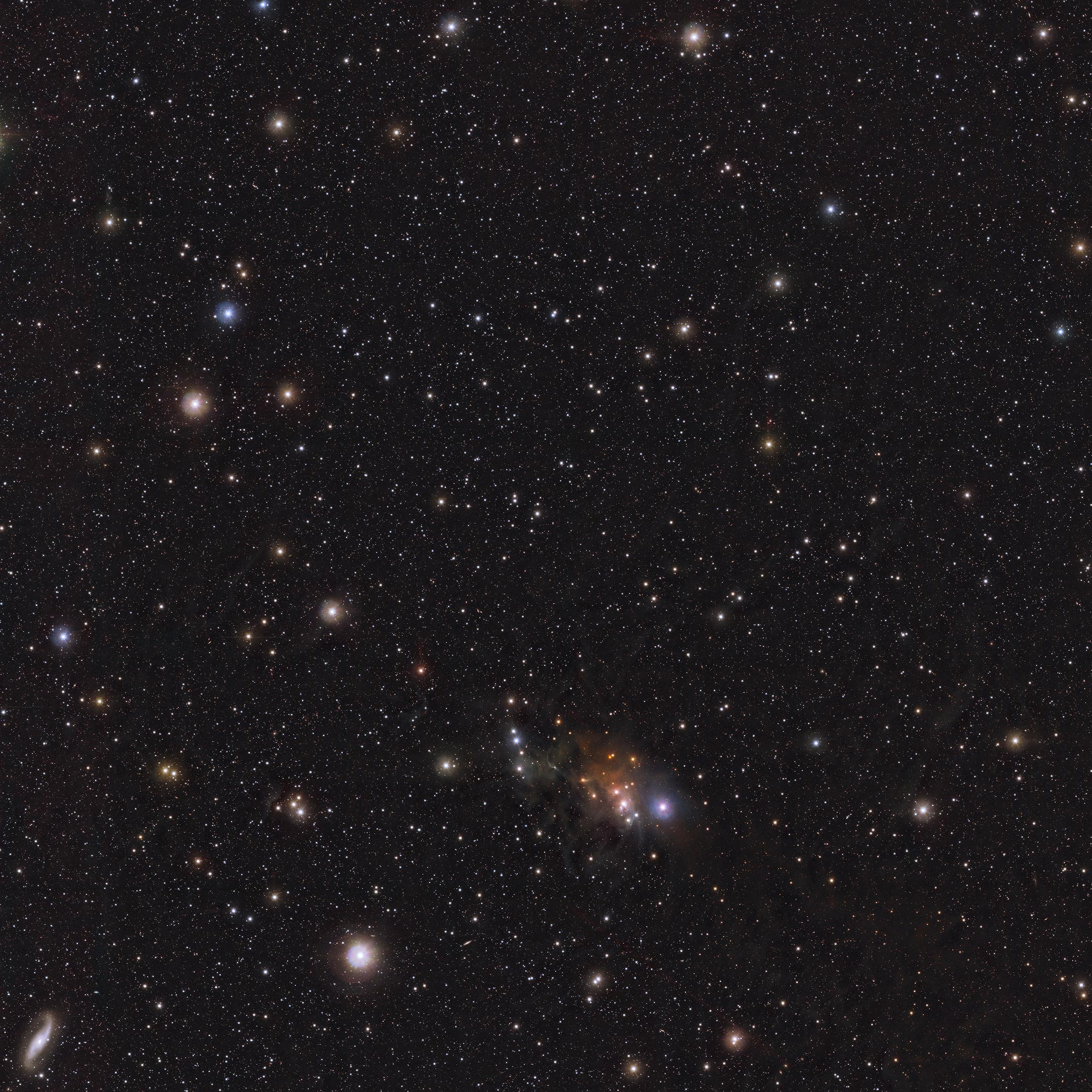
This video zooms in on Cha 1107-7626, located about 620 light-years away in the constellation Chamaeleon. This rogue planet is 5-10 times more massive than Jupiter and doesn’t orbit a star. Credit: ESO/L. Calçada, M. Kornmesser/N. Risinger (skysurvey.org)/Digitized Sky Survey 2/Meingast et al. Music: Azul Cobalto
Blurring the Line Between Stars and Planets
“The origin of rogue planets remains an open question: are they the lowest-mass objects formed like stars, or giant planets ejected from their birth systems?” asks co-author Aleks Scholz, an astronomer at the University of St Andrews, United Kingdom. The findings indicate that at least some rogue planets may share a similar formation path to stars since similar bursts of accretion have been spotted in young stars before. As co-author Belinda Damian, also an astronomer at the University of St Andrews, explains: “This discovery blurs the line between stars and planets and gives us a sneak peek into the earliest formation periods of rogue planets.”
By comparing the light emitted before and during the burst, astronomers gathered clues about the nature of the accretion process. Remarkably, magnetic activity appears to have played a role in driving the dramatic infall of mass, something that has only been observed in stars before. This suggests that even low-mass objects can possess strong magnetic fields capable of powering such accretion events. The team also found that the chemistry of the disc around the planet changed during the accretion episode, with water vapor being detected during it but not before. This phenomenon had been spotted in stars but never in a planet of any kind.
Unlocking the Secrets with Future Telescopes
Free-floating planets are difficult to detect, as they are very faint, but ESO’s upcoming Extremely Large Telescope (ELT), operating under the world’s darkest skies for astronomy, could change that. Its powerful instruments and giant main mirror will enable astronomers to uncover and study more of these lonely planets, helping them to better understand how star-like they are. As co-author and ESO astronomer Amelia Bayo puts it: “The idea that a planetary object can behave like a star is awe-inspiring and invites us to wonder what worlds beyond our own could be like during their nascent stages.”
Reference: “Discovery of an Accretion Burst in a Free-floating Planetary-mass Object” by Victor Almendros-Abad, Aleks Scholz, Belinda Damian, Ray Jayawardhana, Amelia Bayo, Laura Flagg, Koraljka Mužić, Antonella Natta, Paola Pinilla and Leonardo Testi, 2 October 2025, The Astrophysical Journal Letters.
DOI: 10.3847/2041-8213/ae09a8
The team is composed of V. Almendros-Abad (Istituto Nazionale di Astrofisica – Osservatorio Astronomico di Palermo, Italy), Aleks Scholz (School of Physics & Astronomy, University of St Andrews, United Kingdom [St Andrews]), Belinda Damian (St Andrews), Ray Jayawardhana (Department of Physics & Astronomy, Johns Hopkins University, USA [JHU]), Amelia Bayo (European Southern Observatory, Germany), Laura Flagg (JHU), Koraljka Mužić (Instituto de Astrofísica e Ciências do Espaço, Faculdade de Ciências, Universidade de Lisboa, Portugal), Antonella Natta (School of Cosmic Physics, Dublin Institute for Advanced Studies and University College Dublin, Ireland) Paola Pinilla (Mullard Space Science Laboratory, University College London, UK) and Leonardo Testi (Dipartimento di Fisica e Astronomia, Università di Bologna, Italy).
Never miss a breakthrough: Join the SciTechDaily newsletter.
Follow us on Google and Google News.