

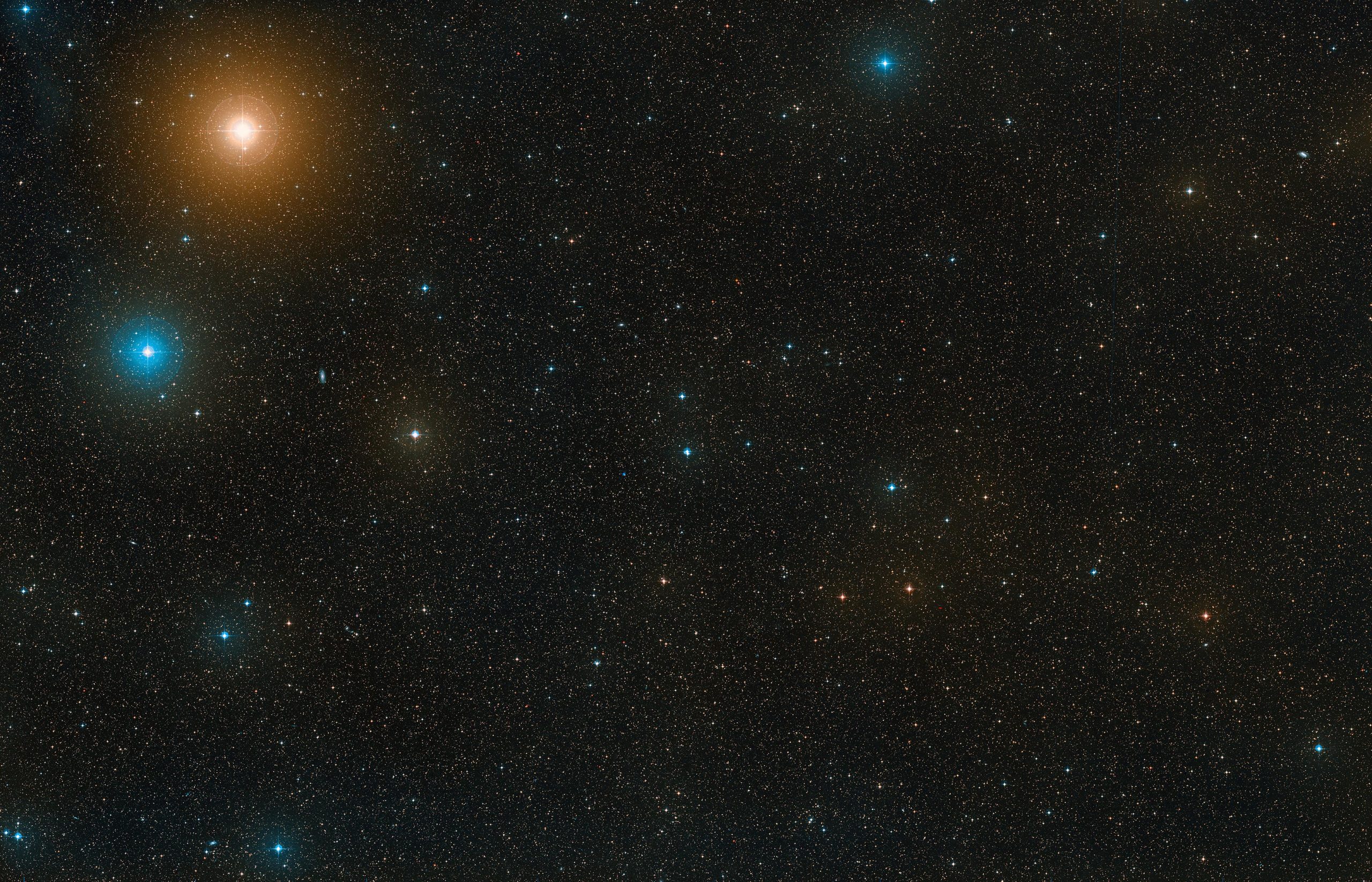
Astronomers may have captured the rare moment of a planet forming around a young star, HD 135344B, 440 light-years away.
Using the powerful ERIS instrument on ESO’s Very Large Telescope, they spotted a potential planet embedded in the disc’s spiral arm—right where theoretical models predicted one might be. This detection stands out because it directly captured the light from the protoplanet, strongly supporting its existence. Meanwhile, another team studying the very young star V960 Mon found a mysterious object that could be either a forming planet or a brown dwarf, potentially offering another window into the cosmic birthing process.
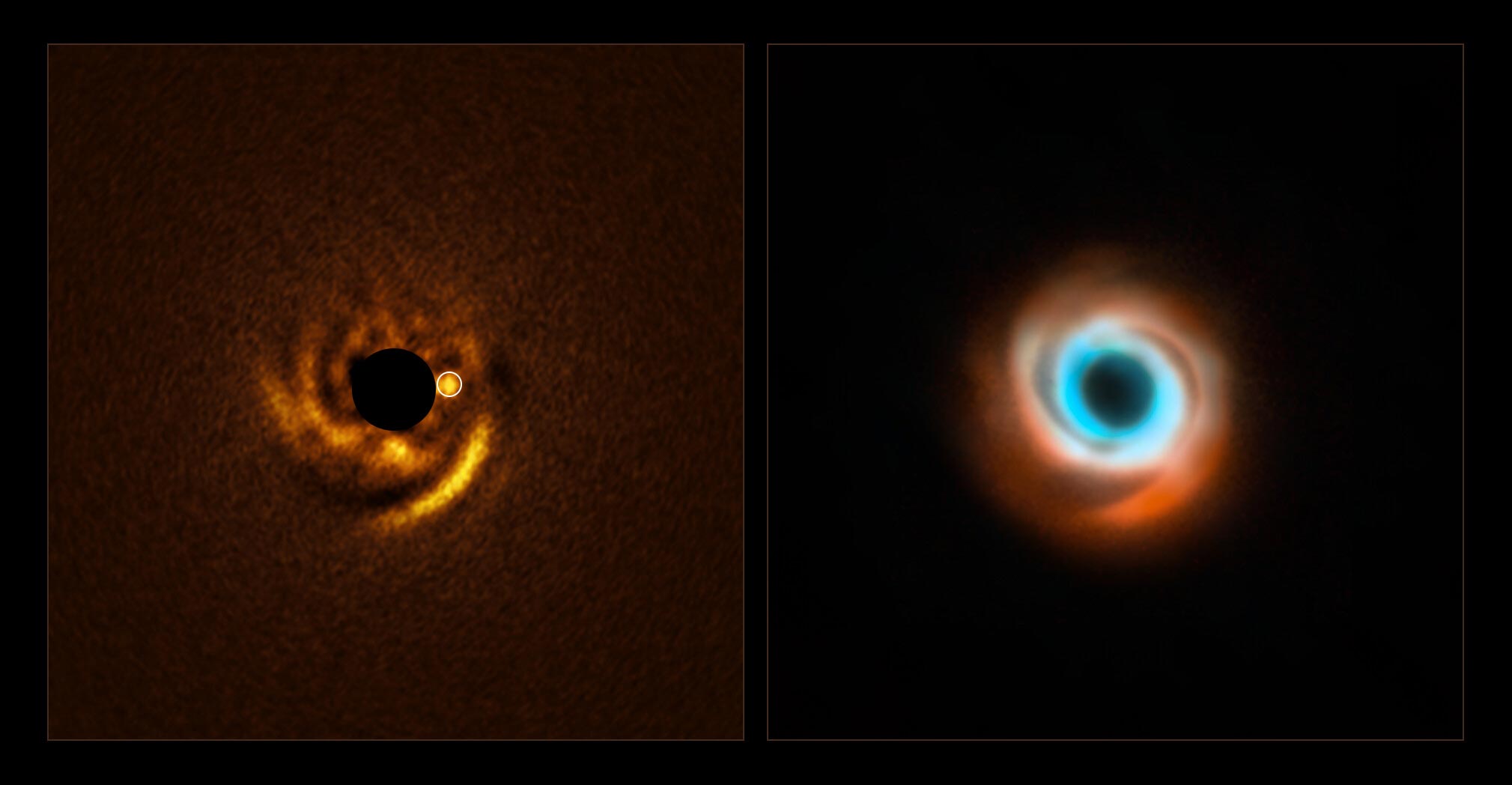
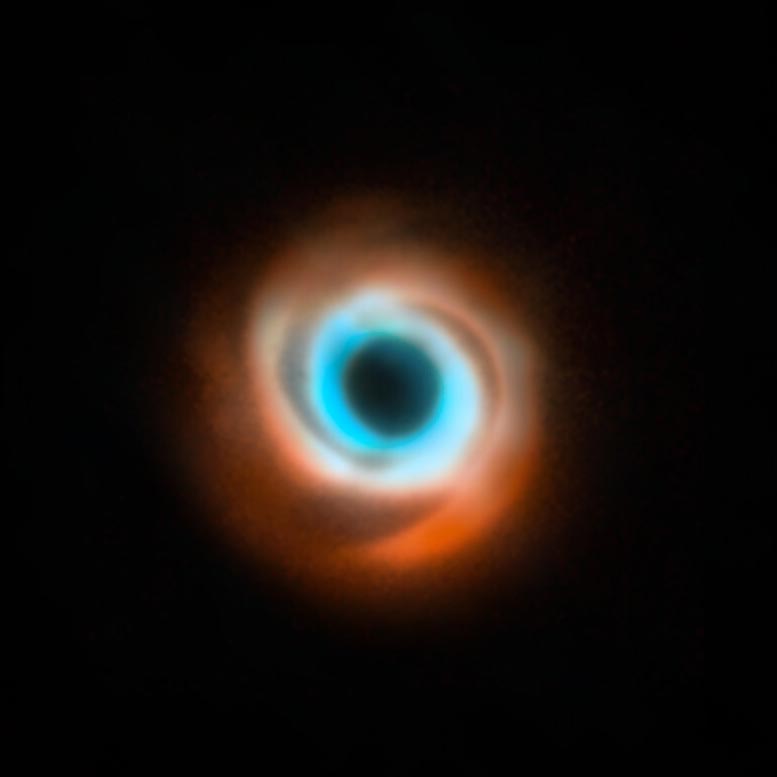
The image to the right is a combination of previous observations taken with the SPHERE instrument also at the VLT (red) and the Atacama Large Millimeter/submillimeter Array (ALMA, orange and blue). These and other previous studies of HD 135344B did not find signatures of a companion, but ERIS may have finally unveiled the culprit responsible for the star’s spiral disc.
Credit: ESO/F. Maio et al./T. Stolker et al./ ALMA (ESO/NAOJ/NRAO)/N. van der Marel et al.
First-Ever Planet in a Spiral Arm
Astronomers believe they have captured a rare view of a planet in the process of forming, shaping the gas and dust that surrounds its young star. Observations made with the European Southern Observatory’s Very Large Telescope (VLT) revealed a planetary disc marked by striking spiral arms. Within those spirals, researchers identified clear evidence of a planet situated deep inside the disc — marking the first time a planet candidate has been seen embedded in such a structure.
“We will never witness the formation of Earth, but here, around a young star 440 light-years away, we may be watching a planet come into existence in real time,” says Francesco Maio, a doctoral researcher at the University of Florence, Italy, and lead author of this study, published on July 21 in Astronomy & Astrophysics.
Massive Planet Sculpting Its Birthplace
The possible newborn planet was spotted in the disc surrounding the star HD 135344B. This disc, known as a protoplanetary disc, is made up of gas and dust that often surrounds young stars. The forming planet is believed to be about twice the size of Jupiter and lies at a distance from its star comparable to Neptune’s orbit around the Sun. As it grows, the planet appears to be influencing the shape and structure of the disc around it.
Although astronomers have previously observed protoplanetary discs with complex patterns — including rings, gaps, and spirals — these features were thought to be caused by unseen young planets collecting material as they orbit. Until now, scientists had not directly observed one of these planets in the act of shaping the disc.
This video zooms into HD 135344B, a young star located around 440 light-years away. The star is surrounded by a disc of dust and gas with prominent spiral features. New observations obtained with ESO’s Very Large Telescope (VLT) may have unveiled a planet that could be sculpting these features.
A Hidden Sculptor Emerges
In the case of HD 135344B’s disc, swirling spiral arms had previously been detected by another team of astronomers using SPHERE (Spectro-Polarimetric High-contrast Exoplanet REsearch), an instrument on ESO’s VLT. However, none of the previous observations of this system found proof of a planet forming within the disc.
Now, with observations from the new VLT’s Enhanced Resolution Imager and Spectrograph (ERIS) instrument, the researchers say they may have found their prime suspect. The team spotted the planet candidate right at the base of one of the disc’s spiral arms, exactly where theory had predicted they might find the planet responsible for carving such a pattern.
“What makes this detection potentially a turning point is that, unlike many previous observations, we are able to directly detect the signal of the protoplanet, which is still highly embedded in the disc,” says Maio, who is based at the Arcetri Astrophysical Observatory, a centre of Italy’s National Institute for Astrophysics (INAF). “This gives us a much higher level of confidence in the planet’s existence, as we’re observing the planet’s own light.”
Birth of a Celestial Companion
A different team of astronomers has also recently used the ERIS instrument to observe another star, V960 Mon, one that is still in the very early stages of its life. In a study published on July 18 in The Astrophysical Journal Letters, the team report that they have found a companion object to this young star. The exact nature of this object remains a mystery.
The new study, led by Anuroop Dasgupta, a doctoral researcher at ESO and at the Diego Portales University in Chile, follows up on observations of V960 Mon made a couple of years ago. Those observations, made with both SPHERE and the Atacama Large Millimeter/submillimeter Array (ALMA), revealed that the material orbiting V960 Mon is shaped into a series of intricate spiral arms. They also showed that the material is fragmenting, in a process known as ‘gravitational instability’, when large clumps of the material around a star contract and collapse, each with the potential to form a planet or a larger object.
Fragmenting Discs and Giant Objects
“That work revealed unstable material but left open the question of what happens next. With ERIS, we set out to find any compact, luminous fragments signalling the presence of a companion in the disc — and we did,” says Dasgupta. The team found a potential companion object very near to one of the spiral arms observed with SPHERE and ALMA. The team say that this object could either be a planet in formation, or a ‘brown dwarf’ — an object bigger than a planet that didn’t gain enough mass to shine as a star.
Brown Dwarf or Baby Planet?
If confirmed, this companion object may be the first clear detection of a planet or brown dwarf forming by gravitational instability.
This research, highlighted in the first part of this article, was presented in the paper “Unveiling a protoplanet candidate embedded in the HD 135344B disk with VLT/ERIS,” published in Astronomy & Astrophysics. The second part of the release highlights the study “VLT/ERIS observations of the V960 Mon system: a dust-embedded substellar object formed by gravitational instability?” published in The Astrophysical Journal Letters.
References:
“Unveiling a protoplanet candidate embedded in the HD 135344B disk with VLT/ERIS” by F. Maio, D. Fedele, V. Roccatagliata, S. Facchini, G. Lodato, S. Desidera, A. Garufi, D. Mesa, A. Ruzza, C. Toci, L. Testi, A. Zurlo and G. Rosotti, 21 July 2025, Astronomy & Astrophysics.
DOI: 10.1051/0004-6361/202554472
“VLT/ERIS Observations of the V960 Mon System: A Dust-embedded Substellar Object Formed by Gravitational Instability?” by Anuroop Dasgupta, Alice Zurlo, Philipp Weber, Francesco Maio, Lucas A. Cieza, Davide Fedele, Antonio Garufi, James Miley, Prashant Pathak, Sebastián Pérez and Veronica Roccatagliata, 18 July 2025, The Astrophysical Journal Letters.
DOI: 10.3847/2041-8213/ade996
The team who conducted the first study (on HD 135344B) is composed of F. Maio (University of Firenze, Italy, and INAF-Osservatorio Astrofisico Arcetri, Firenze, Italy [OAA]), D. Fedele (OAA), V. Roccatagliata (University of Bologna, Italy [UBologna] and OAA), S. Facchini (University of Milan, Italy [UNIMI]), G. Lodato (UNIMI), S. Desidera (INAF-Osservatorio Astronomico di Padova, Italy [OAP]), A. Garufi (INAF – Istituto di Radioastronomia, Bologna, Italy [INAP-Bologna], and Max-Planck-Institut für Astronomie, Heidelberg, Germany [MPA]), D. Mesa (OAP), A. Ruzza (UNIMI), C. Toci (European Southern Observatory [ESO], Garching bei Munchen, Germany, and OAA), L. Testi (OAA, and UBologna), A. Zurlo (Diego Portales University [UDP], Santiago, Chile, and Millennium Nucleus on Young Exoplanets and their Moons [YEMS], Santiago, Chile), and G. Rosotti (UNIMI).
The team behind the second study (on V960 Mon) is primarily composed of members of the Millennium Nucleus on Young Exoplanets and their Moons (YEMS), a collaborative research initiative based in Chile. Core YEMS contributors include A. Dasgupta (ESO, Santiago, Chile, UDP, and YEMS), A. Zurlo (UDP and YEMS), P. Weber (University of Santiago [Usach], Chile, and YEMS, and Center for Interdisciplinary Research in Astrophysics and Space Exploration [CIRAS], Santiago, Chile), F. Maio (OAA, and University of Firenze, Italy), Lucas A. Cieza (UDP and YEMS), D. Fedele (OAA), A. Garufi (INAF Bologna and MPA), J. Miley (Usach, YEMS, and CIRAS), P. Pathak (Indian Institute of Technology, Kanpur, India), S. Pérez (Usach and YEMS, and CIRAS), and V. Roccatagliata (UBologna and OAA).
Never miss a breakthrough: Join the SciTechDaily newsletter.
Follow us on Google and Google News.