
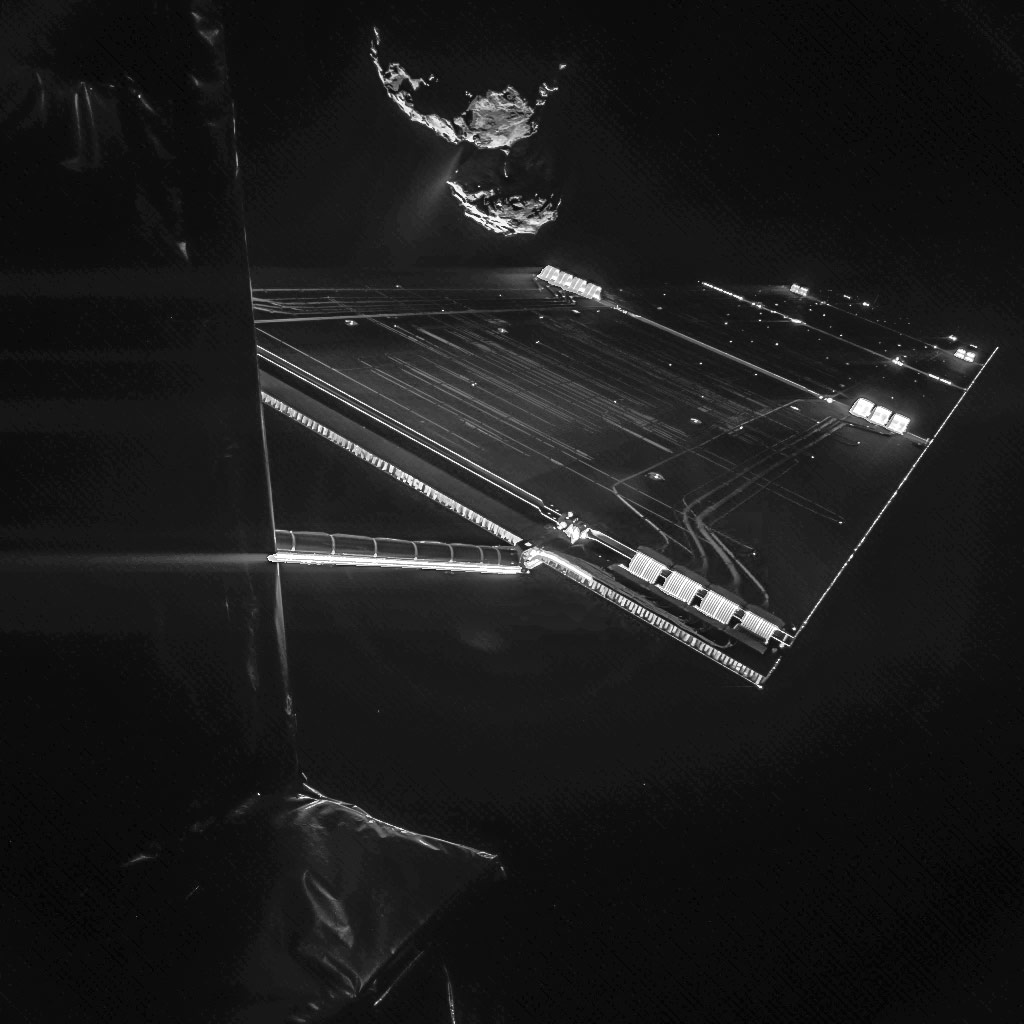
This new image from ESA’s Philae lander shows one of the 52-foot-long (16-meter-long) solar arrays from the Rosetta spacecraft with comet 67P/Churyumov–Gerasimenko hovering in the background.
A camera aboard the European Space Agency’s Philae lander snapped this “selfie” of one of the Rosetta spacecraft’s 52-foot-long (16-meter) solar arrays, with comet 67P/Churyumov–Gerasimenko hovering in the background some 10 miles (16 kilometers) away. The image, taken by the Comet Infrared and Visible Analyzer (CIVA), was taken on October 7. Philae, which is connected to the Rosetta orbiter at this time, will make its descent to the surface of the comet on November 12.
In the image, the active ‘neck’ region of the comet is now clearly visible, with streams of dust and gas extending away from the comet. The primary landing site, currently known as “Site J,” can also be seen on the smaller lobe of the comet.
This is the last image from Philae before the lander separates from Rosetta on November 12. The next image will be taken by CIVA shortly after separation, when the lander will look back at the orbiter to bid it a final farewell.
Two individual CIVA images, one with a short exposure time, one with a longer one, were combined to capture the whole dynamic range of the scene, from the bright parts of the solar arrays to the dark comet and the dark insulation covering the Rosetta spacecraft.
CIVA, one of 10 instruments on board Philae, comprises seven micro-cameras arranged around the top of the lander, and a visible/infrared microscope imager/spectrometer.
Launched in March 2004, Rosetta was reactivated in January 2014 after a record 957 days in hibernation. Composed of an orbiter and lander, Rosetta’s objectives since arriving at comet 67P/Churyumov-Gerasimenko earlier this month have been to study the celestial object up close in unprecedented detail, prepare for landing a probe on the comet’s nucleus in November, and following the landing, track the comet’s changes as it sweeps past the sun.
Comets are time capsules containing primitive material left over from the epoch when the sun and its planets formed. Rosetta’s lander will obtain the first images taken from a comet’s surface and will provide a comprehensive analysis of the comet’s possible primordial composition by drilling into the surface. Rosetta also will be the first spacecraft to witness at close proximity how a comet changes as it is subjected to the increasing intensity of the sun’s radiation. Observations will help scientists learn more about the origin and evolution of our solar system and the role comets may have played in seeding Earth with water, and perhaps even life.
Rosetta is a European Space Agency mission with contributions from its member states and NASA. Rosetta’s Philae lander is provided by a consortium led by the German Aerospace Center, Cologne; Max Planck Institute for Solar System Research, Gottingen; National Center of Space Studies of France (CNES), Paris; and the Italian Space Agency, Rome. NASA’s Jet Propulsion Laboratory in Pasadena, California, a division of the California Institute of Technology, manages the U.S. participation in the Rosetta mission for NASA’s Science Mission Directorate in Washington.
Never miss a breakthrough: Join the SciTechDaily newsletter.
Follow us on Google and Google News.
1 Comment
Comet 67P produces incredible amouts of gas and dust even amonia is found.
What is happening over there? a Comet violatiing the second law of thermodynamics?