
Close Menu
    Facebook X (Twitter) Instagram
    SciTechDaily
    • Biology
    • Chemistry
    • Earth
    • Health
    • Physics
    • Science
    • Space
    • Technology
    Facebook X (Twitter) Pinterest YouTube RSS
    SciTechDaily
    Home»Space»Russian Cosmonauts Arrive at International Space Station
    Space

    Russian Cosmonauts Arrive at International Space Station

    By NASAMarch 19, 2022No Comments2 Mins Read
    Facebook Twitter Pinterest Telegram LinkedIn WhatsApp Email Reddit
    Share
    Facebook Twitter LinkedIn Pinterest Telegram Email Reddit
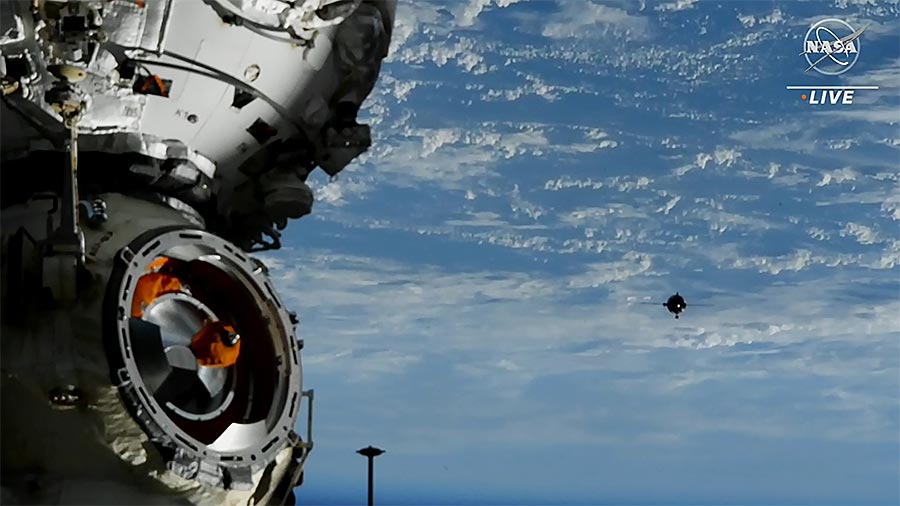
    Soyuz MS-21 Crew Ship
    The Soyuz MS-21 crew ship with three cosmonauts aboard approaches the Prichal module for docking in this view from the space station. Credit: NASA TV

    Roscosmos cosmonaut Oleg Artemyev, Denis Matveev, and Sergey Korsakov on the Soyuz MS-21 spacecraft launched at 11:55 a.m. EDT on March 18, 2022, from the Baikonur Cosmodrome in Kazakhstan (8:55 p.m. Baikonur time). They docked to the International Space Station at 3:12 p.m. EDT, while the station was traveling 260 miles over eastern Kazakhstan.
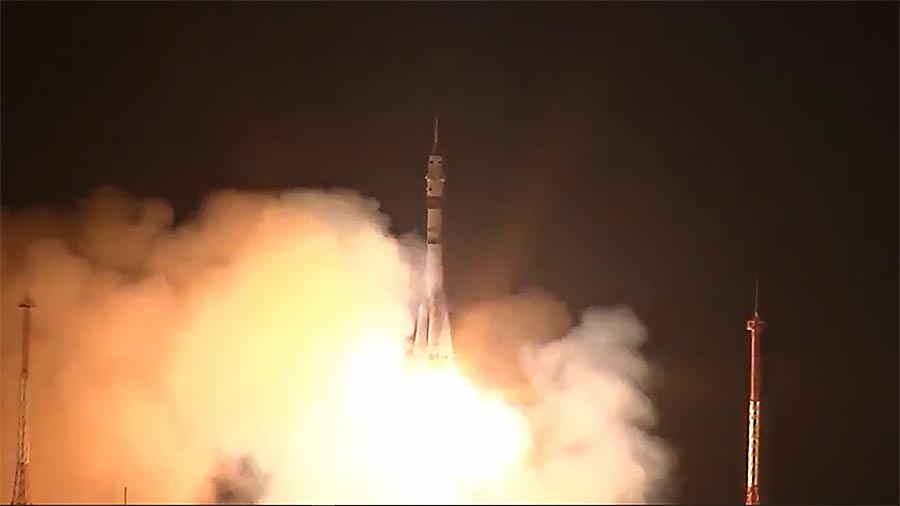
    Soyuz MS-21 Rocket Lifts Off
    The Soyuz MS-21 rocket lifts off on time from Kazakhstan carrying three cosmonauts to the space station. Credit: NASA

    About two hours after docking, hatches between the Soyuz and the station opened and the trio joined Expedition 66 Commander Anton Shkaplerov and cosmonaut Pyotr Dubrov of Roscosmos, as well as NASA astronauts Mark Vande Hei, Raja Chari, Tom Marshburn, and Kayla Barron, and ESA (European Space Agency) astronaut Matthias Maurer.


    Three Russian cosmonauts arrived at the International Space Station on March 18 a little more than three hours after launching from the Baikonur Cosmodrome in Kazakhstan on their Soyuz MS-21 spacecraft. Oleg Artemyev, Denis Matveev, and Sergey Korsakov docked to the Prichal module on the ISS for the start of a planned six-month mission as part of both the Expedition 66 and 67 crews. Credit: NASA

    On March 30, a Soyuz spacecraft will return as scheduled carrying NASA astronaut Mark Vande Hei and cosmonauts Pyotr Dubrov and Anton Shkaplerov back to Earth. Upon their return, Vande Hei will hold the American record for the longest single human spaceflight mission of 355 days.


    Expedition 66-67 Soyuz MS 21 Hatch Opening On International Space Station. Credit: NASA

    Never miss a breakthrough: Join the SciTechDaily newsletter.
    Follow us on Google and Google News.

    Astronaut International Space Station NASA
    Share. Facebook Twitter Pinterest LinkedIn Email Reddit

    Related Articles

    NASA’s Crew-9 Returns After 286-Day Mission With a Spectacular Splashdown in the Gulf of America

    NASA’s SpaceX Crew-9 Splashes Down Off Coast of Florida

    SpaceX Dragon Undocks With NASA Crew-9 Members for Return to Earth

    Liftoff! NASA’s SpaceX Crew-10 Blasts Off From Kennedy Space Center [Video]

    Rocket Ready: NASA’s SpaceX Crew-10 Set for Liftoff

    NASA’s SpaceX Crew-10 Was Moments From Liftoff – Then a Last-Minute Malfunction Shut It Down

    NASA’s SpaceX Crew-10: Four Astronauts, a 17,500 MPH Rocket, and 200+ Experiments

    No Treadmill, No Problem – NASA’s Space Workout Experiment Could Change Fitness Forever

    NASA and SpaceX’s Unexpected Spacecraft Swap Sends Crew-10 to Space Sooner

    Leave A Reply Cancel Reply

    • Facebook
    • Twitter
    • Pinterest
    • YouTube

    Don't Miss a Discovery

    Subscribe for the Latest in Science & Tech!

    Trending News

    Textbooks May Need Rewriting After Researchers Debunk a Core Chemistry Concept

    Alzheimer’s May Start With a Surprising Symptom – Not Memory Loss

    The “Hobbits” Mysteriously Disappeared 50,000 Years Ago – Scientists Have Revealed What Happened to Their Home

    One Sugar Tells Your Brain You’re Full. Another Barely Does

    One of Arizona’s Largest Reservoirs Is Less Than 1% Full After Snowpack Collapse

    This 400-Year-Old Shark May Hold the Secret to Preserving Human Vision

    Your Daily Orange Juice Could Have an Unexpected Health Benefit

    Black Hole Shredded a Massive Star in the Most Powerful Stellar Explosion Ever Seen

    Follow SciTechDaily
    • Facebook
    • Twitter
    • YouTube
    • Pinterest
    • Newsletter
    • RSS
    SciTech News
    • Biology News
    • Chemistry News
    • Earth News
    • Health News
    • Physics News
    • Science News
    • Space News
    • Technology News
    Recent Posts
    • 567-Million-Year-Old Fossils Suggest Animals Evolved Earlier Than We Thought
    • Scientists Discover a 5-Million-Year-Old Whale Graveyard Deep Beneath the Indian Ocean
    • Ancient DNA Reveals the Hidden Origins of China’s Mysterious Shimao Civilization
    • Scientists Finally Solve a 50-Year Mystery Hidden in Solid Nitrogen
    • Saturn’s Largest Moon May Hold the Resources for a Space Colony
    Copyright © 1998 - 2026 SciTechDaily. All Rights Reserved.
    • Science News
    • About
    • Contact
    • Editorial Board
    • Privacy Policy
    • Terms of Use

    Type above and press Enter to search. Press Esc to cancel.