
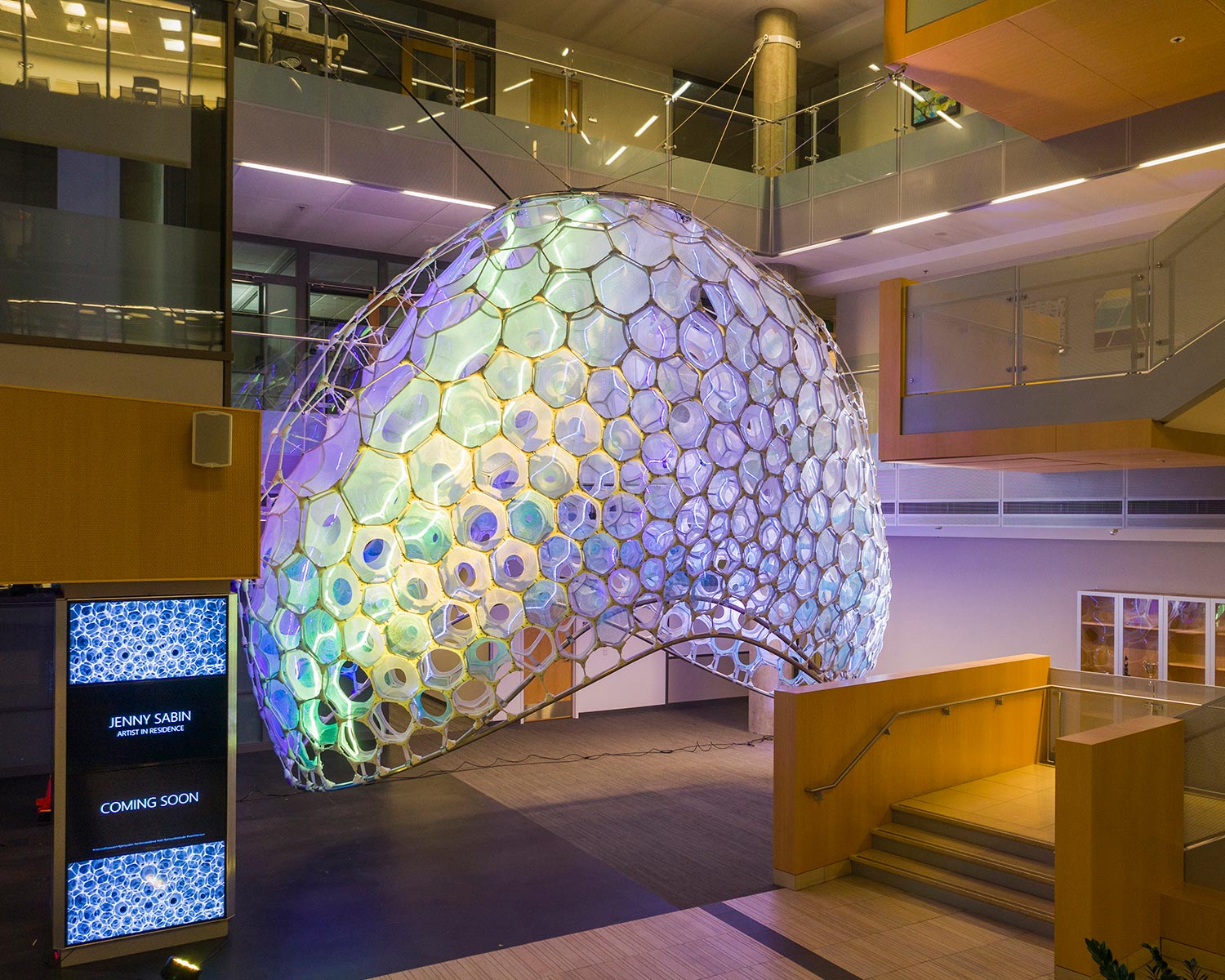
For more than a decade, architect and educator Jenny Sabin has created a series of large sculptural installations at the intersection of architecture, art, and science. Integrating new technologies, inventive material, and a combination of biological phenomena and mathematics, her latest work adds artificial intelligence, or AI.
“Ada,” a responsive, photoluminescent fiber pavilion designed to “smile back at you,” has just opened, suspended in a light-filled atrium at Microsoft Research in Redmond, Washington.
Sabin is the Arthur L. and Isabel B. Wiesenberger Professor in Architecture, director of graduate studies, and associate dean for design initiatives in the College of Architecture, Art, and Planning. Among her recent works was “Lumen,” a temporary outdoor installation in 2017 that functioned as a work of art and provided shade, seating, and cooling for visitors to the Museum of Modern Art PS1 in Long Island City, Queens.
For “Ada,” Sabin and her team at Jenny Sabin Studio collaborated with a group of engineers, data scientists, and designers at Microsoft Research to create a responsive, immersive space that uses AI to process facial patterns and the emotions they reveal as data – known as “sentiment data.”
The project began to take shape in 2018, with Sabin’s appointment as Microsoft Research’s most recent artist-in-residence, a program that looks to artists and designers to bring inspiration, material, and experimental form to Microsoft’s ongoing areas of research.
“Ada” integrates Sabin’s use of new technologies in architecture with Microsoft’s data science and programming expertise to create a responsive space that reflects the collective human experience there.
“From the beginning, our hope has been for both parties [Microsoft Research and Jenny Sabin Studio] to benefit from a collaboration that demonstrates some of the most exciting aspects of AI by bringing an interactive spatial component to Microsoft’s work,” Sabin said. “Our intent was to bring other voices into a project involving emerging technology to demonstrate AI in a way that counters the fearful, dystopic way in which it is often depicted.”
Named after polymath and early computer scientist Ada Lovelace, “Ada” is a pavilion of knitted fiber that is designed and conceived as a flexible space driven by sentiment data captured in real-time. Sabin describes “Ada” as an architecture that is “happy to see you.”
To make “Ada” come to life, Sabin and her team worked with Microsoft researchers to create algorithms and scripts to determine how the data behind the project drives the space and its advanced lighting scheme, the structure’s “knitted light.”
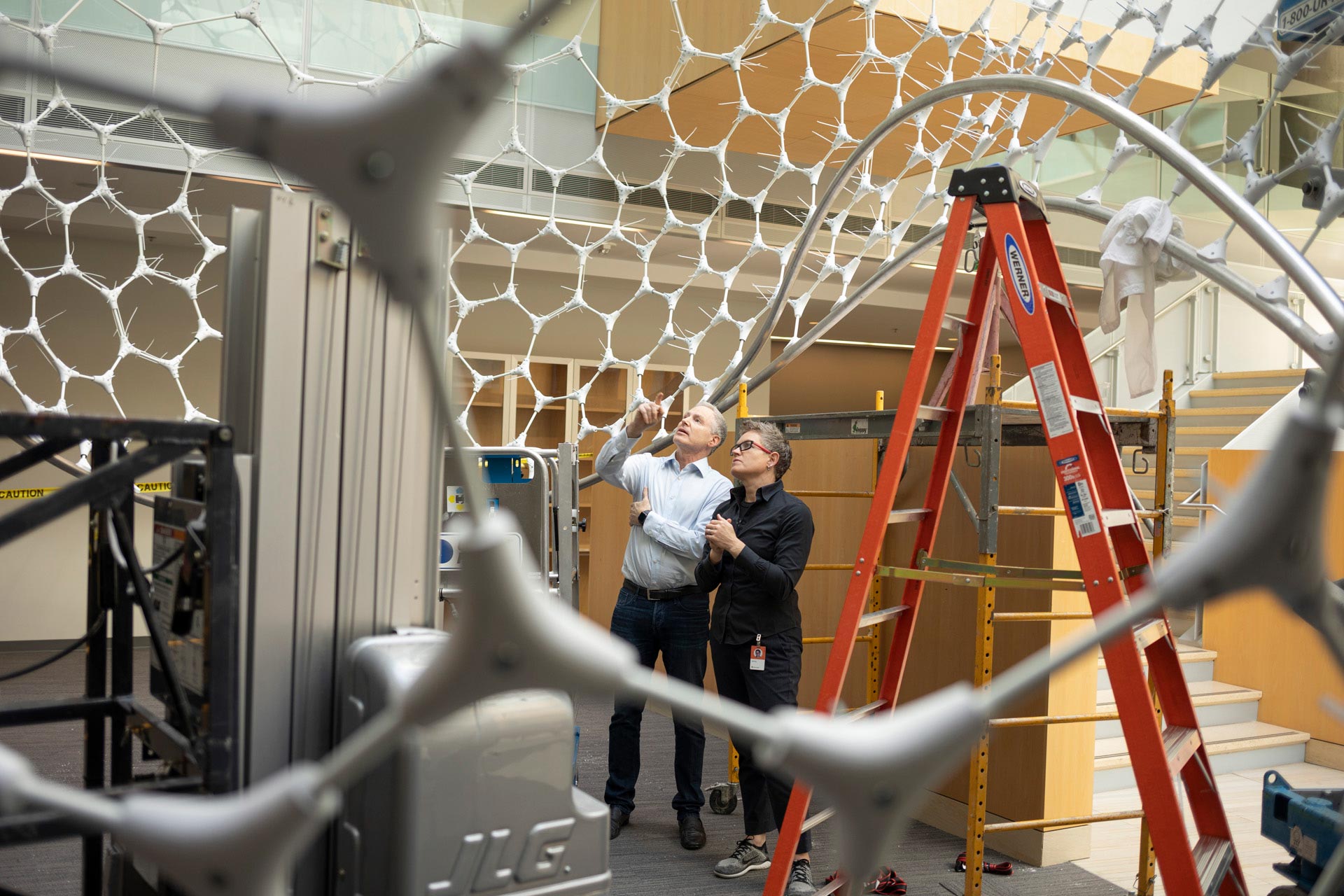
Eric Horvitz, left, director of Microsoft’s research labs, and Jenny Sabin, right, principal designer at Jenny Sabin Studio, an Ithaca, New York-based architectural design firm, and Microsoft’s artist in residence, discuss the installation of her project Ada. Credit: Photo by John Brecher for Microsoft.
“‘Ada’ is not just about producing and designing a beautiful, interactive form,” Sabin said. “I think of it more as a live experiment that can operate across multiple scales and engage diverse publics, including the researchers who work in the building – the team I’ve been working with directly, as well as others who will be invited to see and interact with it.”
Sabin’s background in ceramics and her commitment to the potential of integration of art, design, and science is a through-line for much of what her lab at Cornell and her studio create, encompassing what she and the larger team have accomplished with “Ada.” For example, “Ada” is made with individual parts and pieces made via technologies such as 3D printing, robots, and knitting machines that make it possible to both design and make in real-time.
“There is a component of craft that new technologies revive from a time when architecture was designed as it was produced,” Sabin said. “It’s a pretty big shift in the way we communicate information about form today. For example, architects typically author the drawings and notations we use to communicate information about architecture. They are then interpreted by a builder, and the building then becomes a copy of the drawings.
“Now,” she said, “we author algorithms and scripts that run these machines so that geometry, pattern, materiality, form, context, and program are all inextricably linked, and the relationship between digitally knit threads, how they are organized, designed and materialized is a space we occupy in real-time.”
The Jenny Sabin Studio team includes Dillon Pranger, M.Arch. ’15, project manager; John Hilla, designer; Jeremy Bilotti ’18, designer; and William Qian ’19, designer. The Microsoft Research team is Eric Horvitz, director of Microsoft Research; Asta Roseway and Mira Lane, co-founders of the artist-in-residence program; Daniel McDuff, researcher; Jonathan Lester, engineer; and Wende Copfer, creative director.
Never miss a breakthrough: Join the SciTechDaily newsletter.
Follow us on Google and Google News.