
Close Menu
    Facebook X (Twitter) Instagram
    SciTechDaily
    • Biology
    • Chemistry
    • Earth
    • Health
    • Physics
    • Science
    • Space
    • Technology
    Facebook X (Twitter) Pinterest YouTube RSS
    SciTechDaily
    Home»Space»Saturn’s Spring Witnessed Up Close by an Emissary From Earth
    Space

    Saturn’s Spring Witnessed Up Close by an Emissary From Earth

    By NASAMarch 23, 2021No Comments3 Mins Read
    Facebook Twitter Pinterest Telegram LinkedIn WhatsApp Email Reddit
    Share
    Facebook Twitter LinkedIn Pinterest Telegram Email Reddit
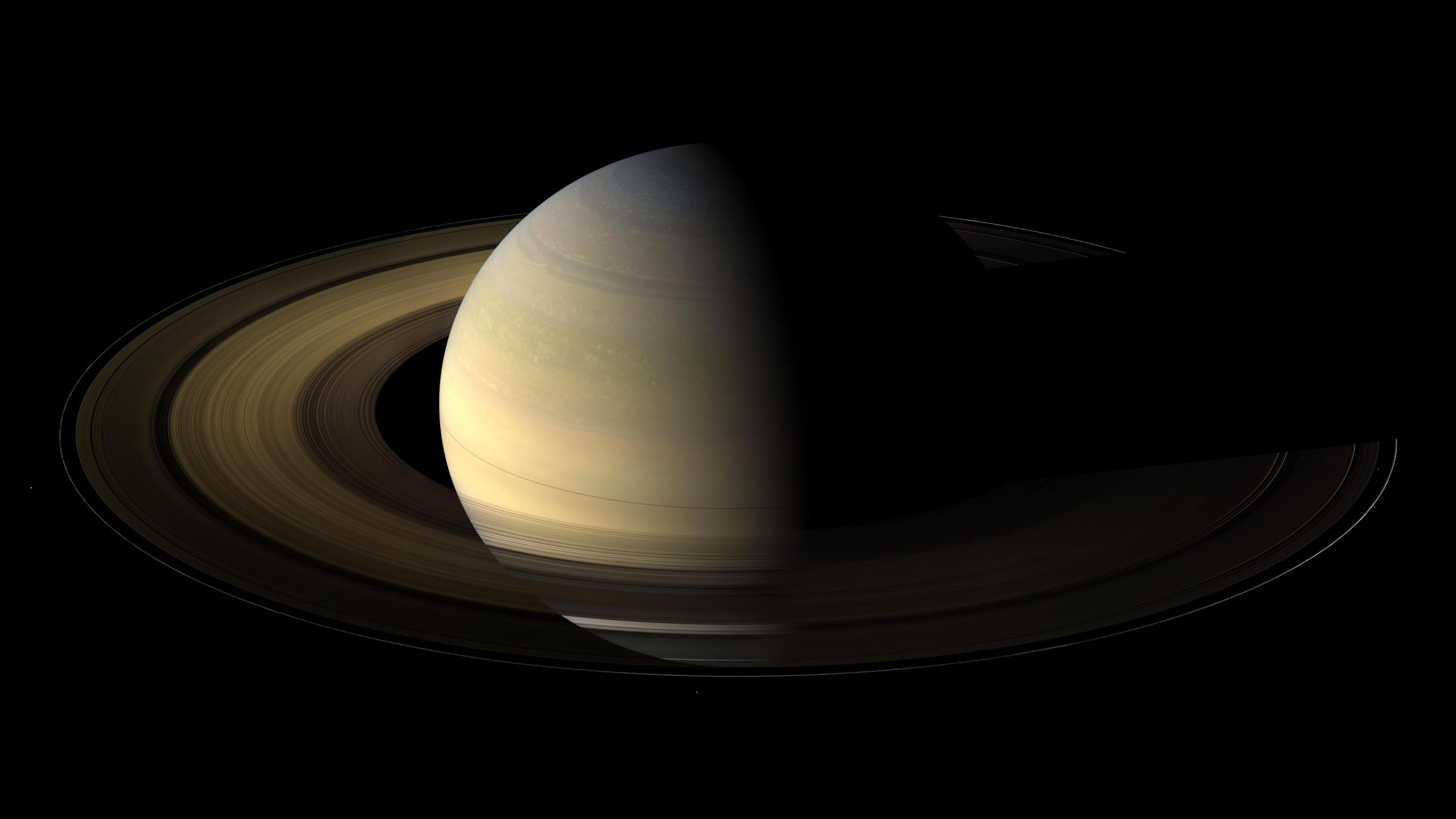
    Cassini Mosaic of Saturn 2009
    Mosaic of Saturn, its rings, and a few of its moons a day and a half after exact Saturn equinox, captured by Cassini’s wide-angle camera in 2009. Credit: NASA/JPL/Space Science Institute

    Cassini’s 2009 equinox image revealed Saturn’s rings casting a thin shadow, a cosmic moment captured like never before.

    Spring doesn’t just happen on Earth. Spring also happens on some of our neighboring planets in the solar system.

    Of the countless equinoxes Saturn has seen since the birth of the solar system, this one, captured here in a mosaic of light and dark, is the first witnessed up close by an emissary from Earth … none other than our faithful robotic explorer, Cassini in this image from 2009.

    Seen from our planet, the view of Saturn’s rings during equinox is extremely foreshortened and limited. But in orbit around Saturn, Cassini had no such problems. From 20 degrees above the ring plane, Cassini’s wide-angle camera shot 75 exposures in succession for this mosaic showing Saturn, its rings, and a few of its moons a day and a half after exact Saturn equinox, when the sun’s disk was exactly overhead at the planet’s equator.

    At equinox, the shadows of the planet’s expansive rings are compressed into a single, narrow band cast onto the planet as seen in this mosaic. At this time so close to equinox, illumination of the rings by sunlight reflected off the planet vastly dominates any meager sunlight falling on the rings. Hence, the half of the rings on the left illuminated by planetshine is, before processing, much brighter than the half of the rings on the right. On the right, it is only the vertically extended parts of the rings that catch any substantial sunlight.

    With no enhancement, the rings would be essentially invisible in this mosaic. To improve their visibility, the dark (right) half of the rings has been brightened relative to the brighter (left) half by a factor of three, and then the whole ring system has been brightened by a factor of 20 relative to the planet. So the dark half of the rings is 60 times brighter, and the bright half 20 times brighter, than they would have appeared if the entire system, planet included, could have been captured in a single image.

    This view looks toward the northern side of the rings from about 20 degrees above the ring plane.

    The images were taken on August 12, 2009, beginning about 1.25 days after exact equinox, using the red, green and blue spectral filters of the wide angle camera and were combined to create this natural color view. The images were obtained at a distance of approximately 847,000 kilometers (526,000 miles) from Saturn and at a Sun-Saturn-spacecraft, or phase, angle of 74 degrees.

    Never miss a breakthrough: Join the SciTechDaily newsletter.
    Follow us on Google and Google News.

    Astronomy NASA Planets Saturn
    Share. Facebook Twitter Pinterest LinkedIn Email Reddit

    Related Articles

    A Cosmic Accident Just Exposed the Hidden Chemistry of Giant Planets

    A Tale of Four Worlds: Hubble’s Ten-Year Hunt for Secrets in the Outer Solar System

    Ring Side Seats: Three Ways To Witness Saturn’s 2023 Opposition

    Saturn’s Rings Shine in Webb’s First Stunning Observations of Ringed Planet

    Saturn’s Rings Are Acting Strange – Hubble Captures Mysterious “Spokes”

    Stunning Hubble Images Capture Changing Seasons in Saturn’s Vast and Turbulent Atmosphere

    Cyclones at Jupiter’s North Pole Appear As Swirls of Striking Colors

    First Possible “Survivor” Planet Discovered by NASA Next to a Stellar Cinder

    Saturn’s Great Atmospheric Mystery Explained by New Data From NASA’s Cassini

    Leave A Reply Cancel Reply

    • Facebook
    • Twitter
    • Pinterest
    • YouTube

    Don't Miss a Discovery

    Subscribe for the Latest in Science & Tech!

    Trending News

    Scientists Uncover Potential Brain Risks of Popular Fish Oil Supplements

    Scientists Discover a Surprising Way To Make Bread Healthier and More Nutritious

    After 60 Years, Scientists Uncover Unexpected Brain Effects of Popular Diabetes Drug Metformin

    New Research Uncovers Hidden Side Effects of Popular Weight-Loss Drugs

    Scientists Rethink Extreme Warming After Surprising Ocean Discovery

    Landmark Study Links Never Marrying to Significantly Higher Cancer Risk

    Researchers Discover Unknown Beetle Species Just Steps From Their Lab

    Largest-Ever Study Finds Medicinal Cannabis Ineffective for Anxiety, Depression, PTSD

    Follow SciTechDaily
    • Facebook
    • Twitter
    • YouTube
    • Pinterest
    • Newsletter
    • RSS
    SciTech News
    • Biology News
    • Chemistry News
    • Earth News
    • Health News
    • Physics News
    • Science News
    • Space News
    • Technology News
    Recent Posts
    • Early Warning Signals of Esophageal Cancer May Be Hiding in Plain Sight
    • Researchers Have Discovered a THC-Free Cannabis Compound That May Replace Opioids
    • Common Blood Pressure Drug Shows Surprising Power Against Deadly Antibiotic-Resistant Superbug
    • Students Build Dark Matter Detector and Set New Experimental Limits
    • Scientists Discover Caffeine Can Repair Key Memory Circuits After Sleep Loss
    Copyright © 1998 - 2026 SciTechDaily. All Rights Reserved.
    • Science News
    • About
    • Contact
    • Editorial Board
    • Privacy Policy
    • Terms of Use

    Type above and press Enter to search. Press Esc to cancel.