
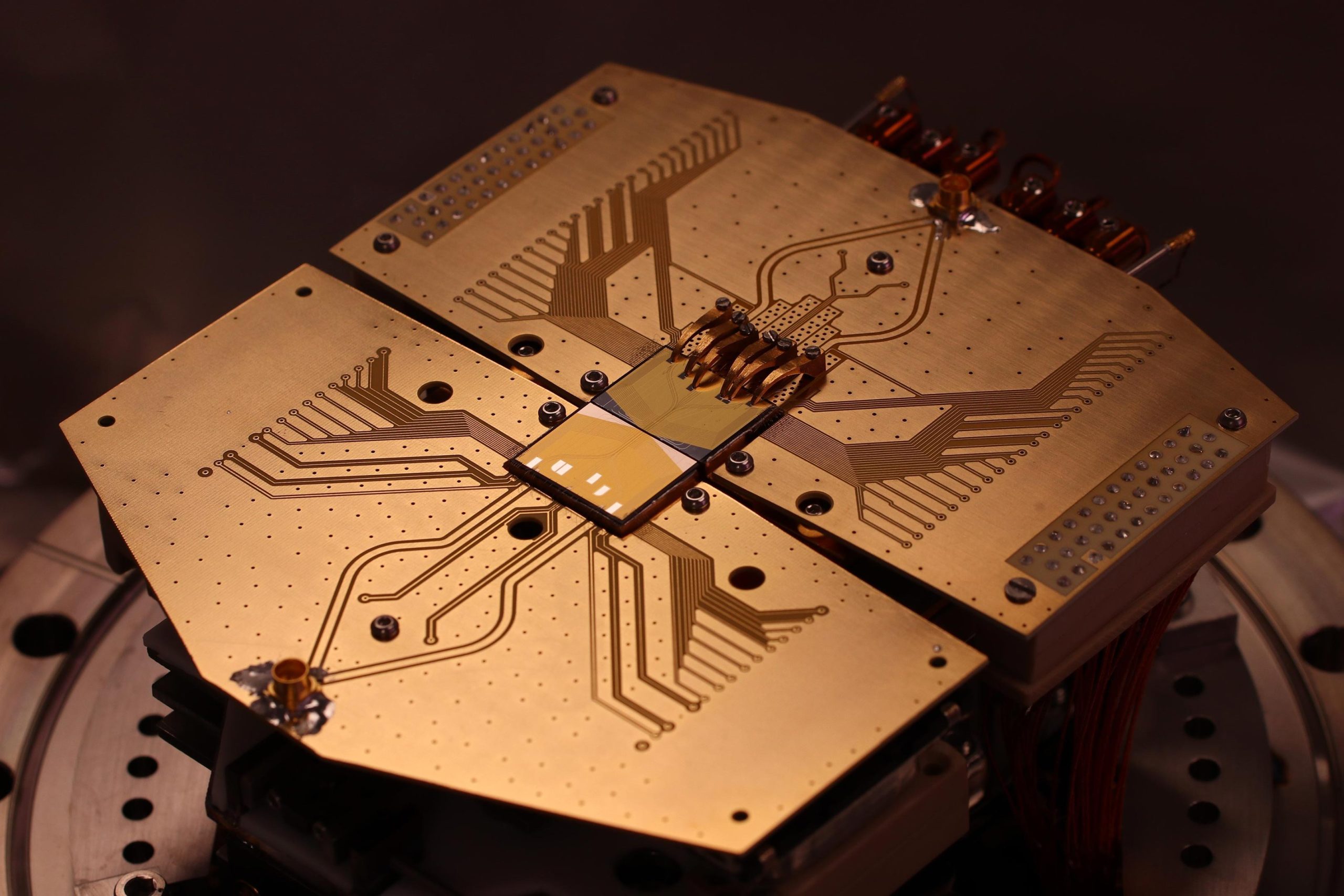
Universal of Sussex and Universal Quantum scientists have, for the first time, connected quantum microchips together, like a jigsaw puzzle, to make powerful quantum computers and with record-breaking connection speed and accuracy.
Researchers from the University of Sussex and Universal Quantum have demonstrated for the first time that quantum bits (qubits) can directly transfer between quantum computer microchips and demonstrated this with record-breaking speed and accuracy. This breakthrough resolves a major challenge in building quantum computers large and powerful enough to tackle complex problems that are of critical importance to society.
Today, quantum computers operate on the 100-qubit scale. Experts anticipate millions of qubits are required to solve important problems that are out of reach of today’s most powerful supercomputers. There is a global quantum race to develop quantum computers that can help in many important societal challenges from drug discovery to making fertilizer production more energy efficient and solving important problems in nearly every industry, ranging from aeronautics to the financial sector.
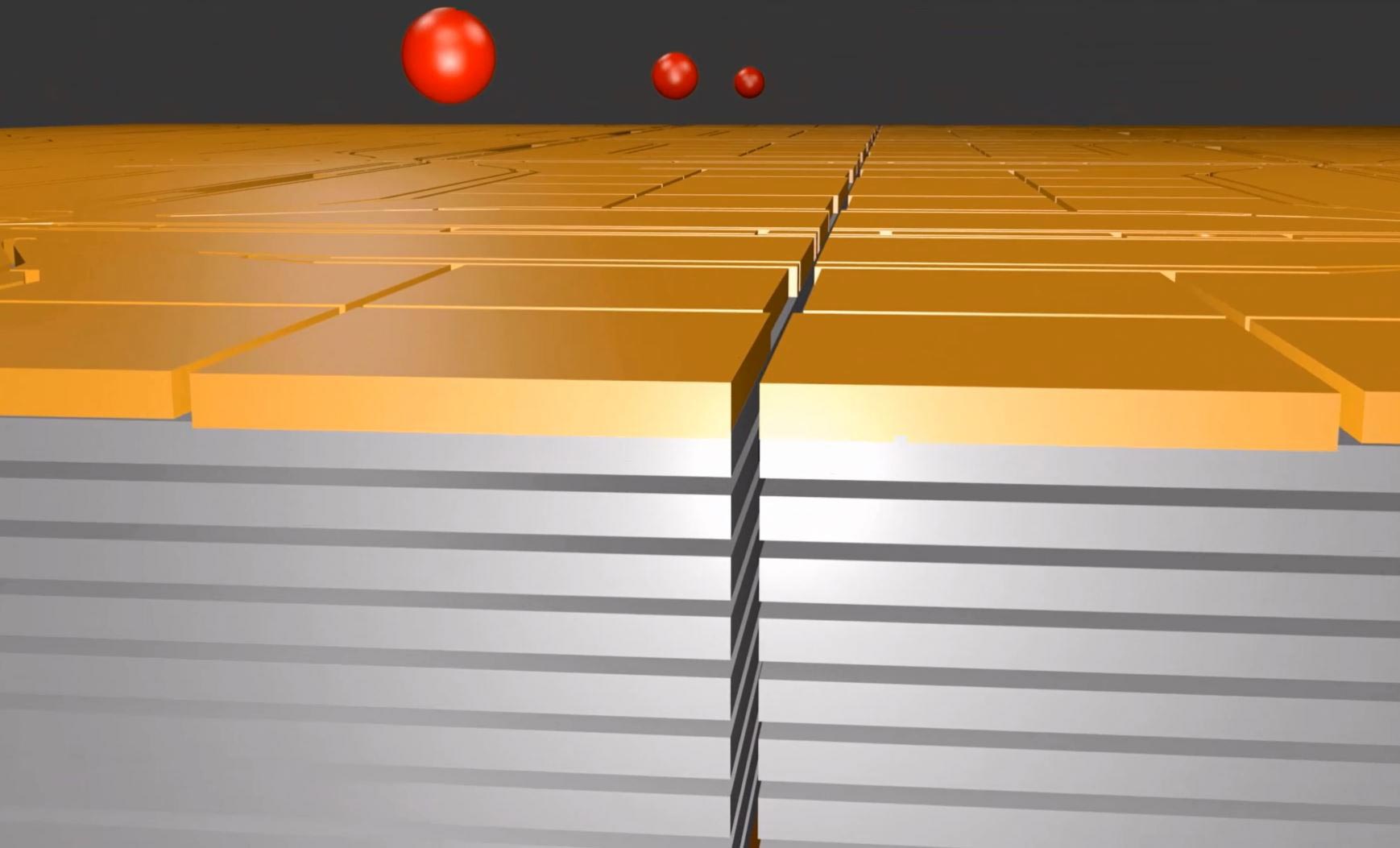
In the research paper, published on February 8, 2023, in the journal Nature Communications, the scientists demonstrate how they have used a new and powerful technique, which they dub ‘UQ Connect’, to use electric field links to enable qubits to move from one quantum computing microchip module to another with unprecedented speed and precision. This allows chips to slot together like a jigsaw puzzle to make a more powerful quantum computer.
Record-Breaking Speed and Accuracy
The University of Sussex and Universal Quantum team were successful in transporting the qubits with a 99.999993% success rate and a connection rate of 2424/s, both numbers are world records and orders of magnitude better than previous solutions.
Professor Winfried Hensinger, Professor of Quantum Technologies at the University of Sussex and Chief Scientist and Co-founder at Universal Quantum said: “As quantum computers grow, we will eventually be constrained by the size of the microchip, which limits the number of quantum bits such a chip can accommodate. As such, we knew a modular approach was key to make quantum computers powerful enough to solve step-changing industry problems. In demonstrating that we can connect two quantum computing chips – a bit like a jigsaw puzzle – and, crucially, that it works so well, we unlock the potential to scale-up by connecting hundreds or even thousands of quantum computing microchips.”
While linking the modules at world-record speed, the scientists also verified that the ‘strange’ quantum nature of the qubit remains untouched during transport, for example, that the qubit can be both 0 and 1 at the same time.
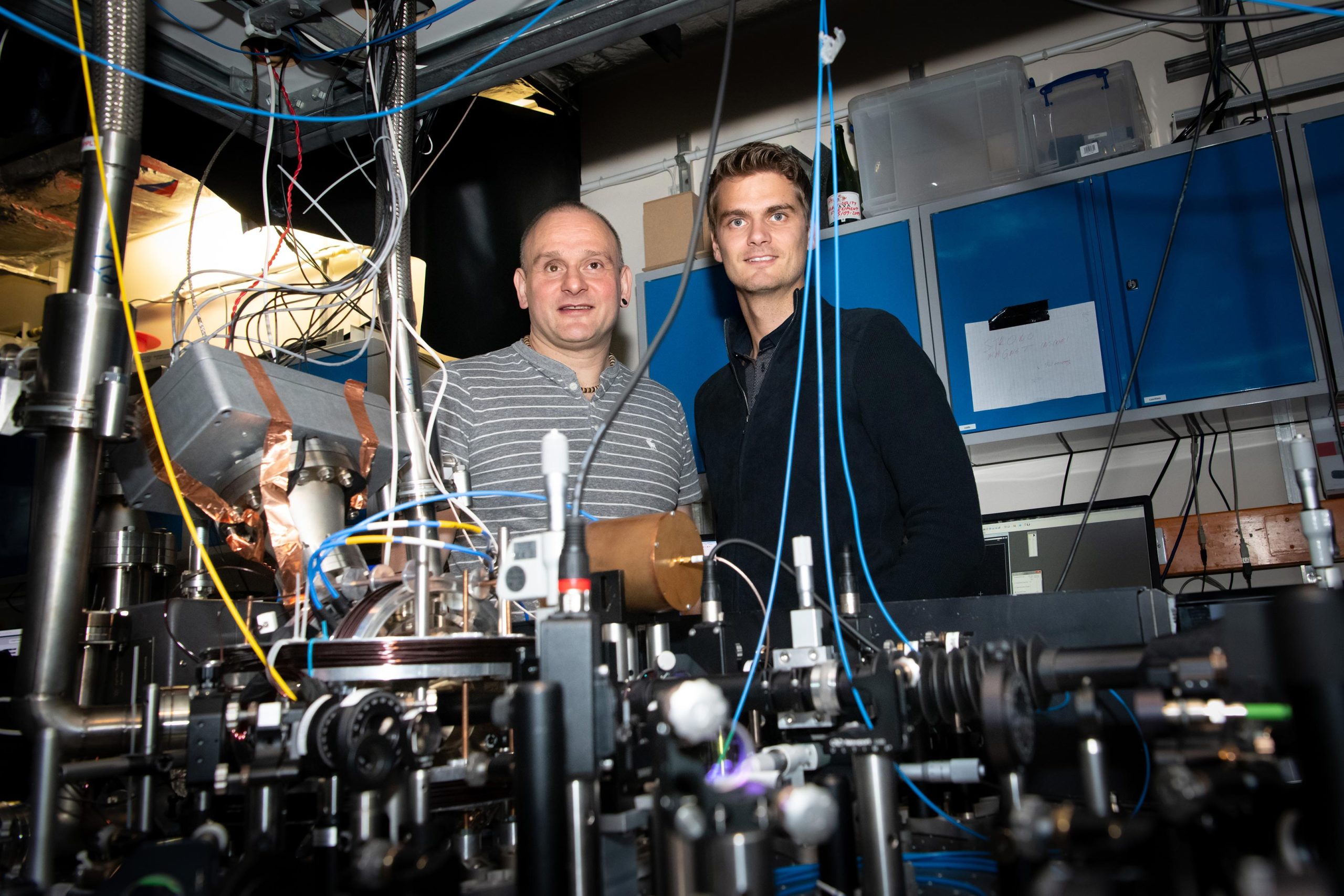
Dr. Sebastian Weidt, CEO and Co-founder of Universal Quantum, and Senior Lecturer in Quantum Technologies at the University of Sussex said: “Our relentless focus is on providing people with a tool that will enable them to revolutionize their field of work. The Universal Quantum and University of Sussex teams have done something truly incredible here that will help make our vision a reality. These exciting results show the remarkable potential of Universal Quantum’s quantum computers to become powerful enough to unlock the many life-changing applications of quantum computing.”
Universal Quantum has just been awarded €67 million from the German Aerospace Center (DLR) to build two quantum computers where they will deploy this technology as part of the contract. The University of Sussex spin-out was also recently named as one of the 2022 Institute of Physics award winners in the Business Start-up category.
Weidt added: “The DLR contract was likely one of the largest government quantum computing contracts ever handed out to a single company. This is a huge validation of our technology. Universal Quantum is now working hard to deploy this technology in our upcoming commercial machines.”
Dr. Mariam Akhtar led the research during her time as Research Fellow at the University of Sussex and Quantum Advisor at Universal Quantum. She said: “The team has demonstrated fast and coherent ion transfer using quantum matter links. This experiment validates the unique architecture that Universal Quantum has been developing – providing an exciting route towards truly large-scale quantum computing.”
Professor Sasha Roseneil, Vice-Chancellor of the University of Sussex, said: “It’s fantastic to see that the inspired work of the University of Sussex and Universal Quantum physicists has resulted in this phenomenal breakthrough, taking us a significant step closer to a quantum computer that will be of real societal use. These computers are set to have boundless applications – from improving the development of medicines, creating new materials, to maybe even unlocking solutions to the climate crisis. The University of Sussex is investing significantly in quantum computing to support our bold ambition to host the world’s most powerful quantum computers and create change that has the potential to positively impact so many people across the world. And with teams spanning the spectrum of quantum computing and technology research, the University of Sussex has both a breadth and a depth of expertise in this. We are still growing our research and teaching in this area, with plans for new teaching programs, and new appointments.”
Professor Keith Jones, Interim Provost and Pro-Vice Chancellor for Research and Enterprise at the University of Sussex, said of the development: “This is a very exciting finding from our University of Sussex physicists and Universal Quantum. It proves the value and dynamism of this University of Sussex spin-out company, whose work is grounded in rigorous and world-leading academic research. Quantum computers will be pivotal in helping to solve some of the most pressing global issues. We’re delighted that Sussex academics are delivering research that offers hope in realizing the positive potential of next-generation quantum technology in crucial areas such as sustainability, drug development, and cybersecurity.”
Reference: “A high-fidelity quantum matter-link between ion-trap microchip modules” by M. Akhtar, F. Bonus, F. R. Lebrun-Gallagher, N. I. Johnson, M. Siegele-Brown, S. Hong, S. J. Hile, S. A. Kulmiya, S. Weidt and W. K. Hensinger, 8 February 2023, Nature Communications.
DOI: 10.1038/s41467-022-35285-3
Never miss a breakthrough: Join the SciTechDaily newsletter.
Follow us on Google and Google News.