
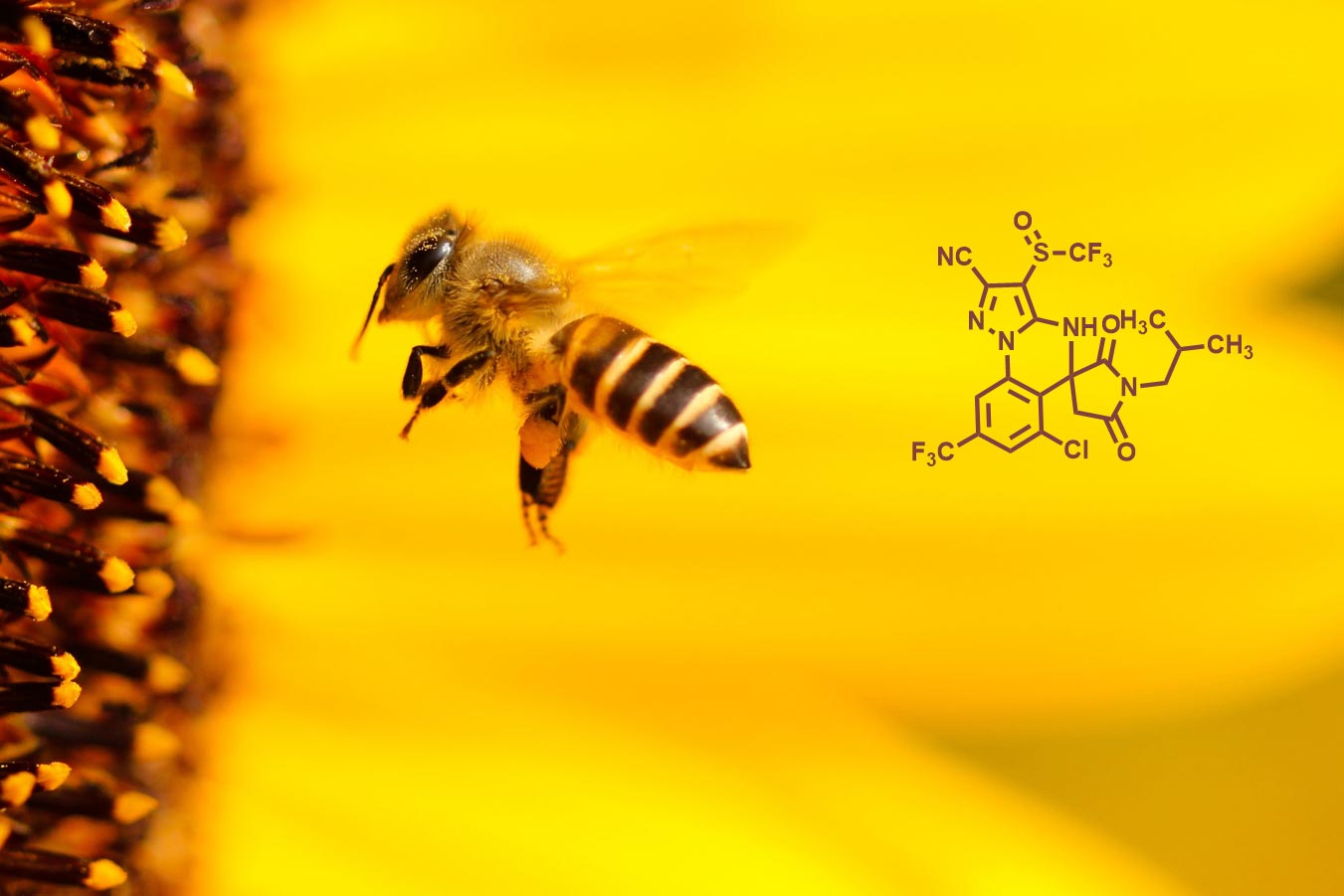
Developing Safer Insecticides with Reduced Bee Toxicity
Researchers at South China Agricultural University have developed new insecticidal compounds that show significantly reduced bee toxicity without reducing effectiveness against target pests – in this case, the diamondback moth and red imported fire ant.
Arylpyrazole insecticides such as fipronil display broad-spectrum insecticidal activity against insect pests, but their high toxicity to honeybees prohibits their agronomic use. In this study, published on February 7 in the SCI journal Pest Management Science, the researchers designed and synthesized a series of new spiro-pyrazolo quinazoline derivatives intended to reduce the toxicity of arylpyrazole analogs to bees.
Spiro motifs are compounds that have at least two molecular rings with only one common atom. They are ubiquitous in natural products and bioactive molecules, but despite their wide application in other fields, between 2010 and 2021 there were fewer than 140 reports of their pesticidal activity. Speaking to SCI, Professor Hanhong Xu, Professor Chen Zhao, and Dr. Guankai Yao explained:
“With high specificity and diversity in structures, spiro motifs have been widely used in pharmaceuticals, asymmetric catalysis, optical materials, flame-retardant materials, polymeric adhesives, etc. However, only a few spiro-containing compounds have become representative pesticides on the market at present, such as spirodiclofen and spirotetramat by Bayer.
“The reasons include the difficulty of synthesis and relatively limited pest species that they are effective against, which bring about the high cost for production and field application. Meanwhile, many spiro compounds possess chiral isomerism. Thus, when assessing their efficacy and safety, it is necessary to fully consider the different bioactivities, toxicities, and environmental behaviors of isomers, leading to long R&D cycles.”
Spiro-Pyrazolo Quinazoline Derivatives: A Novel Approach
The team employed scaffold hopping techniques – an agrochemical discovery strategy widely used to find novel candidates to improve activity levels and/or avoid adverse toxicity. This technique has been successfully used in herbicide research, for example, leading to discovery of the cellulose-biosynthesis inhibitor indaziflam.
Asked about their choice of the diamondback moth (P. xylostella) and imported red fire ant (S. invicta) as target pests in this study, the researchers noted:
“The diamondback moth is among the world’s top-ten pests that severely damage cruciferous vegetables and reduce the yield. The red fire ant is one of the world’s worst invasive alien species, threatening human health and the ecosystem. Respectively, being representative of Lepidoptera and Hymenoptera pests, insecticidal activity against the diamondback moth and red imported fire ant usually indicates similar results for other pests with similar species. In fact, further studies in our lab have revealed excellent insecticidal activity of our compounds against the fall armyworm and the Asian citrus psylla.”
Promising Results and Reduced Bee Toxicity
Results showed that most of the compounds displayed good insecticidal activity – and some comparable with that of fipronil – against the target pests, making them promising insecticide candidates. Remarkably, the bee toxicity study confirmed that one new compound, “5f” showed much lower acute oral toxicity with an LD50 value (1.15 μg bee−1) that was three to four 3–4 orders of magnitude that of fipronil (0.0012 μg bee−1).
“Fipronil is a landmark product in the field of insecticides but has been banned for usage due to its high toxicity to non-target organisms, especially honeybees. During the past twenty years, a series of studies have been conducted in our group on the structural modification of fipronil, aiming for enhanced bioavailability and reduced toxicity. The combination of the spiro motif, as reported in this research paper, is one of our new attempts, and the significance of reduction on bee toxicity is within our expectations. There will be follow-up results on the relevant mechanism,” Professor Zhao explained.
In order to meet the requirements of industrial production, the researchers will need to further improve the yields and scalability of the molecules. The team is currently working on the optimization of the synthesis process and the screening of isomers with enhanced bioactivity to reduce the cost of production.
“We will keep working on the structural optimization of our molecules, as well as the development of simple and efficient strategies for constructing spiro motifs. We hope that more compounds with excellent pesticidal activity could be discovered in the future, and similar spiro structures could occupy a larger share of the pesticide market,” the researchers said.
Reference: “Design, synthesis, and biological activity of novel spiro-pyrazolo[1,5-a]quinazolines derivatives as potential insecticides” by Guangkai Yao, Mengfan Wang, Benjie Li, Hongxiang Peng, Shuai Yang, Chen Zhao and Hanhong Xu, 12 November 2022, Pest Management Science.
DOI: 10.1002/ps.7287
Funding: China Postdoctoral Science Foundation, Guangdong Basic and Applied Basic Research Foundation, Guangdong Provincial Science and Technology Plan Project, National Natural Science Foundation of China
Never miss a breakthrough: Join the SciTechDaily newsletter.
Follow us on Google and Google News.