
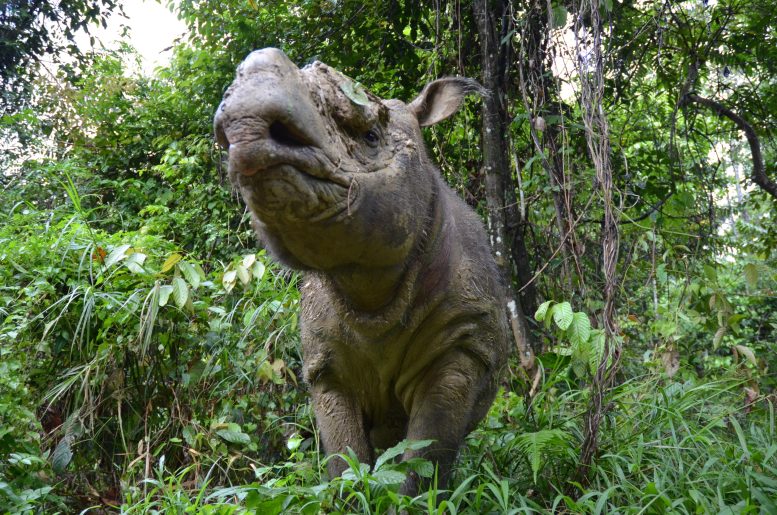
In an effort to save the endangered Sumatran rhino species from extinction, a team from the Max Delbrück Center has successfully grown stem cells and mini-brains from the skin cells of Kertam, the last male Sumatran rhino in Malaysia who died in 2019. The team’s goal is to use these cells to create sperm cells for reproductive efforts.
The Sumatran rhinoceros, the world’s smallest and most ancient rhino species, was once widely distributed throughout East and Southeast Asia. However, poaching and habitat destruction have severely reduced the population, with only a few dozen individuals remaining in the rainforests of Sumatra and the Indonesian portion of Borneo. The rarity of these remaining individuals makes mating encounters increasingly scarce, contributing to the species’ endangered status.
The Last of Their Kind in Malaysia
The Sumatran rhinoceros, which is the only surviving rhino species with hair, has been considered extinct in Malaysia since 2019 following the death of male Kertam and, just a few months later, female Iman. But a team of Berlin scientists led by Dr. Vera Zywitza and Dr. Sebastian Diecke, head of the Pluripotent Stem Cells Platform at the Max Delbrück Center in Berlin, are not content with this. They and their international partners have an ambitious goal: to turn skin cells taken from now-deceased Sumatran rhinos into stem cells, from which they can then derive egg and sperm cells to be used in assisted reproduction – in this case, fertilization in the laboratory. The embryos bred in the petri dish, which will be the offspring of Kertam and other already deceased or infertile individuals, will be carried to term by surrogate rhino mothers.
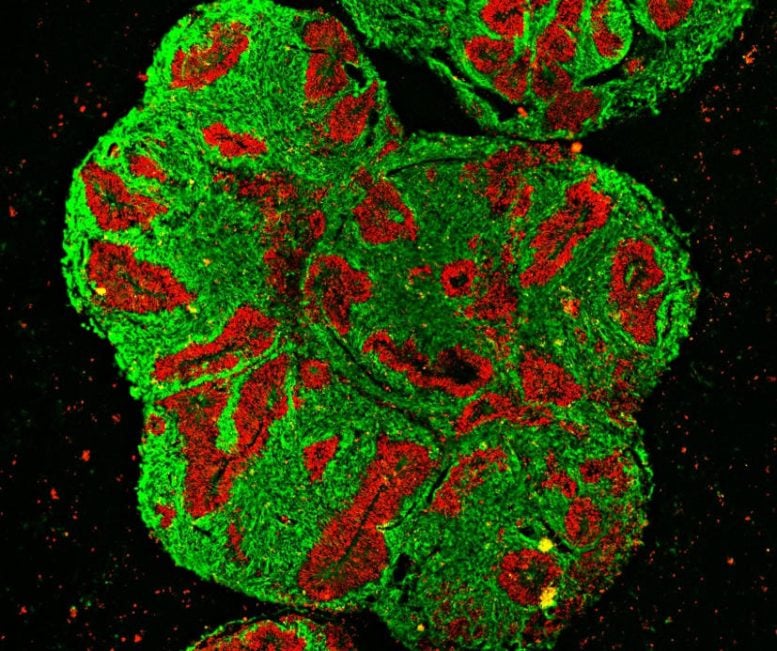
In the scientific journal iScience, the team led by first author Zywitza and last author Diecke has now reported an initial success: they have generated induced pluripotent stem cells, or iPS cells for short, from Kertam’s skin samples. These cells have two key advantages. First, they are able to divide infinitely and therefore never die; and second, they are able to transform into any cell type in the body. For their recently published study, the group has already grown brain organoids, also called “mini-brains,” from Kertam’s iPS cells.
Learning From the White Rhino
The technology platform developed its stem cell technologies as part of the BioRescue research project for the even more critically endangered northern white rhinoceros – of which only two females now remain, living in a Kenyan wildlife reserve. “Our current study has benefited a lot from the knowledge gained through this large-scale project, which is funded by the German Federal Ministry of Education and Research,” says Zywitza. Professor Thomas Hildebrandt, head of the Reproduction Management Department at the Leibniz Institute for Zoo and Wildlife Research (IZW) in Berlin, and his research group were also significantly involved in the project.
Zywitza recounts how all those involved in the current study were surprised and pleased to discover that the methods used to turn the skin cells of northern white rhinos into stem cells also worked well with the cells of Sumatran rhinos. Under the microscope, the stem cells of both rhino species were barely distinguishable from human iPS cells. Nevertheless, there were species-specific differences: “In contrast to northern white rhino iPS cells, Kertam’s iPSCs could not be cultivated without feeder cells, which release growth factors that help to keep stem cells in a pluripotent state,” explains Zywitza.
A Deeper Look Into Evolution
In addition to preserving the species, the stem cells obtained from Kertam’s skin could serve another purpose: “iPS cells from exotic animals provide a unique tool to gain insights into the evolution of organ development,” says Zywitza. To demonstrate this, Dr. Silke Frahm-Barske, who is also a scientist in Diecke’s research group, grew brain organoids from the cells.
“To the best of our knowledge, mini-brains like these have only been obtained from mouse, human, and non-human primates so far,” says Frahm-Barske. “So we were very pleased to see that the stem cells we generated from the Sumatran rhino formed organoids quite similar to those of humans.” However, she added that the team had to treat the human and rhino iPS cells slightly differently in order to generate the brain organoids.
The Next Step is Sperm Cells
The team’s next goal is to use Kertam’s iPS cells to grow sperm suitable for artificial insemination. “This step is more difficult,” says Zywitza. “To obtain sperm cells, we first need to use the iPS cells to cultivate primordial germ cells – the precursors of eggs and sperm.” This is the tricky task the scientists are now going to tackle. They also plan to obtain iPS cells from other Sumatran rhinos.
Reproduction expert Thomas Hildebrandt explains why efforts like these are necessary: “Measures are indeed being taken in Indonesia to preserve the Sumatran rhino population by bringing together the remaining individuals in wildlife reserves,” he says. “But females that have not been pregnant for a long time often become infertile, for example, due to cysts that develop on their reproductive organs, or they may just be too old to bear young.”
“Even though our work is attempting to make the seemingly impossible possible – i.e., to ensure the survival of animals that would otherwise probably disappear from our planet – it must remain an exception and not become the rule,” emphasizes Zywitza. “Despite all the buzz around what we are doing in the lab, this can at best make a small contribution to saving these rhinos from extinction. The protection and conservation of the animals’ few remaining habitats is at least equally important.”
Reference: “Induced pluripotent stem cells and cerebral organoids from the critically endangered Sumatran rhinoceros” by Vera Zywitza, Silke Frahm, Norman Krüger, Anja Weise, Frank Göritz, Robert Hermes, Susanne Holtze, Silvia Colleoni, Cesare Galli, Micha Drukker, Thomas B. Hildebrandt and Sebastian Diecke, 18 November 2022, iScience.
DOI: 10.1016/j.isci.2022.105414
Never miss a breakthrough: Join the SciTechDaily newsletter.
Follow us on Google and Google News.
1 Comment
Only way to save so many on danger species is to get ready of monkey’s, I mean; obsolete monkeys that because have the talking fact they think as they are humans but these are not the real humans because they do not act as humans, they are just called “thieves” but in reality a virus. The real humans pay taxes, the real humans go to work or study, they become members on a system in search of god while monkey-humans;steal, robb, they are liars, scammers, thieves of any sort at eery stage on nation’s all over the planet, they are at governments, they come out from universities, they become strong member on the system but inside of them lives a thieve, a liar, an scammers, an abuser. Thieves are the worst decease, greedeness is carry out on daily matter and the monkey’s are there over a billions taking space, planning how next they’ll will take over honest people assets or declaring a war to neighbor’s . This is a long talk but to make it short; we should start with lawmakers, politicians liars, corrupted and religious brainwashers pervers to the bone that feed on these monkey’s virus that affects human society. We have and mut do something with these monkeys because having them in prison it means state corruption, weakness, failure, we must get ready of delinquents with out having them feed in prison with tax money’s payers that’s an homoungous mistake. We mut physically get ready of any thieve at any level because they’re too many there pointing at us, studying how they gone to feed their little ones with our efforts so tomorrow these little ones will exploit our little ones and the decease will take over and over as or ready happens with Hitler gang on WW2….