
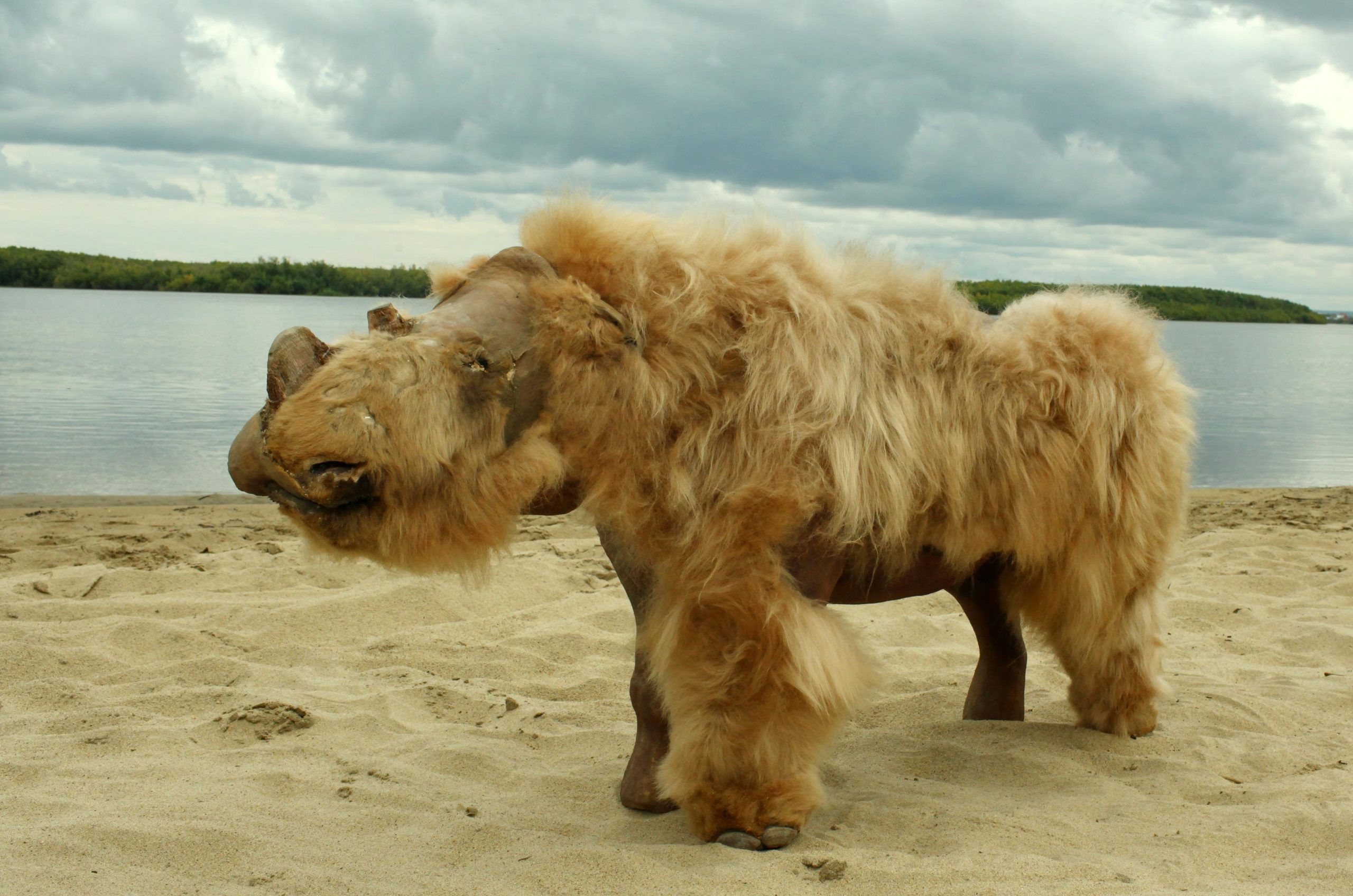
Woolly rhinoceros likely went extinct due to climate change, not overhunting.
The extinction of prehistoric megafauna like the woolly mammoth, cave lion, and woolly rhinoceros at the end of the last ice age has often been attributed to the spread of early humans across the globe. Although overhunting led to the demise of some species, a study appearing today (August 13, 2020) in the journal Current Biology found that the extinction of the woolly rhinoceros may have had a different cause: climate change. By sequencing ancient DNA from 14 of these megaherbivores, researchers found that the woolly rhinoceros population remained stable and diverse until only a few thousand years before it disappeared from Siberia, when temperatures likely rose too high for the cold-adapted species.
“It was initially thought that humans appeared in northeastern Siberia fourteen or fifteen thousand years ago, around when the woolly rhinoceros went extinct. But recently, there have been several discoveries of much older human occupation sites, the most famous of which is around thirty thousand years old,” says senior author Love Dalén (@love_dalen), a professor of evolutionary genetics at the Centre for Palaeogenetics, a joint venture between Stockholm University and the Swedish Museum of Natural History. “So, the decline towards extinction of the woolly rhinoceros doesn’t coincide so much with the first appearance of humans in the region. If anything, we actually see something looking a bit like an increase in population size during this period.”
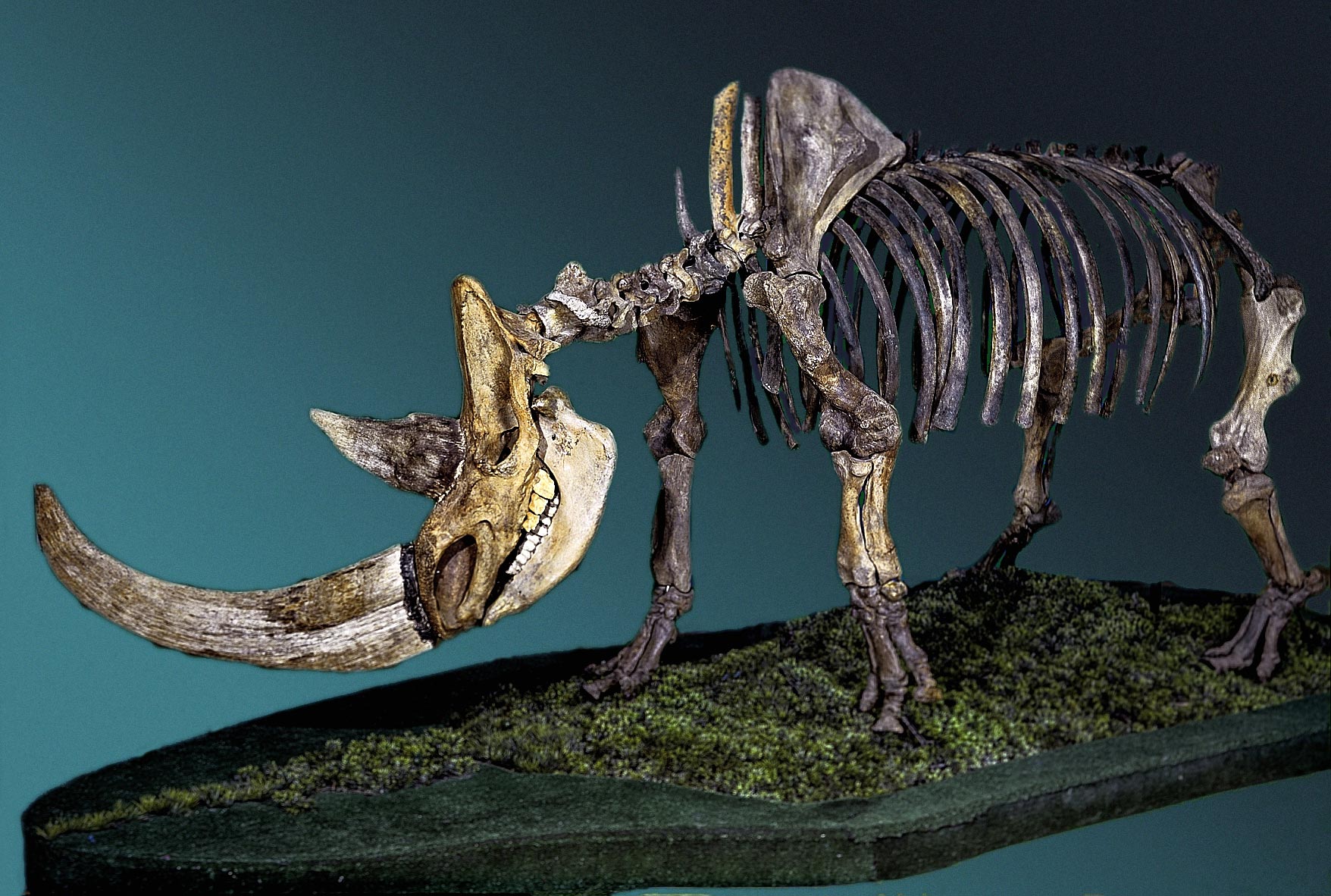
To learn about the size and stability of the woolly rhinoceros population in Siberia, the researchers studied the DNA from tissue, bone, and hair samples of 14 individuals. “We sequenced a complete nuclear genome to look back in time and estimate population sizes, and we also sequenced fourteen mitochondrial genomes to estimate the female effective population sizes,” says co-first author Edana Lord (@EdanaLord), a Ph.D. student at the Centre for Palaeogenetics.
By looking at the heterozygosity, or genetic diversity, of these genomes, the researchers were able to estimate the woolly rhino populations for tens of thousands of years before their extinction. “We examined changes in population size and estimated inbreeding,” says co-first author Nicolas Dussex, a postdoctoral researcher at the Centre for Palaeogenetics. “We found that after an increase in population size at the start of a cold period some 29,000 years ago, the woolly rhino population size remained constant and that at this time, inbreeding was low.”

This stability lasted until well after humans began living in Siberia, contrasting the declines that would be expected if the woolly rhinos went extinct due to hunting. “That’s the interesting thing,” says Lord. “We actually don’t see a decrease in population size after 29,000 years ago. The data we looked at only goes up to 18,500 years ago, which is approximately 4,500 years before their extinction, so it implies that they declined sometime in that gap.”
The DNA data also revealed genetic mutations that helped the woolly rhinoceros adapt to colder weather. One of these mutations, a type of receptor in the skin for sensing warm and cold temperatures, has also been found in woolly mammoths. Adaptations like this suggest the woolly rhinoceros, which was particularly suited to the frigid northeast Siberian climate, may have declined due to the heat of a brief warming period, known as the Bølling-Allerød interstadial, that coincided with their extinction towards the end of the last ice age.
“We’re coming away from the idea of humans taking over everything as soon as they come into an environment, and instead elucidating the role of climate in megafaunal extinctions,” says Lord. “Although we can’t rule out human involvement, we suggest that the woolly rhinoceros’ extinction was more likely related to climate.”
The researchers hope to study the DNA of additional woolly rhinoceroses that lived in that crucial 4,500-year gap between the last genome they sequenced and their extinction. “What we want to do now is to try to get more genome sequences from rhinos that are between eighteen and fourteen thousand years old, because at some point, surely they must decline,” says Dalén. The researchers are also looking at other cold-adapted megafauna to see what further effects the warming, unstable climate had. “We know the climate changed a lot, but the question is: how much were different animals affected, and what do they have in common?”
Reference: “Pre-extinction Demographic Stability and Genomic Signatures of Adaptation in the Woolly Rhinoceros” by Edana Lord, Nicolas Dussex, Marcin Kierczak, David Díez-del-Molino, Oliver A. Ryder, David W.G. Stanton, M. Thomas P. Gilbert, Fátima Sánchez-Barreiro, Guojie Zhang, Mikkel-Holger S. Sinding, Eline D. Lorenzen, Eske Willerslev, Albert Protopopov, Fedor Shidlovskiy, Sergey Fedorov, Hervé Bocherens, Senthilvel K.S.S. Nathan, Benoit Goossens, Johannes van der Plicht, Yvonne L. Chan, Stefan Prost, Olga Potapova, Irina Kirillova, Adrian M. Lister, Peter D. Heintzman, Joshua D. Kapp, Beth Shapiro, Sergey Vartanyan, Anders Götherström and Love Dalén, 13 August 2020, Current Biology.
DOI: 10.1016/j.cub.2020.07.046
This work was supported by FORMAS, the Swiss National Science Foundation, the Carl Tryggers Foundation, the European Research Council Consolidator Award, and the Knut and Alice Wallenberg Foundation.
Never miss a breakthrough: Join the SciTechDaily newsletter.
Follow us on Google and Google News.
3 Comments
Perhaps it was human’s great tool “the dog”. Coincided to about that time.
Perhaps modern day Rhinos and Elephants hold a dormant gene trait for wooly hair and
excessive weight gain when triggered by long term exposure to ice age environments… Obviously, we would not still have Rhinos and Elephants if they do not still have this ability. An Ice Age does not happen over night and does not end over night either. There would have been plenty of time to activate a recessed response to nature and plenty of time to deactivate it too.
To jump start a study, try five generations of frozen embryos and frozen sperm keeping the off spring in harsher and harsher winter environments and see if by generations four and five their natural coats have thickened and then estimate how many generations it takes for genetic coding to respond to an ice age.
Only keep them longer enough to reach maturity for the next generation then return to their natural environment for the rest of their lives. Suggest 20 degree temperature drop each generation.
Normally, I wouldn’t suggest something so cruel however for human endurance and even space exploration, we need to know the hidden secrets of our biological abilities. We already know a human embryo may be triggered to produce full body fur… We don’t know if everyone actually has this ability and what chemicals present produced the fur expression without environmental changes.
Jacob and Esau were two brothers with very different body hair traits and it maybe environment has nothing to do with it because they both experienced the same environment. Then again, maybe God used them to let us all know we hold all the keys we need to survive climate change already because if they lived during a transition period of going into or out of an ice age they could have been seeing both expressions occurring within a few generations.
Genesis records Eden as a garden of paradise…from which they left living outdoors and started living in caves and for which God gave them animal skins to survive… maybe we misinterpreted the gift of animal skins… Maybe it was not animal hides and instead means God gave them the genetic trigger for their own fur because the Bible records their environment changed leaving Eden… And human environment would have changed again after the flood.
When a hundred species of megafauna go extint at once, On only one half the Globe, When a carpet of ash is laid from Alaska to Syria, When the Sea rises 400 feet, Because the ice cap disappears overnight, Dave and Larry didn’t do it.
https://www.howtube.com/channels/RandallCarlson