
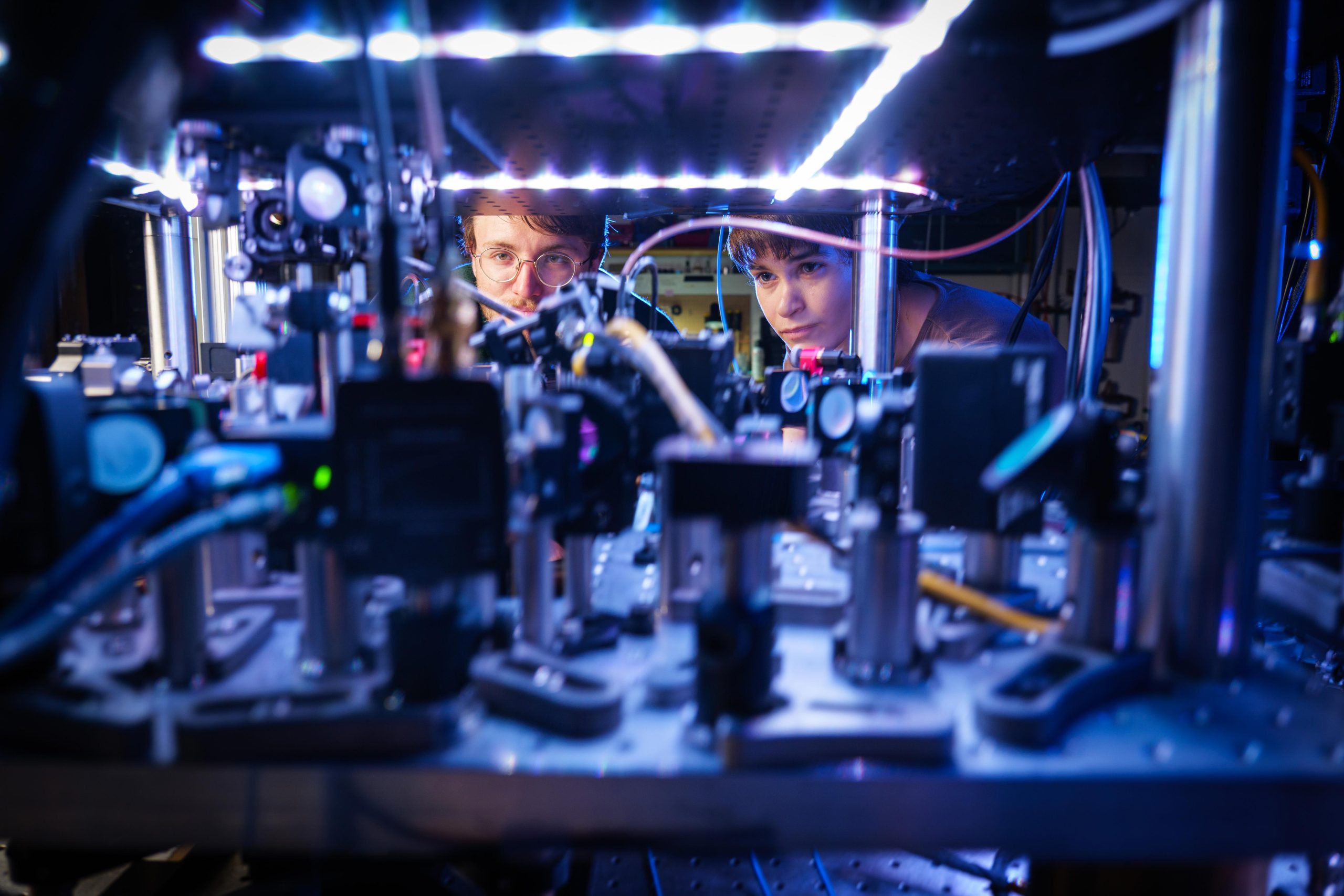
CU Boulder scientists created a quantum device that uses cold atoms and lasers to track 3D acceleration.
In a new study, physicists at the University of Colorado Boulder used a cloud of atoms cooled to extremely low temperatures to measure acceleration in three dimensions at the same time, achieving what many scientists once thought was not possible.
The device, a new kind of atom “interferometer,” could eventually improve navigation for submarines, spacecraft, cars, and other vehicles.
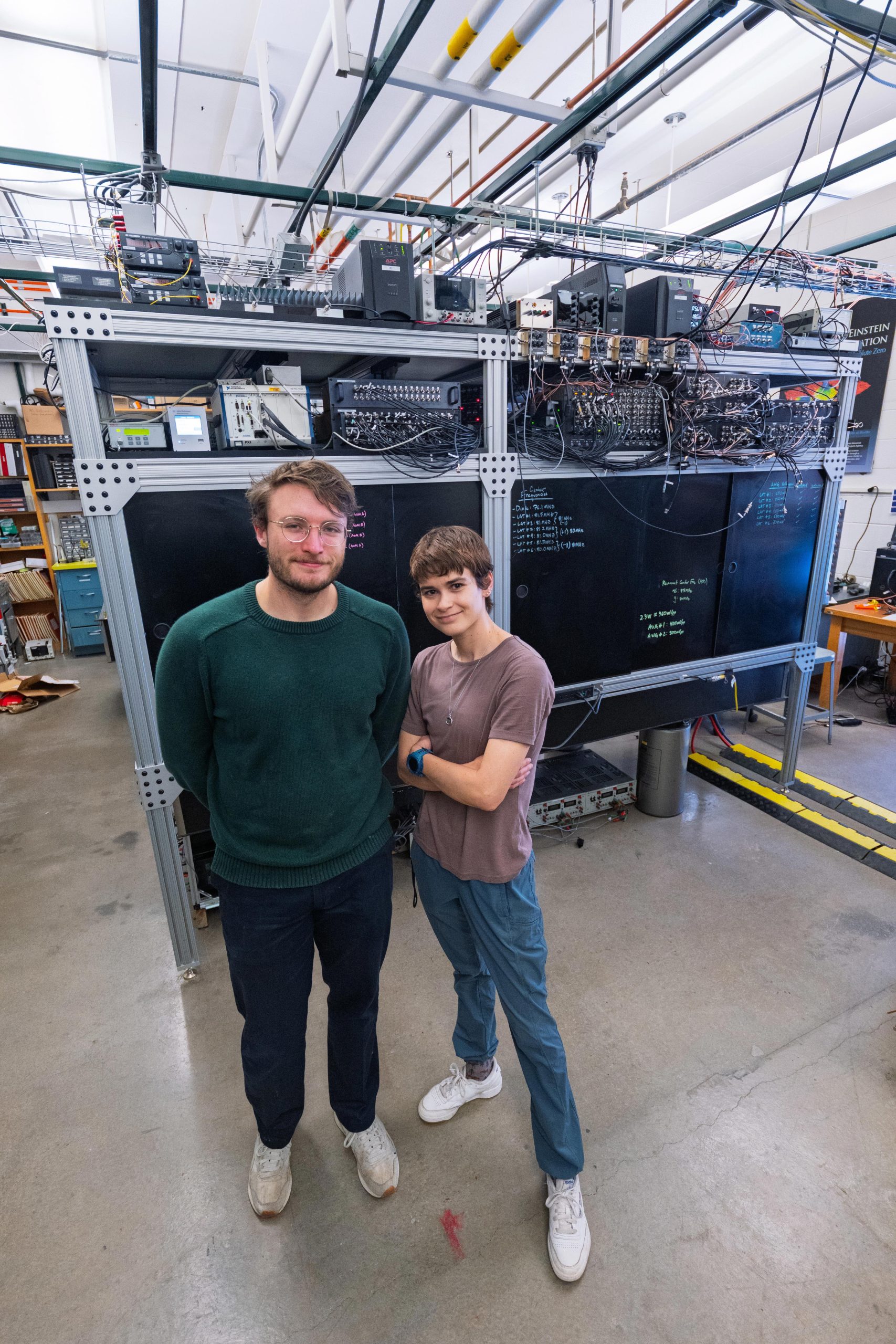
“Traditional atom interferometers can only measure acceleration in a single dimension, but we live within a three-dimensional world,” said Kendall Mehling, a co-author of the new study and a graduate student in the Department of Physics at CU Boulder. “To know where I’m going, and to know where I’ve been, I need to track my acceleration in all three dimensions.”
The researchers published their paper in the journal Science Advances. The team included Mehling; Catie LeDesma, a postdoctoral researcher in physics; and Murray Holland, professor of physics and fellow of JILA, a joint research institute between CU Boulder and the National Institute of Standards and Technology (NIST).
In 2023, NASA awarded the CU Boulder researchers a $5.5 million grant through the agency’s Quantum Pathways Institute to continue developing the sensor technology.
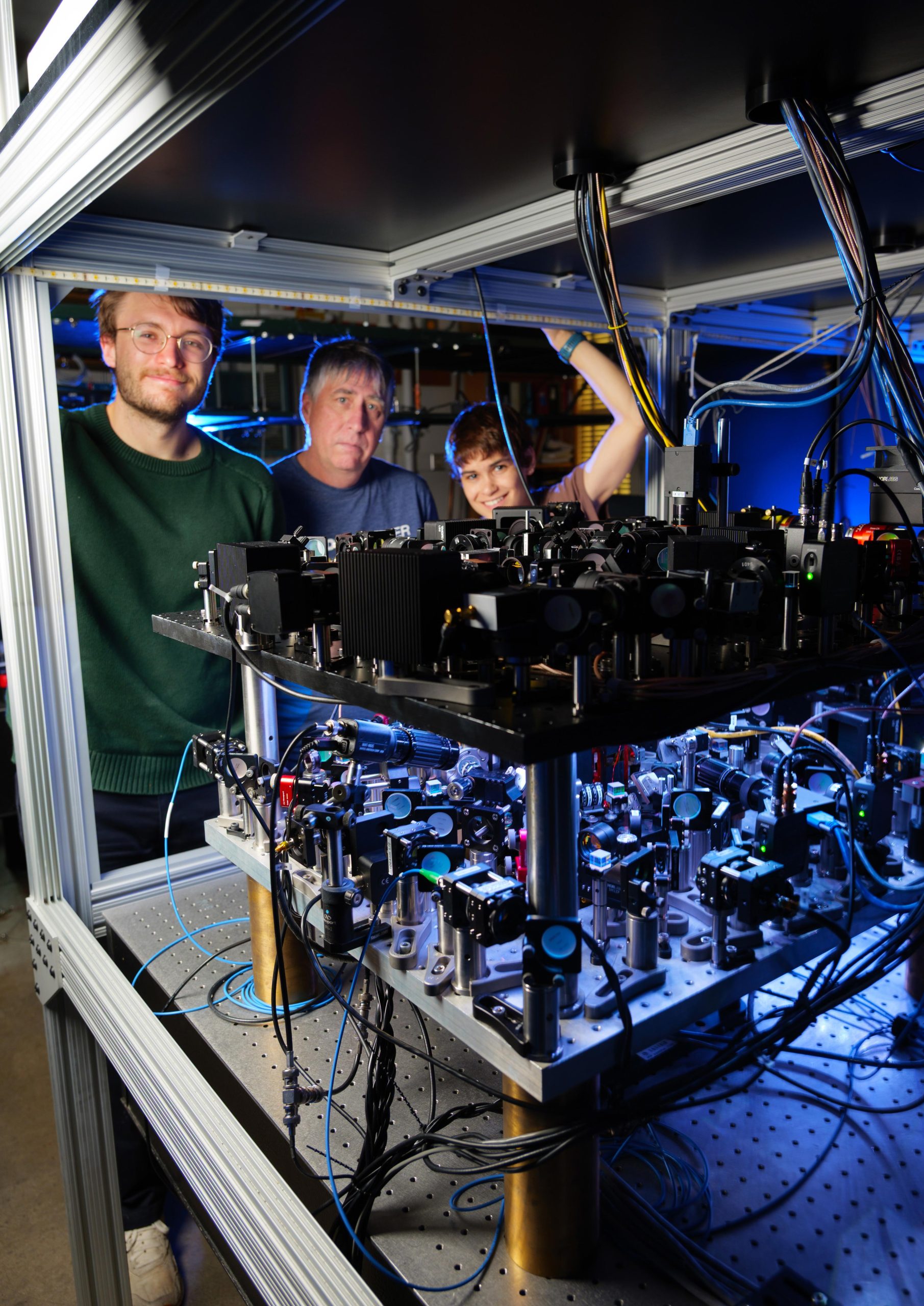
The new device is an impressive feat of engineering. Holland and his colleagues use six lasers, each as thin as a human hair, to trap a cloud of tens of thousands of rubidium atoms. With the help of artificial intelligence, they adjust the lasers in complex patterns, allowing them to observe how the atoms respond to small accelerations, similar to pressing the gas pedal in a car.
Most vehicles today rely on GPS and traditional electronic devices called accelerometers to track acceleration. While the quantum device is not yet ready to replace these tools, the researchers see strong potential for atom-based navigation technology.
“If you leave a classical sensor out in different environments for years, it will age and decay,” Mehling said. “The springs in your clock will change and warp. Atoms don’t age.”
Fingerprints of motion
Interferometers have existed in various forms for centuries and have been used in a wide range of applications, from transmitting information through optical fibers to detecting gravitational waves, which are ripples in the fabric of space.
The basic principle involves splitting something apart and then bringing it back together, similar to unzipping and zipping up a jacket.
In laser interferometry, for example, scientists shine a beam of laser light and then split it into two identical beams that travel along separate paths. When the beams are brought back together, they may not align perfectly if they have been affected differently along their paths, such as by gravity. This mismatch, or interference, reveals information about what the beams experienced—hence the term “interferometer.”
In the current study, the team achieved the same feat, but with atoms instead of light.
Here’s how it works: The device currently fits on a bench about the size of an air hockey table. First, the researchers cool a collection of rubidium atoms down to temperatures just a few billionths of a degree above absolute zero.
In that frigid realm, the atoms form a mysterious quantum state of matter known as a Bose-Einstein Condensate (BEC). Carl Wieman, then a physicist at CU Boulder, and Eric Cornell of JILA won a Nobel Prize in 2001 for creating the first BEC.
Next, the team uses laser light to jiggle the atoms, splitting them apart. In this case, that doesn’t mean that groups of atoms are separating. Instead, each individual atom exists in a ghostly quantum state called a superposition, in which it can be simultaneously in two places at the same time.
When the atoms split and separate, those ghosts travel away from each other following two different paths. (In the current experiment, the researchers didn’t actually move the device itself but used lasers to push on the atoms, causing acceleration).
“Our Bose-Einstein Condensate is a matter-wave pond made of atoms, and we throw stones made of little packets of light into the pond, sending ripples both left and right,” Holland said. “Once the ripples have spread out, we reflect them and bring them back together where they interfere.”
When the atoms snap back together, they form a unique pattern, just like the two beams of laser light zipping together but more complex. The result resembles a thumbprint on a glass.
“We can decode that fingerprint and extract the acceleration that the atoms experienced,” Holland said.
Planning with computers
The group spent almost three years building the device to achieve this feat.
“For what it is, the current experimental device is incredibly compact. Even though we have 18 laser beams passing through the vacuum system that contains our atom cloud, the entire experiment is small enough that we could deploy in the field one day,” LeDesma said.
One of the secrets to that success comes down to an artificial intelligence technique called machine learning. Holland explained that splitting and recombining the rubidium atoms requires adjusting the lasers through a complex, multi-step process. To streamline the process, the group trained a computer program that can plan out those moves in advance.
So far, the device can only measure accelerations several thousand times smaller than the force of Earth’s gravity. Currently available technologies can do a lot better.
But the group is continuing to improve its engineering and hopes to increase the performance of its quantum device many times over in the coming years. Still, the technology is a testament to just how useful atoms can be.
“We’re not exactly sure of all the possible ramifications of this research, because it opens up a door,” Holland said.
Reference: “Vector atom accelerometry in an optical lattice” by Catie LeDesma, Kendall Mehling and Murray Holland, 4 June 2025, Science Advances.
DOI: 10.1126/sciadv.adt7480
Never miss a breakthrough: Join the SciTechDaily newsletter.
Follow us on Google and Google News.
4 Comments
We’re not exactly sure of all the possible ramifications of this research, because it opens up a door,…
That’s the vector going forward by the progressive way.
You may connect many, as possible and applicable sensors on real quantum system so AI start exam it’s data using all the methods of them.
Real challenge is passing you and all the efforts of scientists group to identify results and resuming of ones by the AI.
THAT’S THE GREAT DEAL!!
Welcome through this way, revolutionary way.
It’s a one of possibilities to watch consciousness of the universe.
I’ll glad conversations to continue.
All goods!
Forward!!
All goods! It’s a bit funny.
The progress of physics cannot be separated from innovation. However, some so-called peer-reviewed publications are not like this. They insist on that two sets of cobalt-60 rotating in opposite directions—whether symmetrical or not—constitute mirror images of each other. Is this scientific and logical? The initiator is Physical Review. Those who vigorously defend and promote it are Physical Review Letters (PRL), Science, Proceedings of the National Academy of Sciences (PNAS), Nature,Science Bulletin, etc. Let us continue to witness with facts the dirtiest and ugliest epoch in the history of science and humanities.
If researchers are interested in this, please browse https://zhuanlan.zhihu.com/p/1918614826130838141 and https://zhuanlan.zhihu.com/p/1915292792520966679.
You think we live in a 3D world because you think so. Because you were told so. But the universe is ‘every’ and ‘all’ at the same time. You were told there’s xyz but that’s just an artifice. A childish artifice. As long as you hold some preconceived idea as an inviolable ‘fact’ – you have enslaved yourself intellectually – and at this time, all such are rather insipid.