
Close Menu
    Facebook X (Twitter) Instagram
    SciTechDaily
    • Biology
    • Chemistry
    • Earth
    • Health
    • Physics
    • Science
    • Space
    • Technology
    Facebook X (Twitter) Pinterest YouTube RSS
    SciTechDaily
    Home»Space»Scientists Believe Pluto May Have a Hidden Subsurface Ocean
    Space

    Scientists Believe Pluto May Have a Hidden Subsurface Ocean

    By Naoki Namba, Hokkaido UniversityMay 21, 20192 Comments4 Mins Read
    Facebook Twitter Pinterest Telegram LinkedIn WhatsApp Email Reddit
    Share
    Facebook Twitter LinkedIn Pinterest Telegram Email Reddit
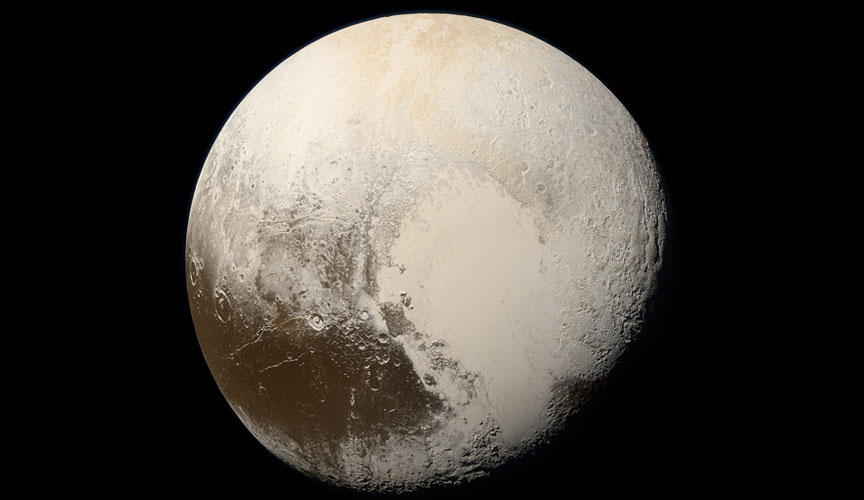
    Hidden Ocean Inside Pluto
    Natural color images of Pluto taken by NASA’s New Horizons spacecraft in 2015. Credit: NASA/Johns Hopkins University Applied Physics Laboratory/Southwest Research Institute/Alex Parker

    Computer simulations provide compelling evidence that an insulating layer of gas hydrates could keep a subsurface ocean from freezing beneath Pluto’s icy exterior, according to a study published in the journal Nature Geoscience.

    In July 2015, NASA’s New Horizons spacecraft flew through Pluto’s system, providing the first-ever close-up images of this distant dwarf planet and its moons. The images showed Pluto’s unexpected topography, including a white-colored ellipsoidal basin named Sputnik Planitia, located near the equator and roughly the size of Texas.

    Because of its location and topography, scientists believe a subsurface ocean exists beneath the ice shell which is thinned at Sputnik Planitia. However, these observations are contradictory to the age of the dwarf planet because the ocean should have frozen a long time ago and the inner surface of the ice shell facing the ocean should have also been flattened.
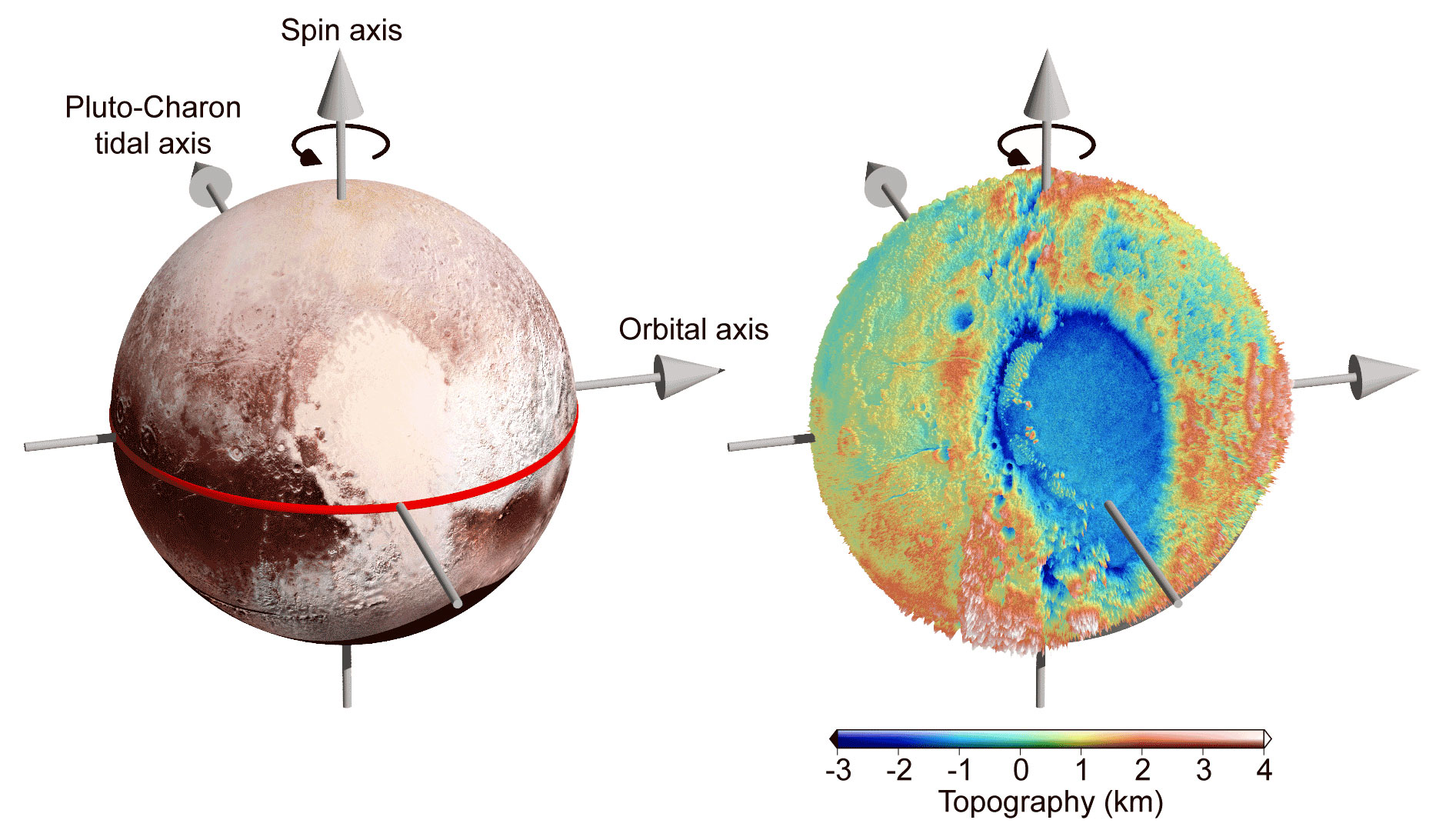
    Possible Hidden Ocean Inside Pluto
    The bright “heart” on Pluto is located near the equator. Its left half is a big basin dubbed Sputnik Planitia. Credit: Figures created using images by NASA/Johns Hopkins University Applied Physics Laboratory/Southwest Research Institute.

    Researchers at Japan’s Hokkaido University, the Tokyo Institute of Technology, Tokushima University, Osaka University, Kobe University, and at the University of California, Santa Cruz, considered what could keep the subsurface ocean warm while keeping the ice shell’s inner surface frozen and uneven on Pluto. The team hypothesized that an “insulating layer” of gas hydrates exists beneath the icy surface of Sputnik Planitia. Gas hydrates are crystalline ice-like solids formed of gas trapped within molecular water cages. They are highly viscous, have low thermal conductivity, and could therefore provide insulating properties.

    The researchers conducted computer simulations covering a timescale of 4.6 billion years, when the solar system began to form. The simulations showed the thermal and structural evolution of Pluto’s interior and the time required for a subsurface ocean to freeze and for the icy shell covering it to become uniformly thick. They simulated two scenarios: one where an insulating layer of gas hydrates existed between the ocean and the icy shell, and one where it did not.
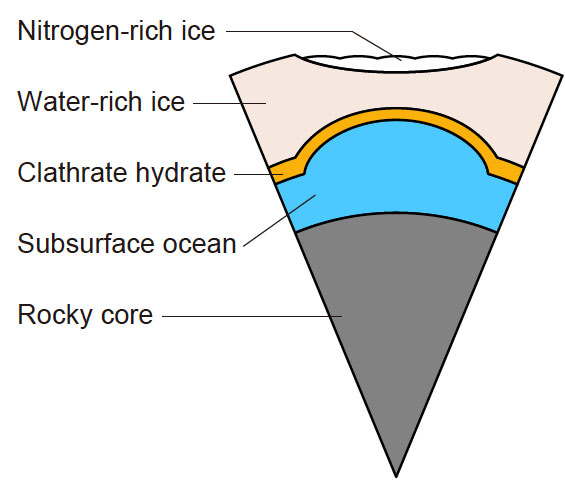
    Ocean Inside Pluto
    The proposed interior structure of Pluto. A thin clathrate (gas) hydrate layer works as a thermal insulator between the subsurface ocean and the ice shell, keeping the ocean from freezing. Credit: Kamata S. et al., Pluto’s ocean is capped and insulated by gas hydrates. Nature Geosciences, May 20, 2019

    The simulations showed that, without a gas hydrate insulating layer, the subsurface sea would have frozen completely hundreds of millions of years ago; but with one, it hardly freezes at all. Also, it takes about one million years for a uniformly thick ice crust to completely form over the ocean, but with a gas hydrate insulating layer, it takes more than one billion years.

    The simulation’s results support the possibility of a long-lived liquid ocean existing beneath the icy crust of Sputnik Planitia.

    The team believes that the most likely gas within the hypothesized insulating layer is methane originating from Pluto’s rocky core. This theory, in which methane is trapped as a gas hydrate, is consistent with the unusual composition of Pluto’s atmosphere — methane-poor and nitrogen-rich.

    Similar gas hydrate insulating layers could be maintaining long-lived subsurface oceans in other relatively large but minimally heated icy moons and distant celestial objects, the researchers conclude. “This could mean there are more oceans in the universe than previously thought, making the existence of extraterrestrial life more plausible,” says Shunichi Kamata of Hokkaido University who led the team.

    Reference: “Pluto’s ocean is capped and insulated by gas hydrates. Nature Geosciences” by Shunichi Kamata, Francis Nimmo, Yasuhito Sekine, Kiyoshi Kuramoto, Naoki Noguchi, Jun Kimura and Atsushi Tani, 20 May 2019, Nature Geoscience.
    DOI: 10.1038/s41561-019-0369-8

    Never miss a breakthrough: Join the SciTechDaily newsletter.
    Follow us on Google and Google News.

    Astronomy Hokkaido University Johns Hopkins APL Planetary Science Pluto Popular
    Share. Facebook Twitter Pinterest LinkedIn Email Reddit

    Related Articles

    Chandra Detects X-Rays from Pluto

    NASA Reveals New Pluto Images from New Horizons Spacecraft

    NASA’s New Horizons Spacecraft Reaches Historic Encounter with Pluto

    New Horizons Reveals Signs of Pluto’s Geology

    Dwarf Planet Pluto: The ‘Other’ Red Planet

    Hubble Reveals That Two of Pluto’s Moons Wobble Unpredictably

    New Horizons Spacecraft Awakens for Encounter with Pluto System

    Planetary Scientists Debate: Is Pluto a Planet?

    Cracks in Pluto’s Moon Charon Could Reveal That it Once Had an Underground Ocean

    2 Comments

    1. Carole Gledhill on May 22, 2019 5:35 am

      Very Interesting.

      Reply
    2. Brad Peen on May 22, 2019 12:55 pm

      I wanted to go there. Does anyone been there before? I bet no one did. Its a coldest planet. I wonder whats like to lived there.

      Reply
    Leave A Reply Cancel Reply

    • Facebook
    • Twitter
    • Pinterest
    • YouTube

    Don't Miss a Discovery

    Subscribe for the Latest in Science & Tech!

    Trending News

    Scientists May Have Found the Key to Jupiter and Saturn’s Moon Mystery

    Scientists Uncover Brain Changes That Link Pain to Depression

    Saunas May Do More Than Raise Body Temperature – They Activate Your Immune System

    Exercise in a Pill? Metformin Shows Surprising Effects in Cancer Patients

    Hidden Oceans of Magma Could Be Protecting Alien Life

    New Study Challenges Alzheimer’s Theories: It’s Not Just About Plaques

    Artificial Sweeteners May Harm Future Generations, Study Suggests

    Splashdown! NASA Artemis II Returns From Record-Breaking Moon Mission

    Follow SciTechDaily
    • Facebook
    • Twitter
    • YouTube
    • Pinterest
    • Newsletter
    • RSS
    SciTech News
    • Biology News
    • Chemistry News
    • Earth News
    • Health News
    • Physics News
    • Science News
    • Space News
    • Technology News
    Recent Posts
    • Scientists Discover Game-Changing New Way To Treat High Cholesterol
    • Breakthrough Drug Delays Rheumatoid Arthritis for Years After Treatment Ends
    • This Small Change to Your Exercise Routine Could Be the Secret to Living Longer
    • Physicists Discover a Strange New Kind of One-Dimensional Particle
    • Scientists Discover Unexpected Climate Benefit Hidden in Forest Soils
    Copyright © 1998 - 2026 SciTechDaily. All Rights Reserved.
    • Science News
    • About
    • Contact
    • Editorial Board
    • Privacy Policy
    • Terms of Use

    Type above and press Enter to search. Press Esc to cancel.