
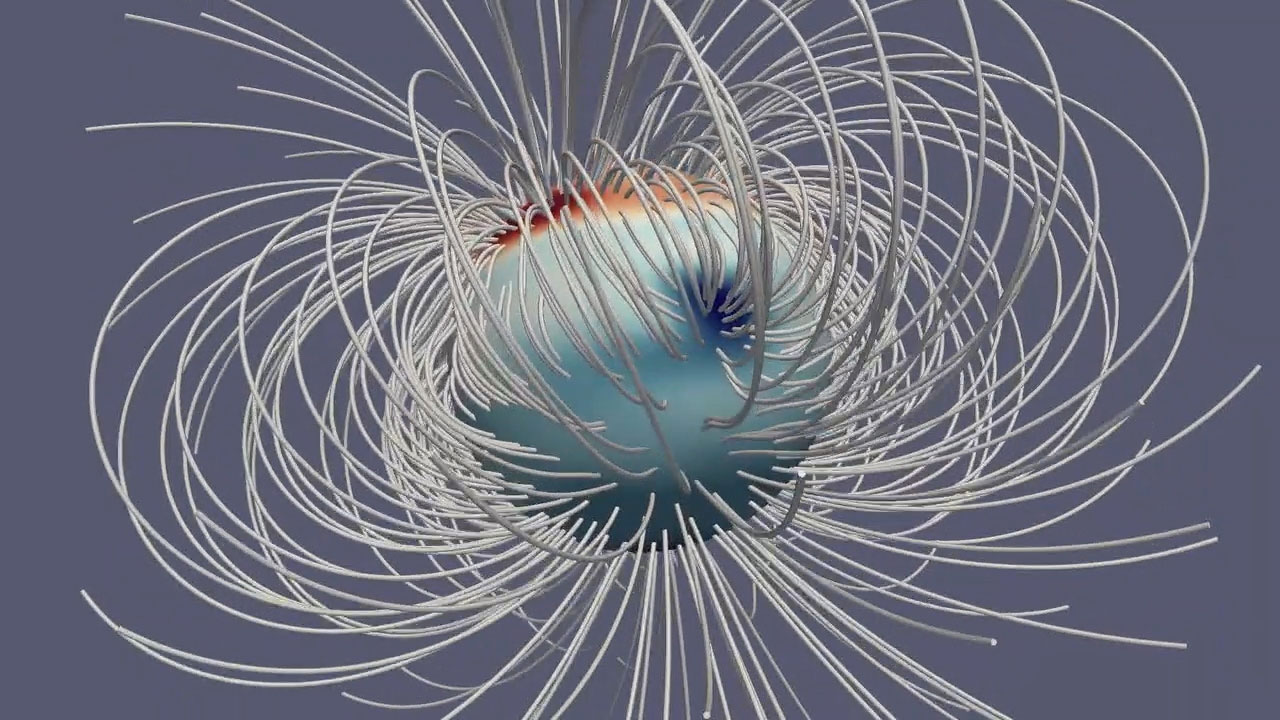
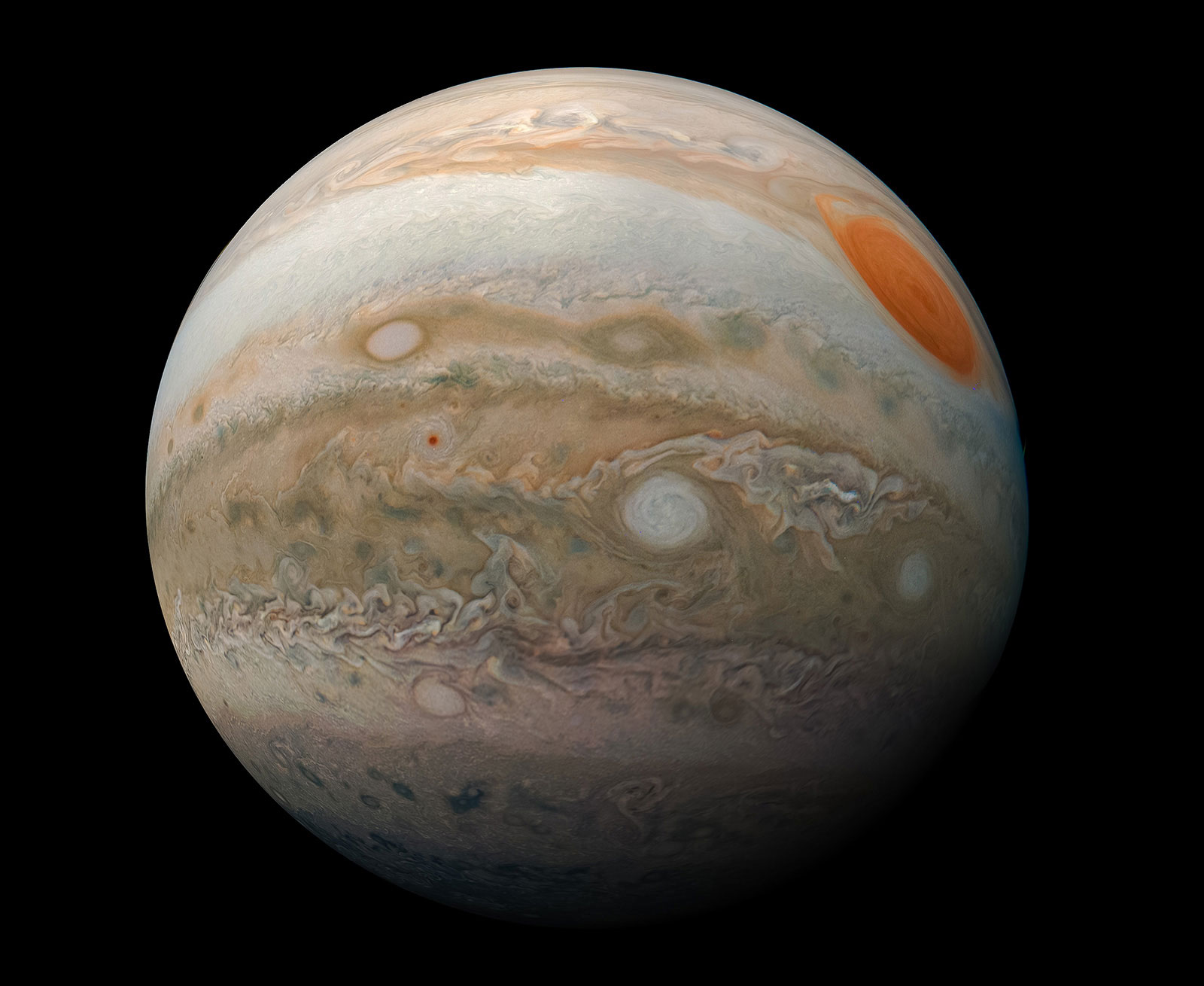
NASA’s Juno mission to Jupiter made the first definitive detection beyond our world of an internal magnetic field that changes over time, a phenomenon called secular variation. Juno determined the gas giant’s secular variation is most likely driven by the planet’s deep atmospheric winds.
The discovery will help scientists further understand Jupiter’s interior structure — including atmospheric dynamics — as well as changes in Earth’s magnetic field. A paper on the discovery was published today in the journal Nature Astronomy.
“Secular variation has been on the wish list of planetary scientists for decades,” said Scott Bolton, Juno principal investigator from the Southwest Research Institute in San Antonio. “This discovery could only take place due to Juno’s extremely accurate science instruments and the unique nature of Juno’s orbit, which carries it low over the planet as it travels from pole to pole.”
Characterizing the magnetic field of a planet requires close-up measurements. Juno scientists compared data from NASA’s past missions to Jupiter (Pioneer 10 and 11, Voyager 1 and Ulysses) to a new model of Jupiter’s magnetic field (called JRM09). The new model was based on data collected during Juno’s first eight science passes of Jupiter using its magnetometer, an instrument capable of generating a detailed three-dimensional map of the magnetic field.
What scientists found is that from the first Jupiter magnetic field data provided by the Pioneer spacecraft through to the latest data provided by Juno, there were small but distinct changes to the field.
“Finding something as minute as these changes in something so immense as Jupiter’s magnetic field was a challenge,” said Kimee Moore, a Juno scientist from Harvard University in Cambridge, Massachusetts. “Having a baseline of close-up observations over four decades long provided us with just enough data to confirm that Jupiter’s magnetic field does indeed change over time.”
Once the Juno team proved secular variation did occur, they sought to explain how such a change might come about. The operation of Jupiter’s atmospheric (or zonal) winds best explained the changes in its magnetic field. These winds extend from the planet’s surface to over 1,860 miles (3,000 kilometers) deep, where the planet’s interior begins changing from gas to highly conductive liquid metal. They are believed to shear the magnetic fields, stretching them and carrying them around the planet.
Nowhere was Jupiter’s secular variation as large as at the planet’s Great Blue Spot, an intense patch of magnetic field near Jupiter’s equator. The combination of the Great Blue Spot, with its strong localized magnetic fields, and strong zonal winds at this latitude result in the largest secular variations in the field on the Jovian world.
“It is incredible that one narrow magnetic hot spot, the Great Blue Spot, could be responsible for almost all of Jupiter’s secular variation, but the numbers bear it out,” said Moore. “With this new understanding of magnetic fields, during future science passes we will begin to create a planetwide map of Jupiter’s secular variation. It may also have applications for scientists studying Earth’s magnetic field, which still contains many mysteries to be solved.”
NASA’s JPL manages and operates the Juno mission for the principal investigator, Scott Bolton, of the Southwest Research Institute in San Antonio. Juno is part of NASA’s New Frontiers Program, which is managed by NASA’s Marshall Space Flight Center in Huntsville, Alabama, for the agency’s Science Mission Directorate. The Italian Space Agency (ASI) contributed two instruments, a Ka-band frequency translator (KaT) and the Jovian Infrared Auroral Mapper (JIRAM). Lockheed Martin Space in Denver built and operates the spacecraft.
Never miss a breakthrough: Join the SciTechDaily newsletter.
Follow us on Google and Google News.