
A study that investigated 42 superflares challenges the traditional blackbody radiation model of superflares, proposing the hydrogen recombination model as a more accurate explanation based on physical plausibility and energy estimates.
Although their primary purpose is to look for exoplanets, observatories like the Kepler Space Telescope and the Transiting Exoplanet Survey Satellite (TESS) have supplied a vast amount of data on stellar flares, detected with high-precision photometry by broadband filters in the visible light spectrum.
The stars are so far away that they appear only as points of light to these telescopes, and the phenomena interpreted as stellar flares are abrupt increases in the brightness of these points.
Challenges in Stellar Flare Research
There is also a lack of data in other parts of the electromagnetic spectrum, and most studies of these events focus on irradiated energy. Observations have detected “superflares,” huge magnetic eruptions in the atmosphere of stars with energies 100 to 10,000 times greater than the most energetic solar flares. The question is whether any of the available models can explain such high levels of energy.
Two models are available. The more popular one treats the radiation of a superflare as blackbody emission at a temperature of 10,000 Kelvin. The other associates the phenomenon with a process of ionization and recombination of hydrogen atoms.
A study conducted by researchers affiliated with the Mackenzie Center for Radio Astronomy and Astrophysics (CRAAM) at Mackenzie Presbyterian University (UPM) in Brazil and the University of Glasgow’s School of Physics and Astronomy in the United Kingdom analyzed the two models.
The group received support from FAPESP via three projects. An article on the study is published in Monthly Notices of the Royal Astronomical Society.
Research Findings
“Given the known processes of energy transfer in flares, we argue that the hydrogen recombination model is physically more plausible than the blackbody model to explain the origin of the broadband optical emission from flares,” said Paulo Simões, first author of the article and a professor at UPM.
The researchers analyzed 37 superflares on the binary star system Kepler-411 and five superflares on the star Kepler-396, using the two models. “We concluded that estimates for total flare energy based on the hydrogen recombination model are about an order of magnitude lower than the values obtained using the blackbody radiation model, and are a better fit to the known flare processes,” Simões said.
Solar Flares as a Model
These processes are described in terms of solar flares. Despite many differences, solar flares continue to inform the models on which stellar flares are interpreted. A huge amount of information has been accumulated on solar flares, first documented in the astronomical literature by two English astronomers, Richard Carington and Richard Hodgson, who independently observed the same solar flare on September 1, 1859.
“Since then, solar flares have been observed with intense brightness lasting seconds to hours and at different wavelengths, from radio waves and visible light to ultraviolet and X-rays. Solar flares are among the most energetic phenomena in our solar system and can affect satellite operations, radio communications, power grids, and navigation and GPS systems, to take just a few examples,” said Alexandre Araújo, PhD candidate at CRAAM, schoolteacher, and co-author of the article.
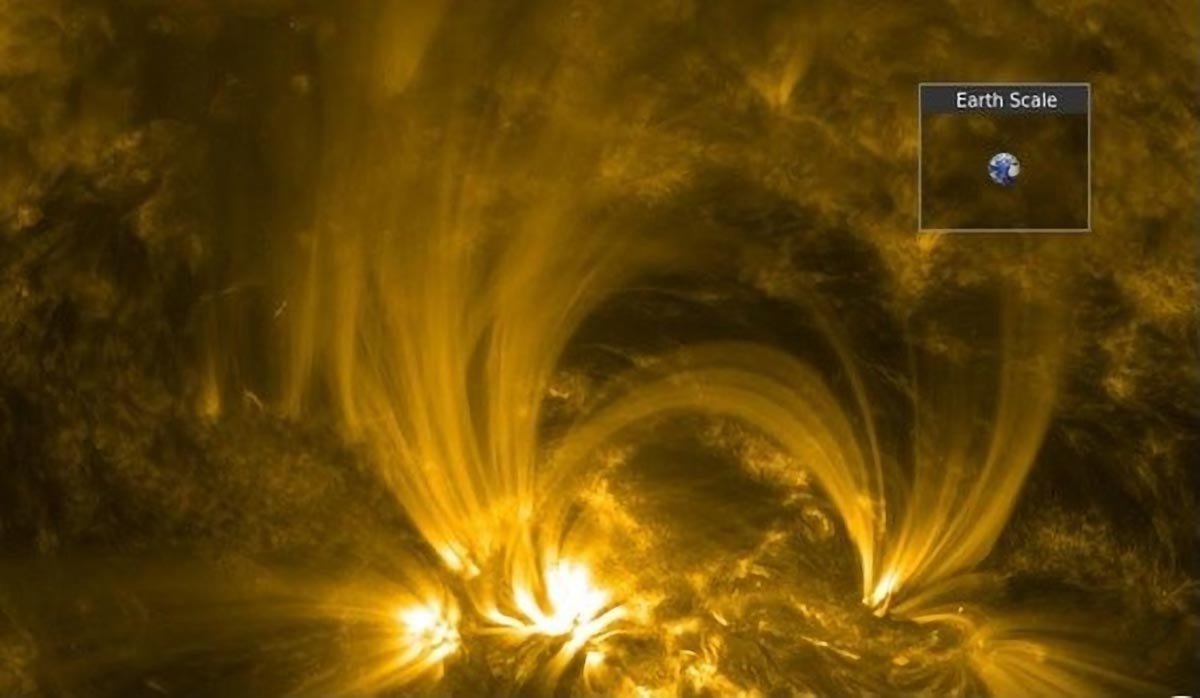
Solar flares occur in active regions associated with intense magnetic fields, where abundant amounts of energy are abruptly released in the corona (the Sun’s outermost layer) by reconnection of the magnetic field, heating the plasma and accelerating electrons and ions, among other particles.
“Because they have less mass, electrons can be accelerated to a large fraction of the speed of light, typically about 30% but sometimes more. The accelerated particles travel along the magnetic field lines, and some are ejected into interplanetary space while others go in the opposite direction into the chromosphere, the layer below the corona, where they collide with the high-density plasma and their energy is transferred to the medium. The surplus energy heats the local plasma, causing ionization and excitation of the atoms, and consequently producing radiation, which we can detect with telescopes on Earth’s surface and in space,” Simões explained.
Ongoing Challenges in Flare Research
Since the 1960s, many observational and theoretical studies have attempted to explain the exceptionally large amount of visible light emitted by solar flares, but a definitive solution has not been found to date. The most popular explanations produced by these studies are (1) blackbody radiation from heating of the photosphere, the layer below the chromosphere, and (2) hydrogen recombination radiation in the chromosphere. This recombination occurs when protons and electrons separated by ionization reunite to form hydrogen atoms.
“The limitation of the first case can be summed up as a matter of energy transport: none of the energy transport mechanisms normally accepted for solar flares has the capacity to deliver the energy required in the photosphere to cause sufficient plasma heating to explain the observations,” Simões said.
Araújo agreed: “Calculations first performed in the 1970s and later confirmed by computer simulations show that most of the electrons accelerated in solar flares fail to cross the chromosphere and enter the photosphere. The blackbody model as an explanation of white light in solar flares is therefore incompatible with the main energy transport process accepted for solar flares,” he said.
As for the hydrogen recombination radiation model, it is more consistent from the physical standpoint but unfortunately cannot yet be confirmed by observations, the researchers conclude, although the article provides additional arguments in favor of this model, which has been neglected in most studies.
Reference: “Hydrogen recombination continuum as the radiative model for stellar optical flares” by Paulo J A Simões, Alexandre Araújo, Adriana Válio and Lyndsay Fletcher, 17 January 2024, Monthly Notices of the Royal Astronomical Society.
DOI: 10.1093/mnras/stae186
Never miss a breakthrough: Join the SciTechDaily newsletter.
Follow us on Google and Google News.