
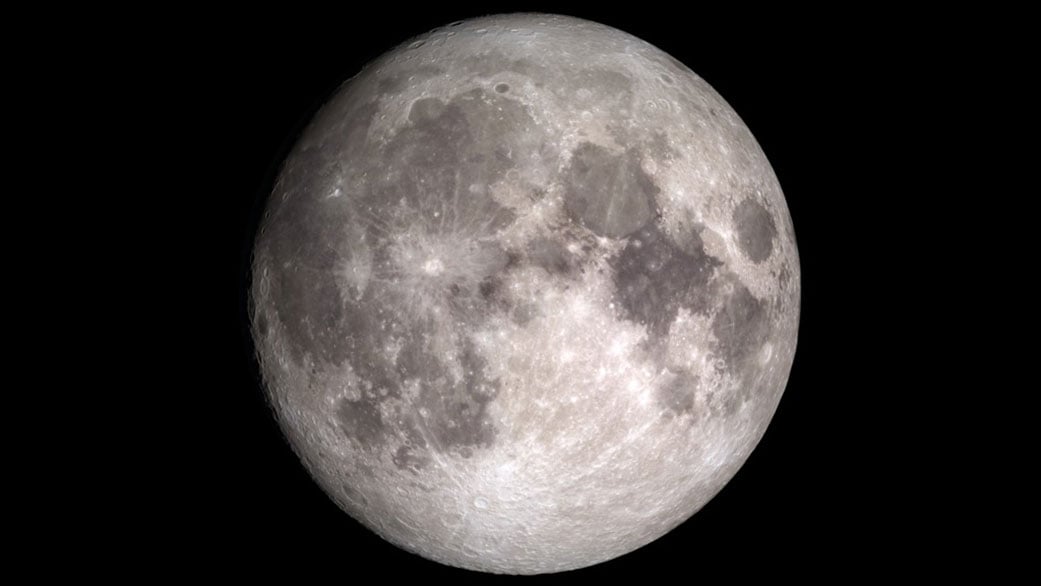
Little is known about the inner structure of the Moon, but a major step forward was made by a University of Rhode Island scientist who conducted experiments that enabled her to determine the temperature at the boundary of the Moon’s core and mantle.
She found the temperature to be between 1,300 and 1,470 degrees Celsius (2,400 and 2,700 degrees Fahrenheit), which is at the high end of an 800 degree range that previous scientists had determined.
“In order to understand the interior structure of the Moon today, we needed to nail down the thermal state better,” said Ananya Mallik, a URI assistant professor of geosciences who joined the University faculty in December 2018. “Now we have the two anchor points – the core-mantle boundary and the surface temperature measured by Apollo – and that will help us create a temperature profile through the Moon. We need that temperature profile to determine the internal state, structure, and composition of the Moon.”
The surface temperature of the Moon is approximately -20 C (-4 F).
According to Mallik, the Moon has an iron core, like that of Earth, and previous research using seismic data found that between 5 and 30 percent of the material at the boundary of the core and mantle was in a liquid or molten state.
“The big question is, why would we have some melt present in the Moon at that depth,” Mallik said.
To begin to answer this question, Mallik conducted a series of experiments in 2016 at the Bavarian Research Institute of Experimental Geochemistry and Geophysics in Germany using a multi-anvil device that can exert the high pressures found deep inside the Moon. She prepared a tiny sample of material similar to that found on the Moon, squeezed it in the device at 45,000 times the Earth’s atmospheric pressure, which is the pressure believed to exist at the Moon’s core-mantle boundary, and used a graphite heater to raise the temperature of the sample until it partially melted.
“The goal was to determine what temperature range would produce a 5 to 30 percent melt, which would tell us the temperature range of the core-mantle boundary,” she said.
Now that the temperature range at the boundary has been narrowed, scientists can begin to develop a more precise temperature profile of the Moon and proceed to determine a profile of the minerals that make up the mantle from its crust to its core.
“It’s important that we know the composition of the Moon to better understand why it has evolved as it has,” Mallik said. “The histories of the Earth and Moon have been intertwined since the beginning. In fact, both are the product of a great collision between proto-Earth and an approximately Mars-sized body that occurred over 4.5 billion years ago. So to understand our Earth better, we have to know our nearest neighbor because we all had a common start.
“Earth is complicated,” she continued. “Any similarity in the composition between Earth and the Moon can give us insight into how these two planetary bodies were formed, what were the energetics of the collision, and how elements were partitioned between them.”
The URI geoscientist noted that Earth has evolved through the process of plate tectonics, which is responsible for the distribution of the continents, the topography of Earth’s surface, the regulation of long-term climate, and perhaps even the origin of life. But there is no evidence of plate tectonics on the Moon.
“Everything on Earth happens because of plate tectonics,” she said. “What does this tell us about our own planet when the Moon doesn’t experience this process? It’s the same argument for why we study Mars and Venus. They are our next closest neighbors, and we all had a common start, but why are they so different from our planet?”
The next steps in Mallik’s research will involve experimentally determining the density of the molten material at the core-mantle boundary, which will further refine the temperature range. In collaboration with Heidi Fuqua Haviland at NASA’s Marshall Space Flight Center and Paul Bremner at the University of Florida, she will then combine these results with computational methods to derive the temperature profile and composition of the interior of the Moon.
Mallik’s research was published on April 1 in the journal Geochimica et Cosmochimica Acta. Co-authors are Tariq Ejaz, a graduate student at the National Center for Antarctic and Ocean Research in India; Svyatoslav Shcheka, a postdoctoral researcher at the Bavarian Research Institute of Experimental Geochemistry and Geophysics in Germany; and Gordana Garapic, assistant professor at the State University of New York at New Paltz.
Reference: “A petrologic study on the effect of mantle overturn: Implications for evolution of the lunar interior” by Ananya Mallik, Tariq Ejaz, Svyatoslav Shcheka and Gordana Garapic, 14 February 2019, Geochimica et Cosmochimica.
DOI: 10.1016/j.gca.2019.02.014
Never miss a breakthrough: Join the SciTechDaily newsletter.
Follow us on Google and Google News.