
Close Menu
    Facebook X (Twitter) Instagram
    SciTechDaily
    • Biology
    • Chemistry
    • Earth
    • Health
    • Physics
    • Science
    • Space
    • Technology
    Facebook X (Twitter) Pinterest YouTube RSS
    SciTechDaily
    Home»Biology»Scientists Can Now Watch Plants “Breathe” in Real Time
    Biology

    Scientists Can Now Watch Plants “Breathe” in Real Time

    By University of Illinois at Urbana-Champaign Institute for Sustainability, Energy, and EnvironmentJanuary 10, 2026No Comments4 Mins Read
    Facebook Twitter Pinterest Telegram LinkedIn WhatsApp Email Reddit
    Share
    Facebook Twitter LinkedIn Pinterest Telegram Email Reddit
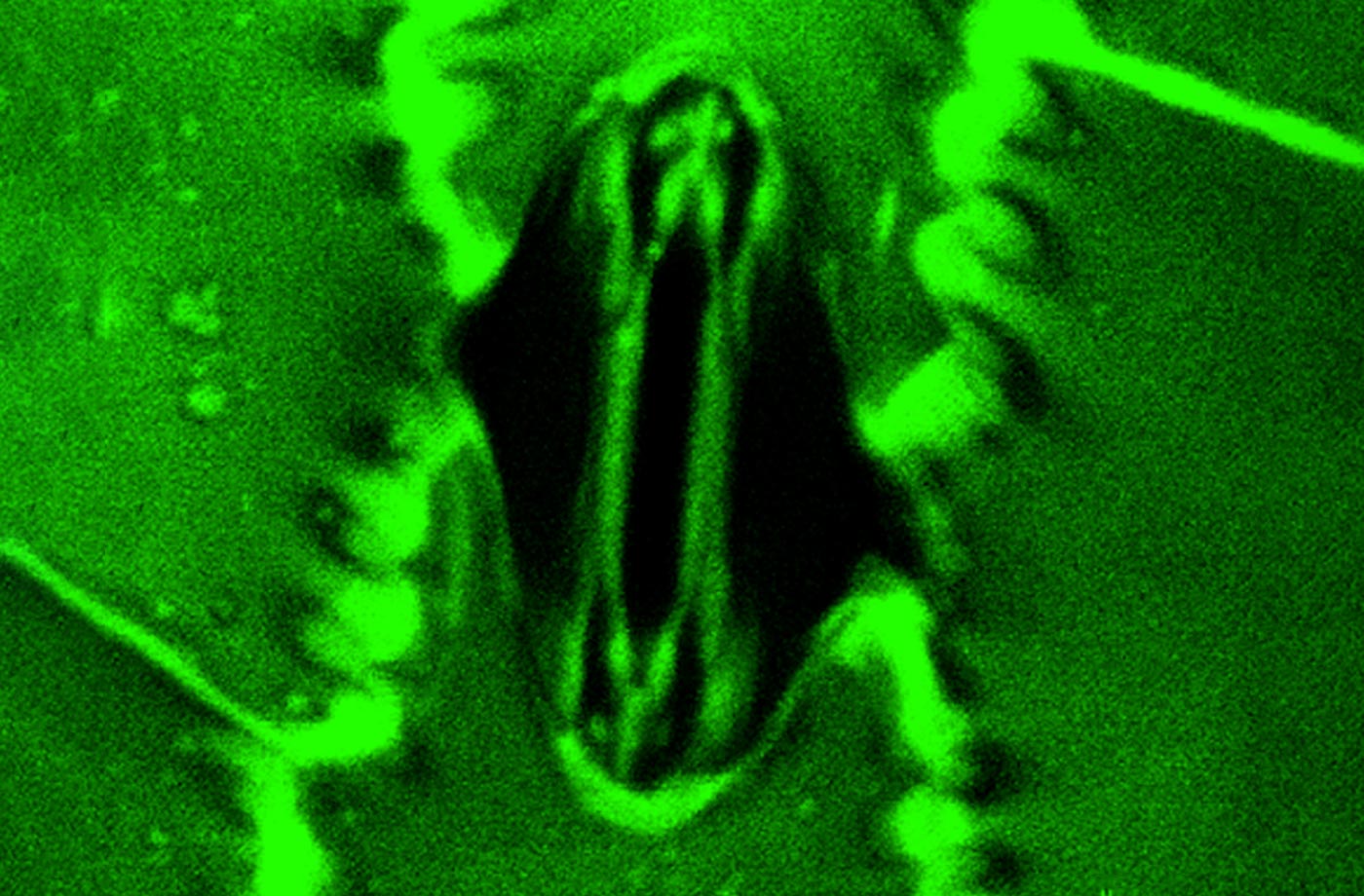
    Watch Plants “Breathe” in Real Time
    A new tool lets scientists watch plants breathe live, revealing how they survive and save water. Credit: Plant Physiology, Volume 199, Issue 4, December 2025, kiaf600, https://doi.org/10.1093/plphys/kiaf600

    Plants constantly balance taking in carbon dioxide with losing water through microscopic leaf pores, but watching this process unfold has long been a challenge.

    For hundreds of years, scientists have understood that plants exchange gases with the air through tiny openings on their leaves known as stomata. These microscopic structures regulate a delicate tradeoff, allowing carbon dioxide to enter for photosynthesis while permitting water vapor to escape into the atmosphere.

    Researchers at the University of Illinois Urbana-Champaign have now created an advanced tool that makes it possible to observe and measure this balancing act as it happens, while precisely controlling the surrounding environment.

    Plant Scientist Holding Twig
    A key plant process that governs growth, water use, and survival has largely been inferred rather than directly observed. A new experimental system now allows scientists to connect microscopic behavior inside leaves with whole-plant function under realistic conditions. Credit: Stock

    The work, published in the journal Plant Physiology, describes a new system called “Stomata In-Sight.” The technology addresses a persistent challenge in plant science by making it possible to track the minute movements of stomatal pores while also recording how much gas flows in and out of the leaf at the same time.

    Stomata, whose name comes from the Greek word for “mouths,” play a central role in agriculture worldwide. Opening these pores allows plants to take in the carbon needed for growth, but it also increases water loss. Understanding how both the number of stomata and their behavior influence the efficiency of gas exchange is therefore essential for developing crops that use water more efficiently and can continue producing food, biofuel and bioproducts under drought conditions.

    “Traditionally, we’ve had to choose between seeing the stomata or measuring their function,” explained the research team.
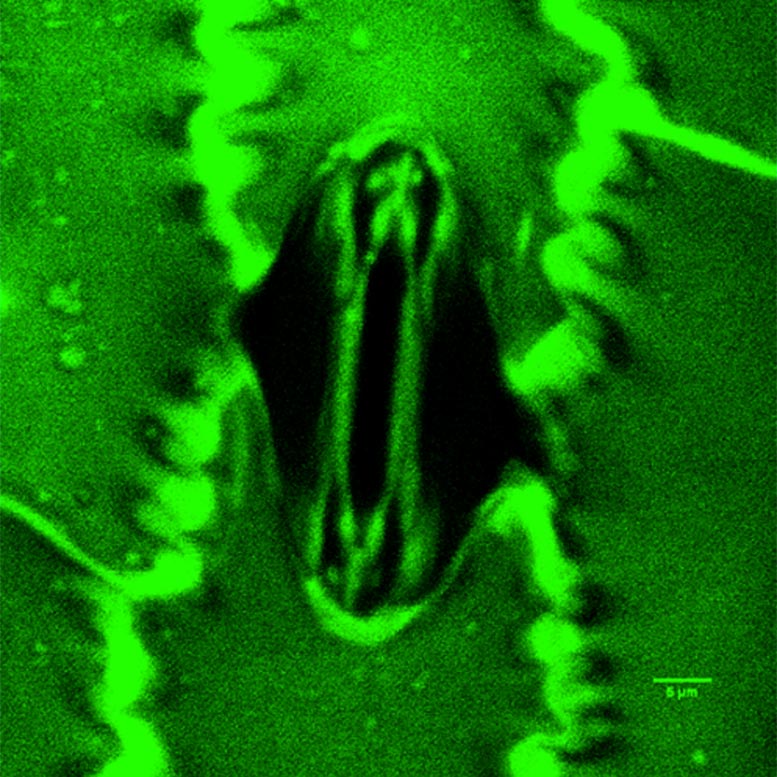
    Open Zea mays Stoma
    Representative 16-bit confocal microscope image of an open Zea mays stoma. Credit: Plant Physiology, Volume 199, Issue 4, December 2025, kiaf600, https://doi.org/10.1093/plphys/kiaf600

    Earlier techniques typically relied on making leaf impressions (like taking a dental mold), which provide only a single moment in time, or on conventional microscopes that cannot control the environmental conditions around the leaf.

    This limitation matters because stomata respond quickly to changes in light, temperature, humidity, and other environmental factors.

    A Window into the Leaf

    The new “Stomata In-Sight” system integrates three complex technologies into one:

    1. Live Confocal Microscopy: A powerful imaging technique that uses lasers to create detailed, three-dimensional views of living cells without slicing into the plant.
    2. Leaf Gas Exchange: High-precision sensors that measure exactly how much CO2 the leaf is taking in and how much water it is releasing.
    3. Environmental Control: A chamber that allows researchers to manipulate light, temperature, humidity, and carbon dioxide levels to mimic real-world conditions.

    By combining these, the team can watch exactly how the stomata respond to variation in the environment.

    Why It Matters

    This high-definition view of plant physiology could revolutionize how we breed crops.

    By understanding the precise mechanical and chemical signals that cause stomata to open or close, and how that is influenced by the number of stomata on a leaf, scientists can identify genetic traits that lead to “smarter” plants—crops that use water most efficiently. That is crucial because water is the environmental factor that limits agricultural production the most.

    Reference: “Stomata in-sight: Integrating live confocal microscopy with leaf gas exchange and environmental control” by Joseph D Crawford, Dustin Mayfield-Jones, Glenn A Fried, Nicolas Hernandez and Andrew D B Leakey, 17 November 2025, Plant Physiology.
    DOI: 10.1093/plphys/kiaf600

    The system was developed by Joseph D. Crawford, Dustin Mayfield-Jones, Glenn A. Fried, Nicolas Hernandez, and Andrew D.B. Leakey at the Department of Plant Biology and the Institute for Genomic Biology at the University of Illinois.

    The work was supported by the U.S. Department of Energy’s Center for Advanced Bioenergy and Bioproducts Innovation, the National Science Foundation, and a philanthropic gift.

    Never miss a breakthrough: Join the SciTechDaily newsletter.
    Follow us on Google and Google News.

    Agriculture Plant Science Popular University of Illinois at Urbana-Champaign
    Share. Facebook Twitter Pinterest LinkedIn Email Reddit

    Related Articles

    Bacterial Invasion: How One Pathogen Threatens Every Plant on Earth

    The Photosynthesis Upgrade: Creating Super Crops for a Changing World

    Scientists Use CRISPR To Turn Sugarcane Into a Super Crop

    Lychee Genome Tells a Colorful Story About an Ancient Tropical Fruit

    Scientists Discover Unreported Plant Body Part – “I Thought It Must Be an Artifact of Genetic Contamination”

    70-Year-Old Coffee-Killing Fungus Brought Back to Life by Scientists – Here’s Why

    Non-Native Seeds Discovered on Shipping Containers Pose Significant Threats

    Photosynthesis Hacks Boost Yield and Conserve Water

    Group Genomics Drive Aggression in Africanized Honey Bees

    Leave A Reply Cancel Reply

    • Facebook
    • Twitter
    • Pinterest
    • YouTube

    Don't Miss a Discovery

    Subscribe for the Latest in Science & Tech!

    Trending News

    Popular Sugar-Free Sweetener Linked to Liver Disease, Study Warns

    What Is Hantavirus? The Deadly Disease Raising Alarm Worldwide

    Scientists Just Discovered How the Universe Builds Monster Black Holes

    Scientists Unveil New Treatment Strategy That Could Outsmart Cancer

    A Simple Vitamin May Hold the Key to Treating Rare Genetic Diseases

    Scientists Think the Real Fountain of Youth May Be Hiding in Your Gut

    Ravens Don’t Follow Wolves, They Predict Them

    This Common Knee Surgery May Be Doing More Harm Than Good

    Follow SciTechDaily
    • Facebook
    • Twitter
    • YouTube
    • Pinterest
    • Newsletter
    • RSS
    SciTech News
    • Biology News
    • Chemistry News
    • Earth News
    • Health News
    • Physics News
    • Science News
    • Space News
    • Technology News
    Recent Posts
    • Why Are So Many New Fathers Dying? Scientists Say the U.S. Has a Dangerous Blind Spot
    • Scientists Identify Simple Supplement That Greatly Reduces Alzheimer’s Damage
    • You May Have a Dangerous Type of Cholesterol Even if Your Tests Look Normal
    • Study Reveals Dangerous Flaw in AI Symptom Checkers
    • New MRI Breakthrough Captures Stunningly Clear Images of the Eye and Brain
    Copyright © 1998 - 2026 SciTechDaily. All Rights Reserved.
    • Science News
    • About
    • Contact
    • Editorial Board
    • Privacy Policy
    • Terms of Use

    Type above and press Enter to search. Press Esc to cancel.