
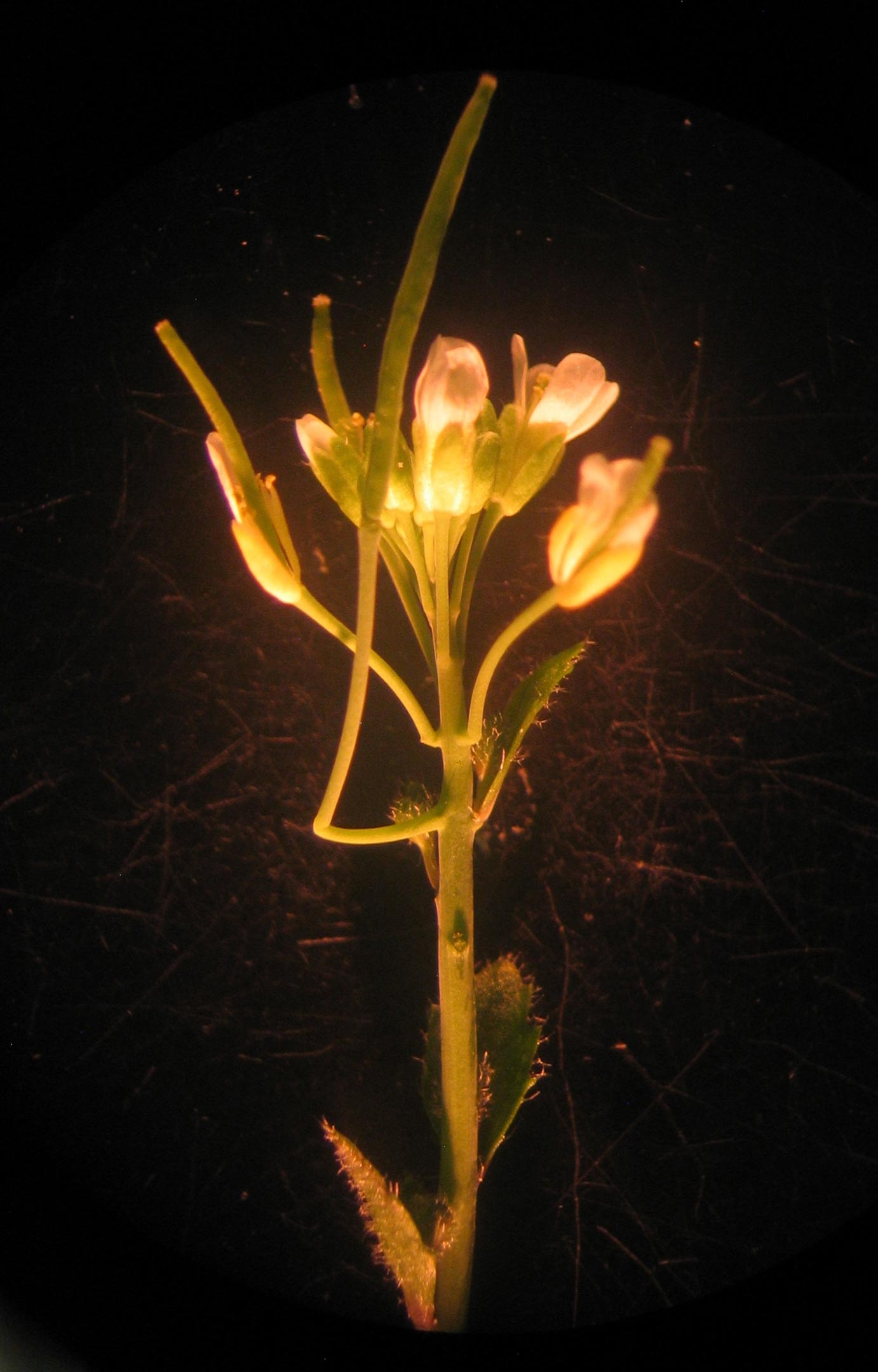
A decade-long study uncovered a hidden flower-supporting structure, the “cantil,” in Arabidopsis thaliana, revealing new genetic and environmental insights into plant architecture.
For many, the Thale cress (Arabidopsis thaliana) is little more than a roadside weed, but this plant has a long history with scientists trying to understand how plants grow and develop. Arabidopsis was first scientifically described as early as the 16th century and the first genetic mutant was identified in the 1800s. Since the 1940s, Arabidopsis has increased in popularity within the scientific community, which continues to use it as a model system to explore plant genetics, development, and physiology to this day.
One might expect that after decades of scientific scrutiny the structure of Arabidopsis had been fully documented, but a new study from scientists from The Pennsylvania State University, USA, has revealed that this humble plant still has some surprises. The researchers describe a previously unreported structure called the ‘cantil’, which connects to the stem at one end and hangs in the air to hold up the flower-bearing stalk, similar to the function of a cantilever in structural engineering.
“I first observed the cantils in 2008,” said Dr. Timothy Gookin, a postdoctoral researcher working in the group of Professor Sarah Assmann. “I initially didn’t trust any of the results; I thought it must be an artifact of genetic contamination, perhaps combined with environmental contamination of the water, soil, fertilizer, or even the building air supply.”
Rare Conditions and Genetic Limitations
How have cantils eluded scientists for so long? First, cantils are rare; they only develop under certain conditions that cause the plant to delay flowering, such as short day lengths, and cantils only form at the precise point at which the plant begins to flower. In addition, as Dr. Gookin discovered, some popular Arabidopsis strains have genetic mutations that make them incapable of producing cantils at all.
Nonetheless, Dr. Gookin set about the gargantuan task of proving that cantils are a naturally occurring structure and not an artifact of mutation or contamination — an effort that took more than a decade. “It took over 12 years of experimentation to really get a grasp on what we were seeing and to understand how cantils were regulated. This study required the growth of 3,782 plants to full maturity and the manual inspection of over 20,000 flower-bearing stalks in 34 unique plant lines,” explained Dr. Gookin. “I finally deemed the cantils a natural phenomenon after identifying them in wild-type (non-mutant) plants from different sources, which were growing in independent locations and diverse conditions.”
Genetic Clues and Evolutionary Insights
During his extensive research, Dr. Gookin identified a number of mutant plants in which cantils appear more frequently, revealing some of the genetic factors that control cantil development. The discovery of cantils is not only a lesson in the virtues of perseverance, but their development also provides important clues for understanding the conditional growth of plant structures in response to their environment. “One speculative interpretation is that the cantil represents a highly repressed ancestral linkage between different types of flowering plant architectures; the multiple layers of genetic and environmental factors that regulate cantil development are certainly quite striking,” said Dr. Gookin.
Reference: “Cantil: a previously unreported organ in wild-type Arabidopsis regulated by FT, ERECTA and heterotrimeric G proteins” by Timothy E. Gookin and Sarah M. Assmann, 15 June 2021, Development.
DOI: 10.1242/dev.195545
Timothy Gookin is a postdoctoral researcher, and Sarah Assmann is the Waller Professor of Biology at Pennsylvania State University. Timothy Gookin is the lead corresponding author of the article.
Funding: National Science Foundation, NIH/National Institute of General Medical Sciences
Never miss a breakthrough: Join the SciTechDaily newsletter.
Follow us on Google and Google News.