

Scientists have traced the evolutionary path from C3 to C4 photosynthesis, discovering key regulatory changes that could enhance crop resilience and efficiency.
This groundbreaking research paves the way for agricultural advances that could help combat the effects of global warming.
Photosynthesis Evolution
Over 3 billion years ago, photosynthesis first appeared in ancient bacteria on an Earth completely covered by water. Over millions of years, these bacteria evolved into plants, adapting to changing environments along the way. About 30 million years ago, a significant advancement occurred: some plants developed a more efficient form of photosynthesis. While plants like rice retained the older C3 method, others, such as corn and sorghum, adopted the more advanced C4 photosynthesis.
Today, there are over 8,000 species of C4 plants, thriving in hot, dry climates and ranking among the world’s most productive crops. Despite this, the majority of plants still rely on the less efficient C3 process. This raises an intriguing question: how did C4 photosynthesis evolve, and is it possible to bring this efficiency to C3 plants?
Breakthrough in Plant Efficiency Research
Now, for the first time ever, Salk scientists and collaborators at the University of Cambridge discovered a key step C4 plants like sorghum needed to take to evolve to become so efficient at photosynthesizing—and how we could use this information to make crops like rice, wheat, and soybeans more productive and resilient against our warming climate.
The findings were published today (November 20) in Nature.
“Asking what makes C3 and C4 plants different is not just important from the basic biological perspective of wanting to know why something evolved and how it functions on the molecular level,” says Professor Joseph Ecker, senior author of the study, Salk International Council Chair in Genetics, and Howard Hughes Medical Institute investigator. “Answering this question is a huge step toward understanding how we can make the most robust and productive crops possible in the face of climate change and a growing global population.”
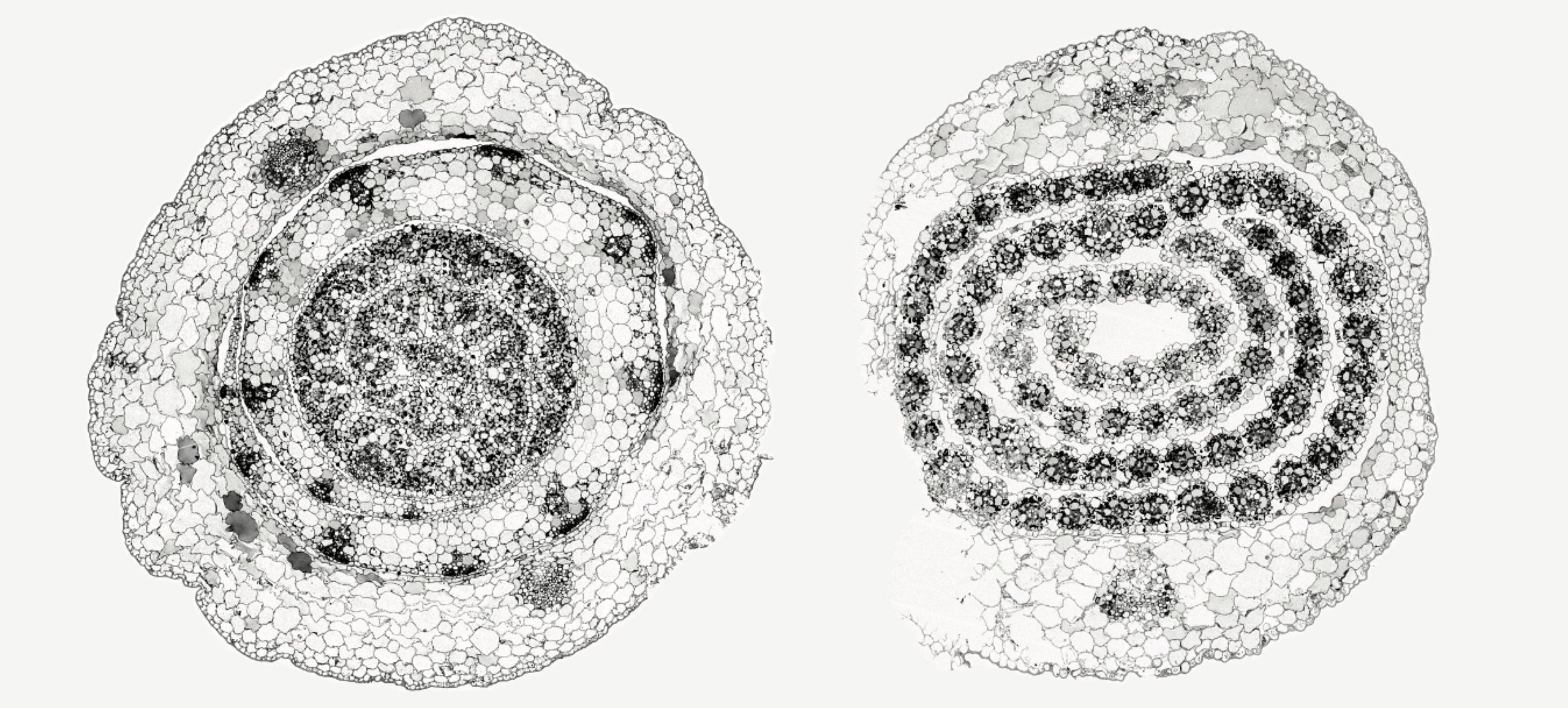
Understanding C3 and C4 Photosynthetic Processes
Around 95% of plants use C3 photosynthesis, in which mesophyll cells—green spongy cells that live inside leaves—turn light, water, and carbon dioxide into plant-powering sugars. Despite its high prevalence, C3 photosynthesis has two major shortcomings: 1) 20% of the time, oxygen is accidentally used instead of carbon dioxide and must be recycled, which slows down the process and wastes energy, and 2) pores on the leaf surface are open too frequently while waiting for carbon dioxide to enter, causing the plant to lose water and become more vulnerable to drought and heat.
Fortunately, evolution has solved these issues with C4 photosynthesis. C4 plants recruit bundle sheath cells, which normally serve as leaf vein support, to photosynthesize alongside mesophyll cells. As a result, C4 plants eliminate those oxygen-use mistakes to conserve energy and keep plant surface pores closed more often to conserve water. The result is a 50% increase in efficiency compared to C3 plants.
Genetic Insights Into C3 to C4 Evolution
But on the molecular level, what made C3 plants turn into C4 plants? And could scientists prompt C3 crops to become C4 crops?
To answer these questions, Salk scientists employed cutting-edge, single-cell genomics technology to look at the difference between C3 rice and C4 sorghum. While previous methods were too imprecise to distinguish neighboring cells like mesophyll and bundle sheath cells, single-cell genomics allowed the team to investigate the genetic and structural changes in each cell type from both plants.
“We were surprised and excited to find that the difference between C3 and C4 plants is not the removal or addition of specific genes,” says Ecker. “Rather, the difference is on a regulatory level, which could make it easier for us in the long run to turn on more efficient C4 photosynthesis in C3 crops.”

The Future of Photosynthesis in Agriculture
All cells within an organism contain the same genes, but which genes are expressed at any given time is what determines each cell’s identity and function. One way that gene expression can be modified is through the activity of transcription factors. These proteins recognize and bind to small stretches of DNA near the genes, called regulatory elements. Once in position at the regulatory element, a transcription factor can help turn the nearby genes “on” or “off.”
When measuring gene expression in rice and sorghum plants, the scientists found that a transcription factor family commonly referred to as DOFs was in charge of turning on the genes to make bundle sheath cells in both species. They also noticed that DOFs were binding to the same regulatory element in both species. However, in C4 sorghum plants, this regulatory element was not only associated with bundle sheath identity genes—it was also turning on the photosynthesis genes. That suggested that C4 plants had at some point tacked ancestral regulatory elements for bundle sheath genes onto photosynthesis genes, so that DOFs would turn on both sets of genes at the same time. This would explain how bundle sheath cells in C4 plants gained the ability to photosynthesize.
These experiments revealed that both C3 and C4 plants contain the necessary genes and transcription factors required for the superior C4 photosynthesis process—a promising discovery for scientists hoping to nudge C3 plants to use C4 photosynthesis.
“Now we’ve got this blueprint for how different plants utilize the sun’s energy to survive in different environments,” says Joseph Swift, co-first author of the study and a postdoctoral researcher in Ecker’s lab. “The ultimate goal is to try to switch C4 photosynthesis on and, in turn, create more productive and resilient crops for the future.”
Next on the docket for the team is determining whether rice can be engineered to use C4 photosynthesis rather than C3. This remains a very long-term goal with significant technical challenges that are being addressed by a global collaborative effort known as the “C4 Rice Project.” More immediately, the findings will inform the Salk Harnessing Plants Initiative’s mission to create optimized crops that simultaneously fight and withstand the threat of climate change.
Their single-cell genomics data has also been shared as a resource for scientists around the world, quickly garnering excitement for its answers to this long-standing mystery in evolution.
Reference: “Exaptation of ancestral cell-identity networks enables C4 photosynthesis” by Joseph Swift, Leonie H. Luginbuehl, Lei Hua, Tina B. Schreier, Ruth M. Donald, Susan Stanley, Na Wang, Travis A. Lee, Joseph R. Nery, Joseph R. Ecker and Julian M. Hibberd, 20 November 2024, Nature.
DOI: 10.1038/s41586-024-08204-3
Other authors include Travis Lee and Joseph Nery of Salk, as well as Leonie Luginbuehl, Lei Hua, Tina Schreier, Ruth Donald, Susan Stanley, Na Wang, and Julian Hibberd of the University of Cambridge in the United Kingdom.
The work was supported by the Howard Hughes Medical Institute, Biotechnology and Biological Sciences Research Council, C4 Rice Project, Bill and Melinda Gates Foundation, Life Sciences Research Foundation, Herchel Smith Fellowship, and European Molecular Biology Organization.
Never miss a breakthrough: Join the SciTechDaily newsletter.
Follow us on Google and Google News.