
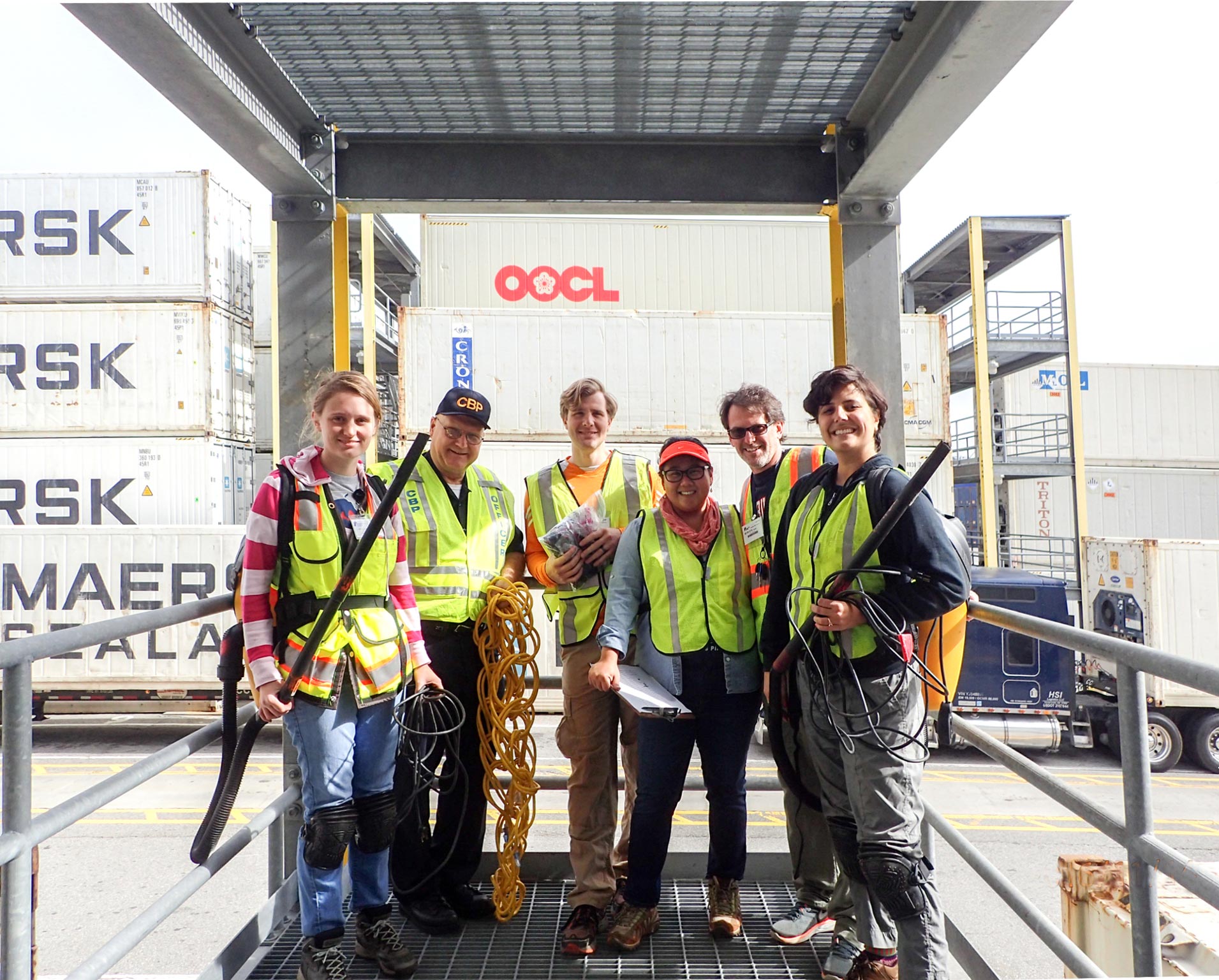
Seeds that float in the air can hitchhike in unusual places — like the air-intake grille of a refrigerated shipping container. A team of researchers from the USDA Forest Service, Arkansas State University, and other organizations recently conducted a study that involved vacuuming seeds from air-intake grilles over two seasons at the Port of Savannah, Georgia.
The viability of such seeds is of significant interest to federal regulatory and enforcement agencies, and the project required a shared stewardship approach. Imported refrigerated shipping containers are inspected by the U.S. Customs & Border Protection, Agriculture Program (Department of Homeland Security). The research team worked closely with this agency, as well as the USDA Animal and Plant Health Inspection Service, and the Georgia Ports Authority.
Their findings were recently published in the journal Scientific Reports. Seeds from 30 plant taxa were collected from the air-intake grilles, including seeds of wild sugarcane (Saccharum spontaneum), a grass on the USDA Federal Noxious Weed List.
Federal noxious weeds pose immediate, significant threats to agriculture, nursery, and forestry industries. Although a lovely grass and useful in its native range, wild sugarcane has the potential to join cogongrass, stiltgrass, and other nonnative species that have become extremely widespread in the U.S.
“During the two shipping seasons, we estimate that over 40,000 seeds from this species entered the Garden City Terminal at the Port of Savannah,” says Rima Lucardi, a Forest Service researcher and lead author of the project. “This quantity of incoming seeds is more than sufficient to cause introduction and establishment of this nonnative invader, even If the escape rate from the shipping containers is limited.”
To estimate the chance that seeds would survive and establish in the U.S., Lucardi and her colleagues analyzed and modeled viable seeds from four plant taxa. All are prolific seed producers, wind-pollinated and wind-dispersed, and able to persist in a wide range of environmental conditions and climates.
The researchers propose several possible strategies for reducing risk to native ecosystems and agricultural commodities. For example, in lieu of labor-intensive vacuuming of air-intake grilles, a liquid pre-emergent herbicide could potentially be applied to containers while in port. Prevention and best management practices, from the farm to the store, reduce the probability of nonnative seeds establishing in the U.S. Inspection for exterior seeds hitching a ride on shipping containers at their points-of-origin or stops along the way would also reduce the risk of invasion.
Preventing nonnative plant invasions is much more cost-effective in the long run than trying to manage them once they have spread and become widely established. “Investment in the prevention and early detection of nonnative plant species with known negative impacts results in nearly a 100-fold increase in economic return when compared to managing widespread nonnatives that can no longer be contained,” says Lucardi.
The team had previously shown, in PLOS One, that the Port is a hotspot of nonnative plant diversity and richness.
Reference: “Seeds attached to refrigerated shipping containers represent a substantial risk of nonnative plant species introduction and establishment” by Rima D. Lucardi, Emily S. Bellis, Chelsea E. Cunard, Jarron K. Gravesande, Steven C. Hughes, Lauren E. Whitehurst, Samantha J. Worthy, Kevin S. Burgess and Travis D. Marsico, 14 September 2020, Scientific Reports.
DOI: 10.1038/s41598-020-71954-3
Never miss a breakthrough: Join the SciTechDaily newsletter.
Follow us on Google and Google News.
1 Comment
Wacth Tom Minute Papers on YouTube reporter. Good stuff for camera tech and video cable tv/computer tech! mmm. MH 370 problems no more.