
Close Menu
    Facebook X (Twitter) Instagram
    SciTechDaily
    • Biology
    • Chemistry
    • Earth
    • Health
    • Physics
    • Science
    • Space
    • Technology
    Facebook X (Twitter) Pinterest YouTube RSS
    SciTechDaily
    Home»Space»Stop-and-Start Young Radio Jets Detected From Galaxy 500 Million Light-Years From Earth
    Space

    Stop-and-Start Young Radio Jets Detected From Galaxy 500 Million Light-Years From Earth

    By National Radio Astronomy ObservatorySeptember 14, 2020No Comments3 Mins Read
    Facebook Twitter Pinterest Telegram LinkedIn WhatsApp Email Reddit
    Share
    Facebook Twitter LinkedIn Pinterest Telegram Email Reddit
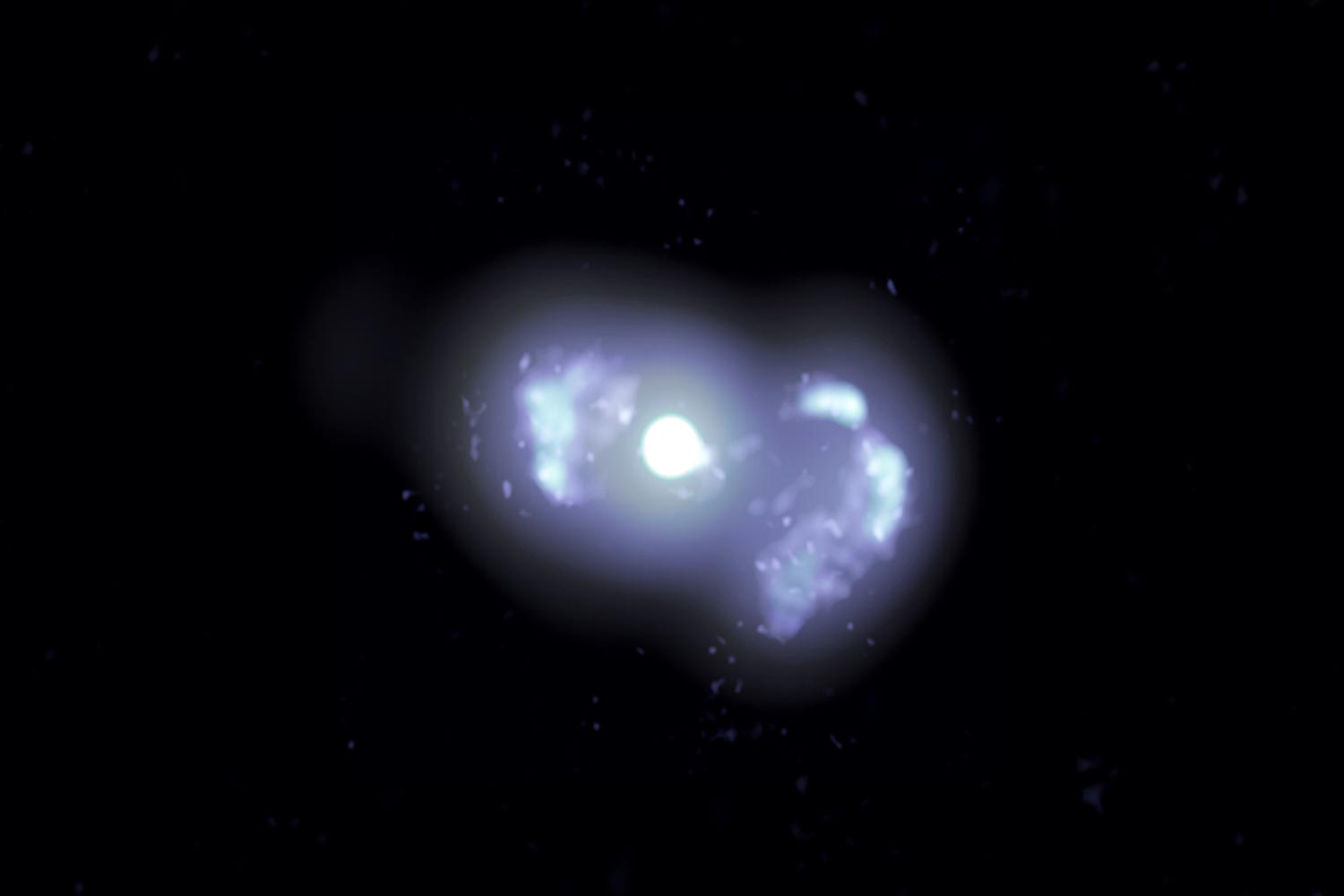
    Galaxy's Young Jets
    Multi-frequency composite VLBA image of the galaxy TXS 0128+554, 500 million light-years from Earth. The image shows young radio jets originating near a supermassive black hole at the core of the galaxy. The jets in this image started about 80 years ago, stopped, then resumed about 10 years ago. Credit: Lister et al.; Sophia Dagnello, NRAO/AUI/NSF

    Very long baseline array reveals object’s history.

    In this image, made with the National Science Foundation’s Very Long Baseline Array (VLBA), young, radio-emitting jets of material emerge from the core of an elliptical galaxy some 500 million light-years from Earth. After NASA’s Fermi Gamma-ray Space Telescope detected high-energy gamma rays coming from the object, scientists used the VLBA to make high-resolution images of the galaxy, dubbed TXS 0128+554.

    This image is a composite of six VLBA images made at observing frequencies ranging from 2.2 GigaHertz (GHz) to 22.2 GHz. The broad lobes on either side of the bright core are the result of jet activity that began roughly 80 years ago. The gap between these lobes and the central region indicates, the scientists said, that the jet activity stopped sometime after that, then resumed about 10 years ago.
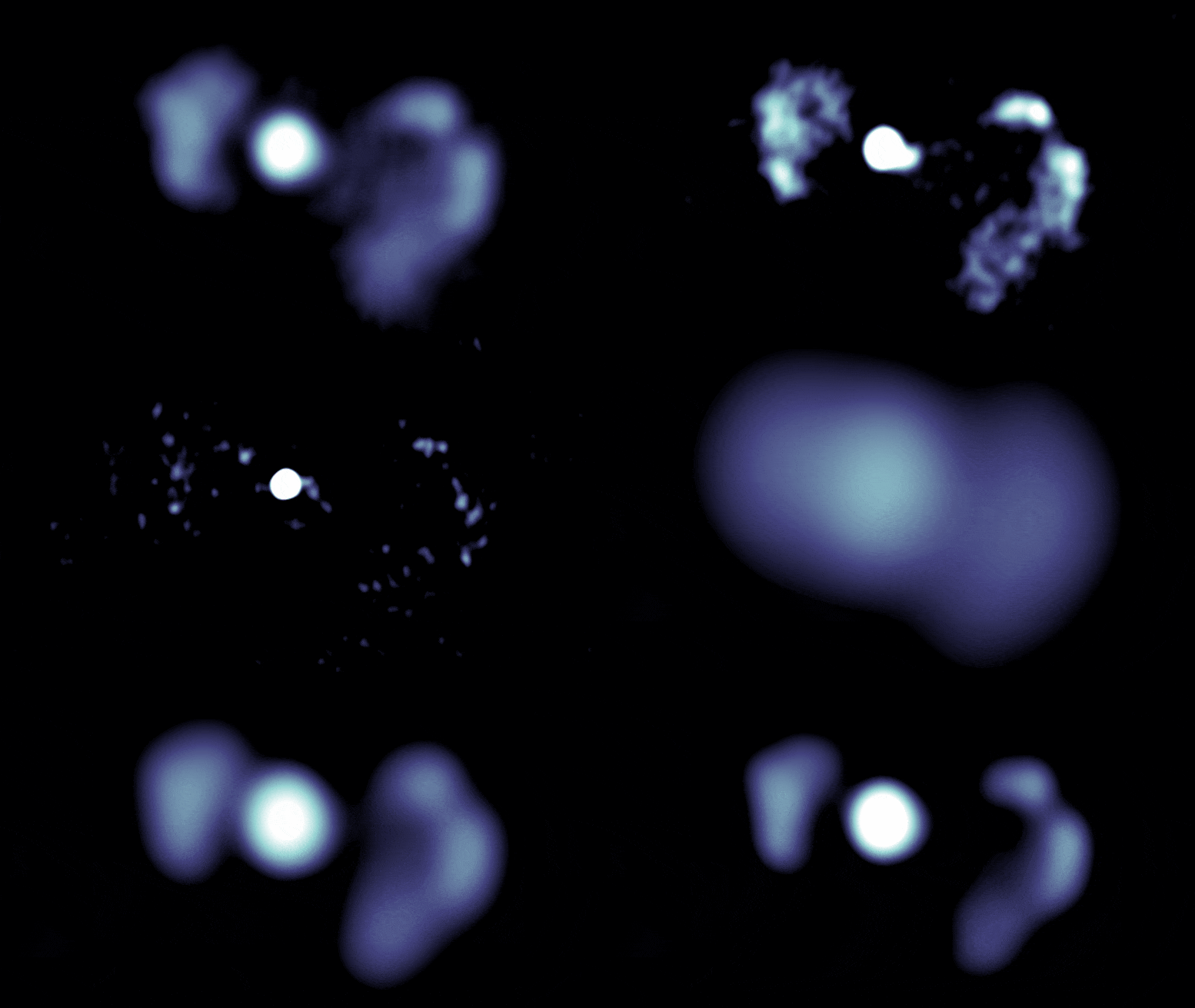
    Galaxy's Young Jets
    Animated sequence of VLBA images of the galaxy TXS 0128+554, indicating the radio frequency at which the image was made. Higher observing frequencies produce higher resolution, showing smaller details. Credit: Lister et al.: Sophia Dagnello, NRAO/AUI/NSF.

    “These are among the youngest known jets in such systems, and only a handful are known to emit gamma-rays,” said Matthew Lister, of Purdue University.

    The bright edges of the lobes are where the ejected material, moving at about a third the speed of light, impacted material within the galaxy. The bright emitting areas total about 35 light-years across, and are at the core of the galaxy, where a supermassive black hole about one million times the mass of the Sun resides.

    Lister and his colleagues are reporting their findings in the Astrophysical Journal.
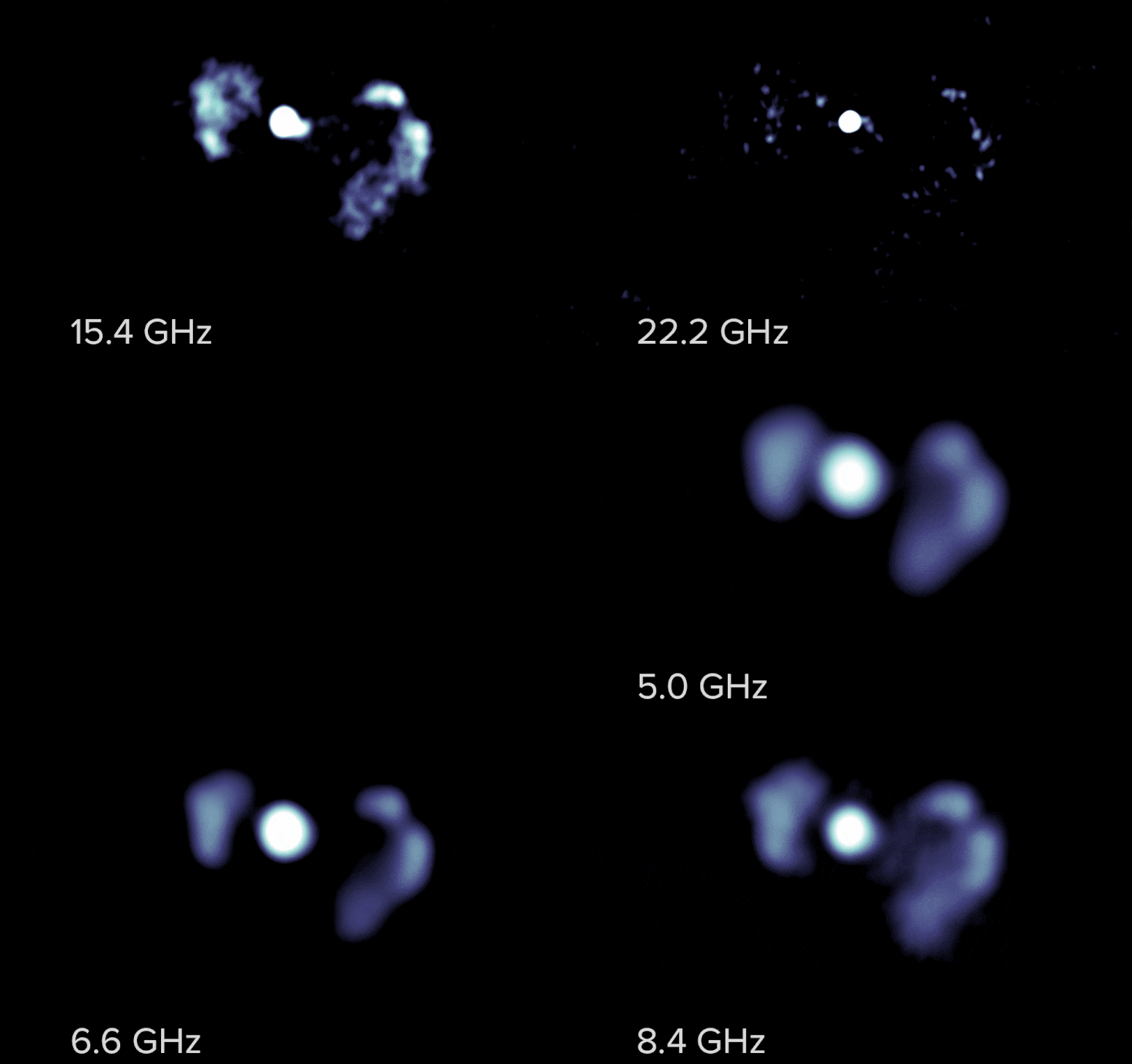
    Galaxy's Young Jets Annotated
    Animated sequence (with labels) of VLBA images of the galaxy TXS 0128+554, indicating the radio frequency at which the image was made. Higher observing frequencies produce higher resolution, showing smaller details. Credit: Lister et al.; Sophia Dagenello, NRAO/AUI/NSF

    To learn more about this research, read NASA Missions Explore a “TIE Fighter” Active Galaxy Far, Far Away.

    Reference: “TXS 0128+554: A Young Gamma-Ray-emitting Active Galactic Nucleus with Episodic Jet Activity” by M. L. Lister, D. C. Homan, Y. Y. Kovalev, S. Mandal, A. B. Pushkarev and A. Siemiginowska, 25 August 2020, The Astrophysical Journal.
    DOI: 10.3847/1538-4357/aba18d

    The National Radio Astronomy Observatory is a facility of the National Science Foundation, operated under cooperative agreement by Associated Universities, Inc.

    Never miss a breakthrough: Join the SciTechDaily newsletter.
    Follow us on Google and Google News.

    Astronomy Astrophysics Fermi Gamma-ray Space Telescope National Radio Astronomy Observatory Very Long Baseline Array
    Share. Facebook Twitter Pinterest LinkedIn Email Reddit

    Related Articles

    NASA Missions Explore a “TIE Fighter” Active Galaxy Far, Far Away

    Saturn-Sized Exoplanet Discovered by the Gravitational “Wobble” in the Small, Cool Star It Orbits

    Very Long Baseline Array Discovers Orbital Motion in Pair of Supermassive Black Holes

    Astronomers Discover a”Nearly Naked” Supermassive Black Hole

    Supersonic Outflows Contain a Million Times the Energy of an Exploding Star

    New Analysis Method Discovers Millisecond Pulsar via Its Pulsed Gamma Radiation

    Newly Discovered Gamma-Ray Pulsar J1838-0537

    New Technique Leads to the Discovery of 5 New Pulsars

    Using ALMA and VLA to Unveil Astronomical Mysteries

    Leave A Reply Cancel Reply

    • Facebook
    • Twitter
    • Pinterest
    • YouTube

    Don't Miss a Discovery

    Subscribe for the Latest in Science & Tech!

    Trending News

    Even Occasional Binge Drinking May Triple Liver Damage Risk

    Liftoff! NASA’s Artemis II Launch Sends Astronauts Around the Moon for First Time in 50 Years

    Scientists Discover New Way To Eliminate “Zombie Cells” Driving Aging

    This New Quantum Theory Could Change Everything We Know About the Big Bang

    This One Vitamin May Help Protect Your Brain From Dementia Years Later

    Stopping Weight-Loss Drugs Like Ozempic Can Quickly Erase Heart Benefits

    A 500-Million-Year-Old Surprise Is Forcing Scientists to Rethink Spider Evolution

    Coffee and Blood Pressure: What You Need To Know Before Your Next Cup

    Follow SciTechDaily
    • Facebook
    • Twitter
    • YouTube
    • Pinterest
    • Newsletter
    • RSS
    SciTech News
    • Biology News
    • Chemistry News
    • Earth News
    • Health News
    • Physics News
    • Science News
    • Space News
    • Technology News
    Recent Posts
    • You Don’t Need To Be Rich: New Study Reveals a Simple Life Is the Real Secret to Happiness
    • “Crazy Dice” Help Scientists Prove Only One 150-Year-Old Theory About Randomness Works
    • Scientists Discover Hidden “Good Fats” in Green Rice That Could Transform Nutrition
    • Longevity Isn’t Equal: Why Life-Extending Treatments May Be a “Biological Lottery”
    • AI May Soon Detect Cancer Just by Listening to You Speak
    Copyright © 1998 - 2026 SciTechDaily. All Rights Reserved.
    • Science News
    • About
    • Contact
    • Editorial Board
    • Privacy Policy
    • Terms of Use

    Type above and press Enter to search. Press Esc to cancel.