

Scientists have decoded the Swiss genome of the 1918 flu virus from a century-old specimen, revealing early adaptations for human infection.
Scientists from the Universities of Basel and Zurich have successfully decoded the genome of the influenza virus that caused the 1918–1920 pandemic in Switzerland, using a preserved specimen from the University of Zurich’s Medical Collection. Their analysis shows that the virus had already acquired crucial traits for infecting humans at the very beginning of what would become the most lethal influenza outbreak ever recorded.
The emergence of new viral epidemics continues to pose serious risks to global health. To better prepare for future outbreaks, it is essential to understand how viruses evolve and to study the patterns of past pandemics. The 1918–1920 influenza pandemic, often referred to as the Spanish flu, resulted in an estimated 20 to 100 million deaths around the world. However, scientists have had limited information about how the virus changed and adapted as the pandemic unfolded.
More than 100-year-old flu virus sequenced
Now, an international team of researchers, led by Verena Schünemann—a paleogeneticist and professor of archaeological science at the University of Basel (previously at the University of Zurich)—has reconstructed the first Swiss genome of the 1918 influenza virus.
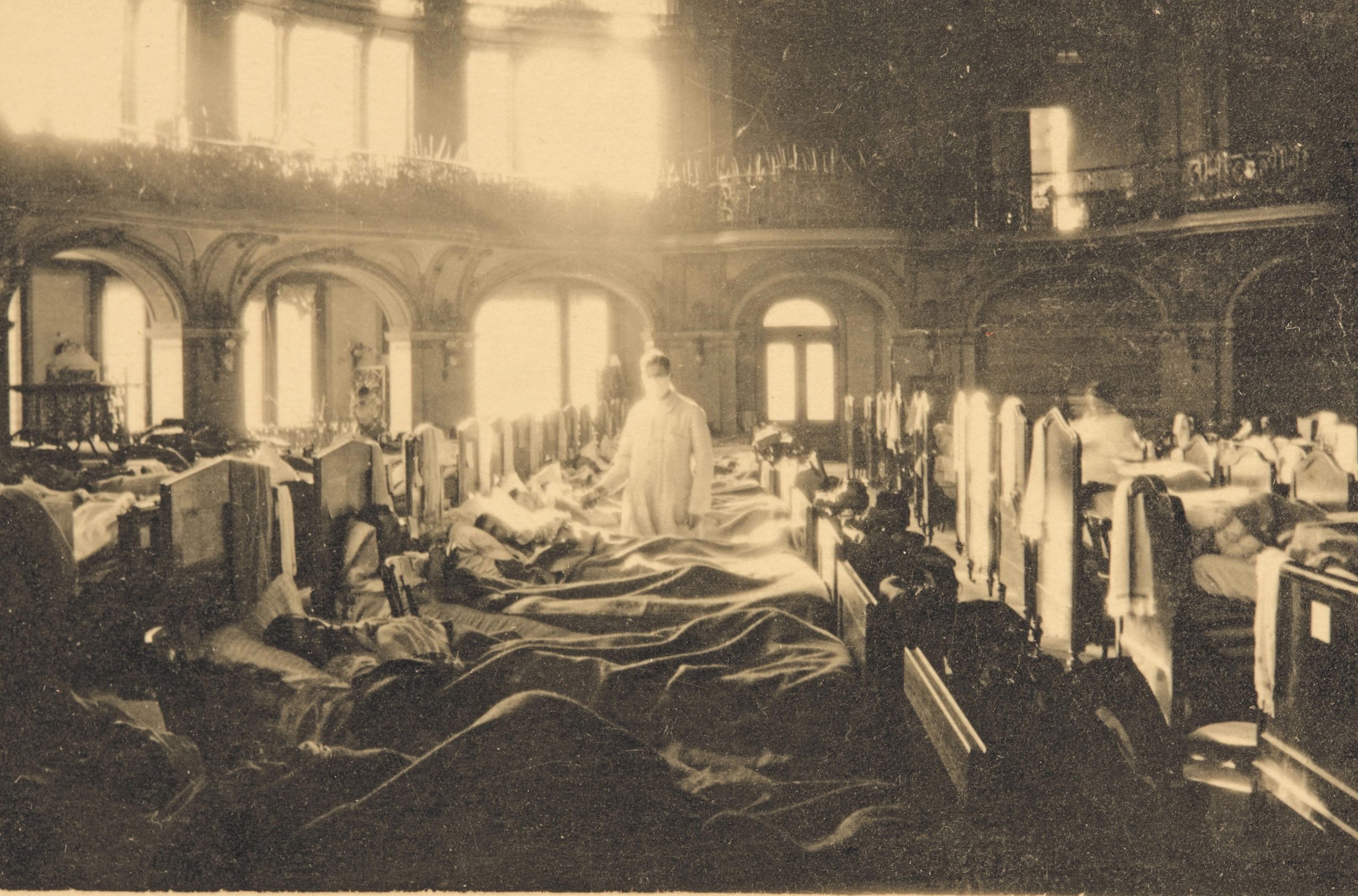
For their study, the researchers used a more than 100-year-old virus taken from a formalin-fixed wet specimen sample in the Medical Collection of the Institute of Evolutionary Medicine at UZH. The virus came from an 18-year-old patient from Zurich who had died during the first wave of the pandemic in Switzerland and underwent autopsy in July 1918.
Three key adaptations in Swiss virus genome
“This is the first time we’ve had access to an influenza genome from the 1918–1920 pandemic in Switzerland. It opens up new insights into the dynamics of how the virus adapted in Europe at the start of the pandemic,” says last author Verena Schünemann. By comparing the Swiss genome with the few influenza virus genomes previously published from Germany and North America, the researchers were able to show that the Swiss strain already carried three key adaptations to humans that would persist in the virus population until the end of the pandemic.
Two of these mutations made the virus more resistant to an antiviral component in the human immune system – an important barrier against the transmissions of avian-like flu viruses from animals to humans. The third mutation concerned a protein in the virus’s membrane that improved its ability to bind to receptors in human cells, making the virus more resilient and more infectious.
New genome-sequencing method
Unlike adenoviruses, which cause common colds and are made up of stable DNA, influenza viruses carry their genetic information in the form of RNA, which degrades much faster.
“Ancient RNA is only preserved over long periods under very specific conditions. That’s why we developed a new method to improve our ability to recover ancient RNA fragments from such specimens,” says Christian Urban, the study’s first author from UZH. This new method can now be used to reconstruct further genomes of ancient RNA viruses and enables researchers to verify the authenticity of the recovered RNA fragments.
Invaluable archives
For their study, the researchers worked hand in hand with UZH’s Medical Collection and the Berlin Museum of Medical History of the Charité University Hospital. “Medical collections are an invaluable archive for reconstructing ancient RNA virus genomes. However, the potential of these specimens remains underused,” says Frank Rühli, co-author of the study and head of the Institute of Evolutionary Medicine at UZH.
The researchers believe the results of their study will prove particularly important when it comes to tackling future pandemics. “A better understanding of the dynamics of how viruses adapt to humans during a pandemic over a long period of time enables us to develop models for future pandemics,” Verena Schünemann says.
“Thanks to our interdisciplinary approach that combines historico-epidemiological and genetic transmission patterns, we can establish an evidence-based foundation for calculations,” adds Kaspar Staub, co-author from UZH. This will require further reconstructions of virus genomes as well as in-depth analyses that include longer intervals.
Reference: “An ancient influenza genome from Switzerland allows deeper insights into host adaptation during the 1918 flu pandemic in Europe” by Christian Urban, Bram Vrancken, Livia V. Patrono, Ariane Düx, Mathilde Le Vu, Katarina L. Matthes, Nina Maria Burkhard-Koren, Navena Widulin, Thomas Schnalke, Sabina Carraro, Frank Rühli, Philippe Lemey, Kaspar Staub, Sébastien Calvignac-Spencer and Verena J. Schuenemann, 1 July 2025, BMC Biology.
DOI: 10.1186/s12915-025-02282-z
Never miss a breakthrough: Join the SciTechDaily newsletter.
Follow us on Google and Google News.
4 Comments
Great work, and as a virus, masks didn’t work then, and don’t work now. As a virus, then as now, it didn’t become less infection after 10 pm or 11 pm. Therefore, all the masking laws and decrees and curfews are just agitprop against medicine, against science, and kindling for the fire that will burn if another virus is “declared” and once again, governments make foolish and useless declarations. Deadly virus? Isolate the sick, stay outdoors and best, move to a remote location.
OFFS masks work, you just don’t understand how. You can’t isolate the sick when a virus has a 10 day asymptomatic spread phase.
Sorry Eric. Masks work. Personal experience. If the mask contains coughs and sneezes adequately as does the N95 mask, it will minimise cross-infection. And yes, of course isolate the sick. That slows the infection rate which enables health systems to cope better with those who are sick. The early phase of Covid-19, as with assorted bugs, carries a sore throat. So, if you have sore throat, wear a mask. Then you have a chance of not infecting anyone with a common cold, influenza, Covid-19 and, for that matter, diptheria.
Dumbest response I’ve ever seen was when hospitals had you go through the enclosed air conditioner tents before going into the hospital. If you didn’t have COVID before. Go to a place that enclosed you into a closed env that everyone with COVID flu or cold or whatever went through the last few days. And have the ac unit blasting you all over so every time breathe nose it mouth you get a lung or two full of what ever as they demand you change face masks inside then take. Your mask off as they jam a previously sterilized stock swab they expose to everything in the air and jam it right to the back of your throat base of your brain and spinal cord areas. As far back as they can to insure you get a nose full of whatever s been flying arround the last few days or weeks. Guaranteeing infection if something. lol this isn’t decontamination or isolation this was in intentional infection in my book I’ve been through cbre military training and my families git medical back grounds half the stupid stuff they did got people sick or sicker. And in the race to. Get a vaccine. I knew they wouldn’t make an effective one or one without problematic risks in such a short time abd new the vaccine makers greedy fur money wouldn’t make a one and done vaccine nope they wanted to poke you yearly globally to make the big bucks lol. I never had a covid vaccine knew a few people that died of Covid or died of the vaccine or had methcam broken after the vaccine related to the vaccine. My cousin almost died from lungs full of blood clots a day after schools require her to get the vaccine. After she took it has been messed up ever since I’ve had plenty of Covid like illnesses over the last few years been close to people that tested positive. I get the same illness’s they had sand symthoms but showed negative tests. Only one time did I have a positive covid test. After illness. And why the world hasn’t went after china and the bat science lady there and fucci and the nih. Baffles me. And why china is still playing with it and other medical university’s globally are still messing with it risking new out breaks of more deadly varrients baffle me Mentally. Next time I ever see or hear of some pandemic coming over taking out alot of people with a high fatality rate and seeing govt s taking rights away from people like I did. I’m gonna disappear. Some where where to have to fly several hours boat several hours then walk several hours to some remote place I was said to be a few months ago. Away from everyone. Out on the open in a cold and high place a remote place And just hang out there fur a few years till sanity comes back to he world if I survive cause by then they will know the best treatments. The govt control mesures wil be removed and better care medically will be known to improve the survival rate of you. If you get infected coming back. Lessons learned drill over. What a cluster F###