
Coyotes now live across North America, from Alaska to Panama, California to Maine. But where they came from, and when, has been debated for decades. Using museum specimens and fossil records, researchers from the North Carolina Museum of Natural Sciences and North Carolina State University have produced a comprehensive (and unprecedented) range history of the expanding species that can help reveal the ecology of predation as well as evolution through hybridization. Their findings appeared in ZooKeys in May.
The geographic distribution of coyotes has dramatically expanded since 1900, spreading across much of North America in a period when most other mammal species have been declining. Although this unprecedented expansion has been well documented at the state/provincial scale, the continent-wide picture of coyote spread was coarse and largely anecdotal. A more thorough compilation of available records was needed. “We began by mapping the original range of coyotes using archeological and fossil records,” says co-author Dr. Roland Kays, Head of the Museum’s Biodiversity Lab and Research Associate Professor in NC State’s Department of Forestry and Environmental Resources. “We then plotted their range expansion across North America from 1900 to 2016 using museum specimens, peer-reviewed reports, and game department records.” In all, Kays and lead author James Hody reviewed more than 12,500 records covering the past 10,000 years for this study.
Their findings indicate that coyotes historically occupied a larger area of North America than generally suggested in the literature. Previous maps, as it turns out, had ancient coyotes only located across the central deserts and grasslands. However, fossils from across the arid west link the distribution of coyotes from 10,000 years ago to specimens collected in the late 1800s, proving that their geographic range was not only broader but had been established for hundreds, perhaps thousands of years, which also contradicts some widely-cited descriptions of their historical distribution.
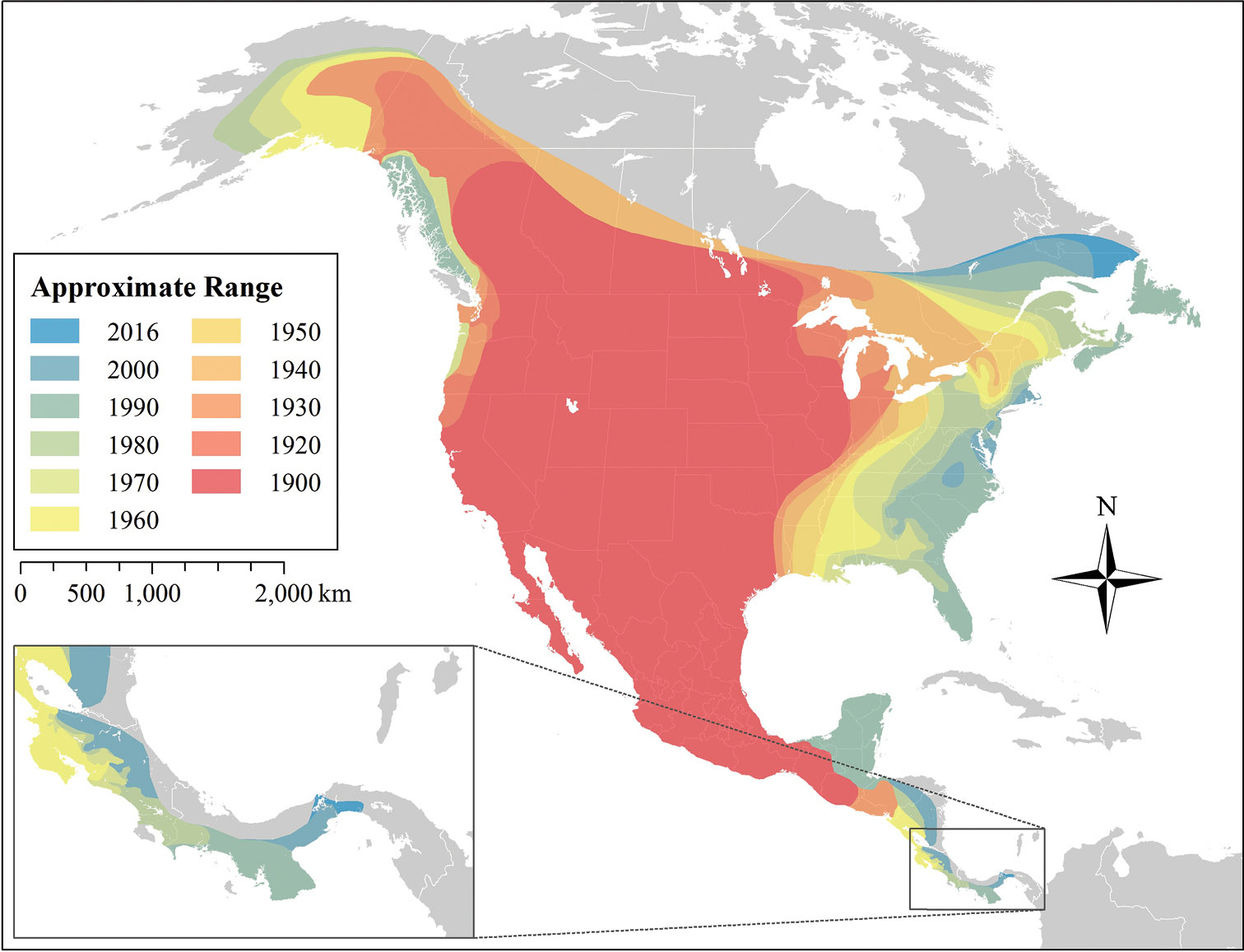
It wasn’t until approximately 1920 that coyotes began their expansion across North America. This was likely aided by an expansion of human agriculture, forest fragmentation, and hybridization with other species. Eastern expansion in particular was aided by hybridization with wolves and dogs, resulting in size and color variation among eastern coyotes.
Before too long, coyotes may no longer be just a North American species. Kays notes that coyotes are continually expanding their range in Central America, crossing the Panama Canal in 2010. Active camera traps are now spotting coyotes approaching the Darien Gap, a heavily forested region separating North and South America, suggesting that they are at the doorstep of South America.
“The expansion of coyotes across the American continent offers an incredible experiment for assessing ecological questions about their roles as predators, and evolutionary questions related to their hybridization with dogs and wolves,” adds Hody. “By collecting and mapping these museum data we were able to correct old misconceptions of their original range, and more precisely map and date their recent expansions.
“We hope these maps will provide useful context for future research into the ecology and evolution of this incredibly adaptive carnivore.”
Reference: “Mapping the expansion of coyotes (Canis latrans) across North and Central America” James W. Hody and Roland Kays, 22 May 2018, ZooKeys.
DOI: 10.3897/zookeys.759.15149
Never miss a breakthrough: Join the SciTechDaily newsletter.
Follow us on Google and Google News.