
Close Menu
    Facebook X (Twitter) Instagram
    SciTechDaily
    • Biology
    • Chemistry
    • Earth
    • Health
    • Physics
    • Science
    • Space
    • Technology
    Facebook X (Twitter) Pinterest YouTube RSS
    SciTechDaily
    Home»Biology»How Genetic Diversity Helps Protect Against Disease
    Biology

    How Genetic Diversity Helps Protect Against Disease

    By Katharina Bunk, IGBMay 23, 2018No Comments3 Mins Read
    Facebook Twitter Pinterest Telegram LinkedIn WhatsApp Email Reddit
    Share
    Facebook Twitter LinkedIn Pinterest Telegram Email Reddit
    Genetic Diversity Helps Protect Against Disease
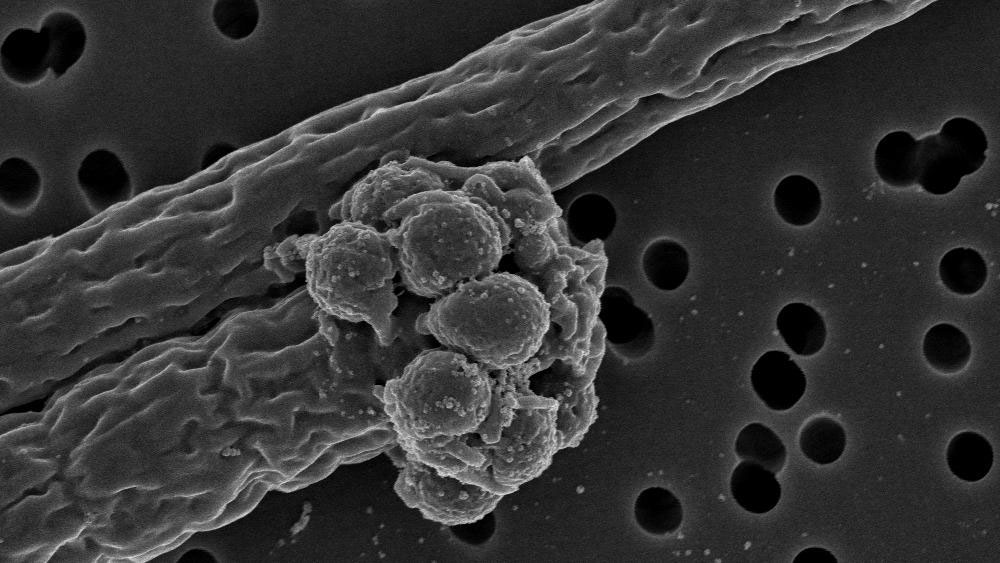
    The micrograph, taken using a scanning electron microscope, shows two cyanobacterial filaments at 6000-fold magnification. The lower filament has been infected by several chytrid spores – the round structures at the tip of the filament. The parasite penetrates the filament, takes up the nutrients from its interior and uses it for its growth. This helps the spores to develop into bigger structures. Once the so-called sporangia are mature, they release new spores capable of infecting other hosts. | Image: Reingard Roßberg / IGB

    So much for survival of the fittest – diversity is the key: a team of researchers from the Leibniz-Institute of Freshwater Ecology and Inland Fisheries (IGB) has succeeded in demonstrating experimentally that genetic diversity makes populations more resistant to disease.

    Why is it that animal and plant species throughout the world have different genetic variants within their particular species, even though it is supposed to be the “fittest” gene pool that survives? According to a common theory in evolutionary biology, it is to enable the species to respond more effectively to changes in the environment, such as the occurrence of disease. However, experimental evidence to support this theory is very difficult to obtain: After all, it is virtually impossible to observe how evolutionary trends develop in most animal and plant species – their generation times are simply too long.

    Evolutionary change in real time

    A team led by IGB researcher and evolutionary ecologist Dr. Ramsy Agha has now investigated the evolution of the fungal parasite Rhizophydium megarrhizum. This parasite infects the cyanobacterium species Planktothrix, which is prevalent in many freshwaters. The team exposed the parasite to host populations whose individuals were genetically identical to each other, and alternatively to populations comprised of different genetic variants. Since the fungus multiplies rapidly, roughly once a day, the scientists monitored its performance for a total period of 200 days. “We wanted to observe evolutionary change in real time and under controlled conditions, to find out if and how quickly parasites adapt to genetically homogenous and diverse hosts,” explained Ramsy Agha.

    The scientists permitted the adaptation of Rhizophydium megarrhizum, but kept the host populations in an evolutionary standstill. “We were able to show that the fungi adapt to genetically homogenous hosts very quickly, that is within just three months,” reported Agha. This adaptation is reflected in the fact that the parasites managed to adhere to the hosts and overcome their defense mechanisms more quickly, and were therefore able to reproduce more rapidly.

    Genetic diversity in the host population slows down adaptation of parasites

    If, on the other hand, the cyanobacteria were genetically diverse, these effects did not occur. The parasite failed to adapt, and the state of the disease remained unchanged. Genetic diversity in cyanobacteria evidently slows down the adaptation of the parasite, increasing their resistance to disease.

    “Our findings are also significant for ecosystem research in general, because they help us to explain why a high degree of diversity in populations may be valuable for their preservation,” said Agha. He and his team want to investigate next what happens when not only the parasite, but also the host population is permitted to adapt to changed conditions. The researchers hope to gain further insights into how disease – generally perceived as a negative phenomenon – is a crucial natural process that promotes and preserves biological diversity.

    Reference: “Adaptation of a Chytrid Parasite to Its Cyanobacterial Host Is Hampered by Host Intraspecific Diversity” by Ramsy Agha, Alina Gross, Thomas Rohrlack and Justyna Wolinska, 3 May 2018, Front. Microbiol.
    doi:10.3389/fmicb.2018.00921

    Never miss a breakthrough: Join the SciTechDaily newsletter.
    Follow us on Google and Google News.

    Cyanobacteria Disease Ecology Molecular Biology
    Share. Facebook Twitter Pinterest LinkedIn Email Reddit

    Related Articles

    Researchers Identify a Protein That Blocks HIV

    Epigenetics Are Important To Evolutionary Success

    SSRL Validates Anti-Flu Protein Design

    New Genetic Modifications Result in Cows With Allergen-Free Milk

    New Design Makes Previously Inaccessible Proteins Vulnerable to Drugs

    Molecular and Statistical Tools Analyze Complex Differences Between Genomes

    A Step Towards Understanding the Cellular Basis for Age-Related Vulnerability to Breast Cancer

    Viruses Attack Mitochondria to Travel and Spread Within the Nervous System

    Black Band Disease Puts Great Barrier Reef at Risk

    Leave A Reply Cancel Reply

    • Facebook
    • Twitter
    • Pinterest
    • YouTube

    Don't Miss a Discovery

    Subscribe for the Latest in Science & Tech!

    Trending News

    Scientists Uncover Potential Brain Risks of Popular Fish Oil Supplements

    Scientists Discover a Surprising Way To Make Bread Healthier and More Nutritious

    After 60 Years, Scientists Uncover Unexpected Brain Effects of Popular Diabetes Drug Metformin

    New Research Uncovers Hidden Side Effects of Popular Weight-Loss Drugs

    Scientists Rethink Extreme Warming After Surprising Ocean Discovery

    Landmark Study Links Never Marrying to Significantly Higher Cancer Risk

    Researchers Discover Unknown Beetle Species Just Steps From Their Lab

    Largest-Ever Study Finds Medicinal Cannabis Ineffective for Anxiety, Depression, PTSD

    Follow SciTechDaily
    • Facebook
    • Twitter
    • YouTube
    • Pinterest
    • Newsletter
    • RSS
    SciTech News
    • Biology News
    • Chemistry News
    • Earth News
    • Health News
    • Physics News
    • Science News
    • Space News
    • Technology News
    Recent Posts
    • Scientists Discover Caffeine Can Repair Key Memory Circuits After Sleep Loss
    • Strange 65-Foot Dinosaur Discovered in Argentina
    • Researchers Uncover Source of Strange Deformation in Earth’s Largest Continental Rift
    • Scientists Solve Mystery of Where the Colorado River Vanished Millions of Years Ago
    • Not Just Alzheimer’s: Scientists Uncover Clues to a Second, Overlooked Disorder
    Copyright © 1998 - 2026 SciTechDaily. All Rights Reserved.
    • Science News
    • About
    • Contact
    • Editorial Board
    • Privacy Policy
    • Terms of Use

    Type above and press Enter to search. Press Esc to cancel.