
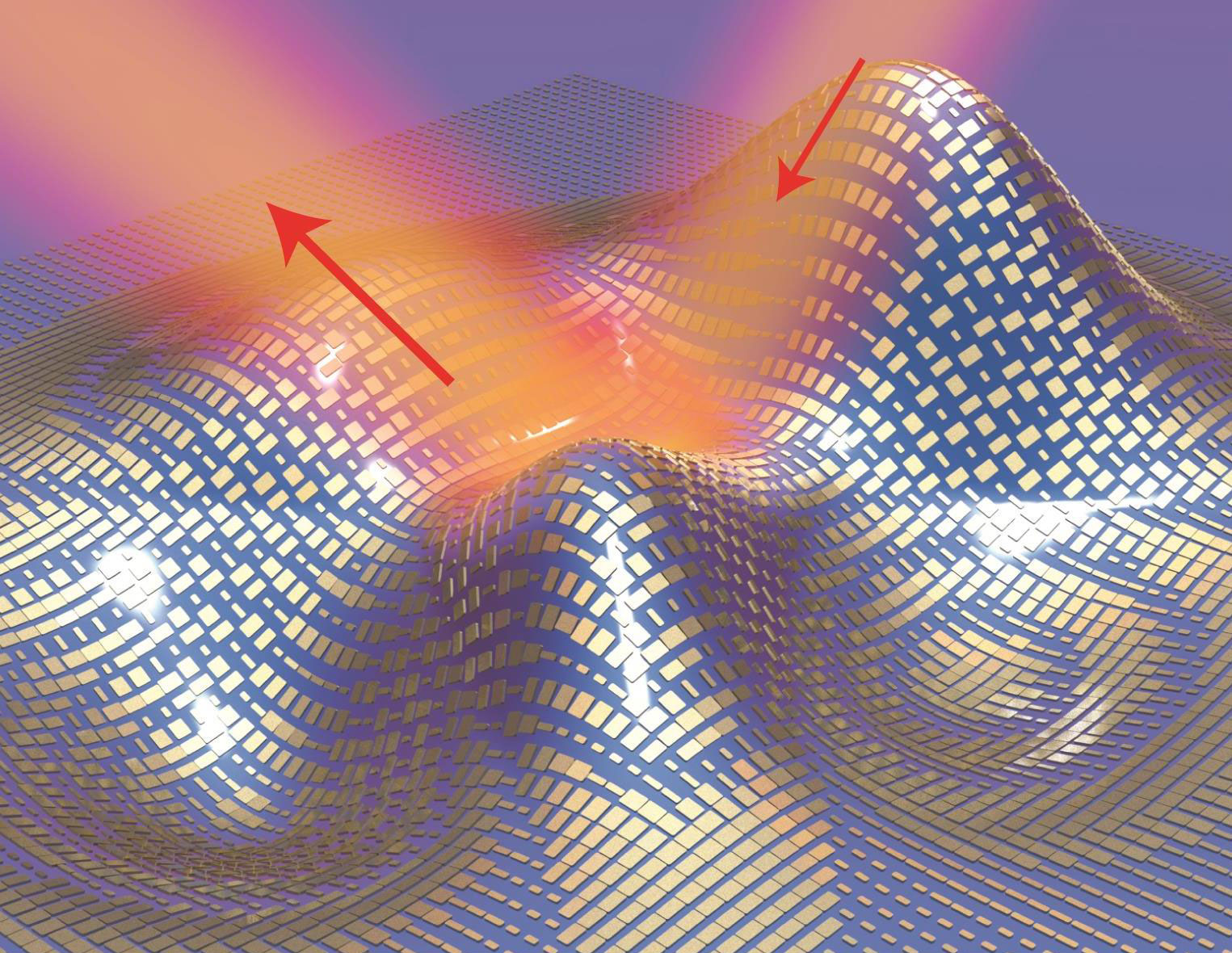
A team of scientists have invented an ultra-thin invisibility cloak that can conform to the shape of an object and conceal it from detection with visible light.
Invisibility cloaks are a staple of science fiction and fantasy, from Star Trek to Harry Potter, but don’t exist in real life, or do they? Scientists at the U.S. Department of Energy (DOE)’s Lawrence Berkeley National Laboratory (Berkeley Lab) and the University of California (UC) Berkeley have devised an ultra-thin invisibility “skin” cloak that can conform to the shape of an object and conceal it from detection with visible light. Although this cloak is only microscopic in size, the principles behind the technology should enable it to be scaled up to conceal macroscopic items as well.
Working with brick-like blocks of gold nanoantennas, the Berkeley researchers fashioned a “skin cloak” barely 80 nanometers in thickness, that was wrapped around a three-dimensional object about the size of a few biological cells and arbitrarily shaped with multiple bumps and dents. The surface of the skin cloak was meta-engineered to reroute reflected light waves so that the object was rendered invisible to optical detection when the cloak is activated.
“This is the first time a 3D object of arbitrary shape has been cloaked from visible light,” said Xiang Zhang, director of Berkeley Lab’s Materials Sciences Division and a world authority on metamaterials – artificial nanostructures engineered with electromagnetic properties not found in nature. “Our ultra-thin cloak now looks like a coat. It is easy to design and implement, and is potentially scalable for hiding macroscopic objects.”
Zhang, who holds the Ernest S. Kuh Endowed Chair at UC Berkeley and is a member of the Kavli Energy NanoSciences Institute at Berkeley (Kavli ENSI), is the corresponding author of a paper describing this research in Science. The paper is titled “An Ultra-Thin Invisibility Skin Cloak for Visible Light.” Xingjie Ni and Zi Jing Wong are the lead authors. Other co-authors are Michael Mrejen and Yuan Wang.
This short video clip shows how the activation of a metasurface cloak made from an ultrathin layer of nanoantennas can render a 3D object invisible. When the cloak is turned “on,” the bump-shaped object being illuminated in the center white spot disappears from view. The object reappears when the cloak is turned “off.” Video courtesy of Xiang Zhang and his research group, Berkeley Lab/UC Berkeley.
It is the scattering of light – be it visible, infrared, X-ray, etc., – from its interaction with matter that enables us to detect and observe objects. The rules that govern these interactions in natural materials can be circumvented in metamaterials whose optical properties arise from their physical structure rather than their chemical composition. For the past ten years, Zhang and his research group have been pushing the boundaries of how light interacts with metamaterials, managing to curve the path of light or bend it backwards, phenomena not seen in natural materials, and to render objects optically undetectable. In the past, their metamaterial-based optical carpet cloaks were bulky and hard to scale up and entailed a phase difference between the cloaked region and the surrounding background that made the cloak itself detectable – though what it concealed was not.
“Creating a carpet cloak that works in the air was so difficult we had to embed it in a dielectric prism that introduced an additional phase in the reflected light, which made the cloak visible by phase-sensitive detection,” says co-lead author Xingjie Ni, a recent member of Zhang’s research group who is now an assistant professor at Penn State University. “Recent developments in metasurfaces, however, allow us to manipulate the phase of a propagating wave directly through the use of subwavelength-sized elements that locally tailor the electromagnetic response at the nanoscale, a response that is accompanied by dramatic light confinement.”
In the Berkeley study, when red light struck an arbitrarily shaped 3D sample object measuring approximately 1,300 square microns in area that was conformally wrapped in the gold nanoantenna skin cloak, the light reflected off the surface of the skin cloak was identical to light reflected off a flat mirror, making the object underneath it invisible even by phase-sensitive detection. The cloak can be turned “on” or “off” simply by switching the polarization of the nanoantennas.
“A phase shift provided by each individual nanoantenna fully restores both the wavefront and the phase of the scattered light so that the object remains perfectly hidden,” says co-lead author Zi Jing Wong, also a member of Zhang’s research group.
The ability to manipulate the interactions between light and metamaterials offers tantalizing future prospects for technologies such as high-resolution optical microscopes and superfast optical computers. Invisibility skin cloaks on the microscopic scale might prove valuable for hiding the detailed layout of microelectronic components or for security encryption purposes. At the macroscale, among other applications, invisibility cloaks could prove useful for 3D displays.
Reference: “An ultrathin invisibility skin cloak for visible light” by Xingjie Ni, Zi Jing Wong, Michael Mrejen, Yuan Wang and Xiang Zhang, 18 September 2015, Science.
DOI: 10.1126/science.aac9411
This research was funded by the DOE Office of Science.
Never miss a breakthrough: Join the SciTechDaily newsletter.
Follow us on Google and Google News.
6 Comments
Please don’t equate Star Trek with Harry Potter. There is a distinct difference between fiction which attempts to depict the realistic application of science and technology in a future society, and something like a pure escapist fantasy that has no basis in reality whatsoever.
ALL thinking, can be interlinked to other planets in other galaxies in the Universe, will we ever know?
We’ll know by the consipracy theories, the fawning over dictators, the ostentatiously rococo layout, the shockingly gruesome pictures, etc. It’s not hard to spot.
What will this technology be good for? Making an undectable spy camera? Undectectable weapons? I can’t think of any realistic application for optical invisiblity that does not seem creepy or evil. As an engineer, I’m glad I don’t have to work on this type of thing, and I do not look forward to its commercial applications.
can you please make it so that I can buy it
This has no good intent. Cloakng or “hiding” is by its very nature only used in acts of deception. Thus this has no valid good application ommercially or othewise because any good use it has is swiftly applicable to an equally evil use. Hide things tom thieves becomes hide things from police. Etc etc.