
Close Menu
    Facebook X (Twitter) Instagram
    SciTechDaily
    • Biology
    • Chemistry
    • Earth
    • Health
    • Physics
    • Science
    • Space
    • Technology
    Facebook X (Twitter) Pinterest YouTube RSS
    SciTechDaily
    Home»Chemistry»Scientists Discover a New Approach for Changing CO2 into CO
    Chemistry

    Scientists Discover a New Approach for Changing CO2 into CO

    By Jim Shelton, Yale UniversityJuly 28, 20172 Comments2 Mins Read
    Facebook Twitter Pinterest Telegram LinkedIn WhatsApp Email Reddit
    Share
    Facebook Twitter LinkedIn Pinterest Telegram Email Reddit

    Chemists Discover New Approach for Changing CO2 into CO

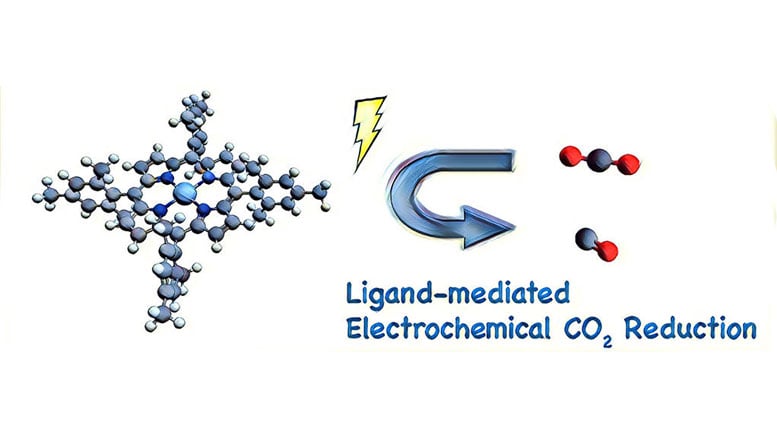
    Using a zinc-porphyrin electrocatalyst, chemists from Yale University and Oregon State University have discovered the framework for a new method of electrochemical carbon dioxide reduction.

    Chemists at Yale and Oregon State University have discovered a new process for converting carbon dioxide into carbon monoxide, potentially establishing a framework for creating fuels and chemical products from carbon emissions.

    Electrochemical carbon dioxide reduction — the idea of using electricity to change CO2 to value-added products — is widely considered to be a promising approach for improving energy technology. Not only would it remove carbon dioxide from the atmosphere, it also would generate useful products such as carbon monoxide, an important chemical feedstock and fuel used in industry.

    Yale chemistry assistant professor Hailiang Wang, Yale chemistry chair and professor Gary Brudvig, and Oregon State University assistant professor Zhenxing Feng collaborated on the new finding, published in the journal ACS Central Science on July 26. Brudvig and Wang are faculty members of the Energy Sciences Institute at Yale West Campus.

    The researchers discovered a zinc-porphyrin complex that acts as a catalyst in an unexpected way: the zinc ion binds the reactant but does not change its oxidation state, while the porphyrin ion (or ligand) is reduced and delivers electrons to complete the reaction.

    “The zinc-porphyrin electrocatalyst reported in this work can catalyze carbon dioxide reduction to carbon monoxide with a current efficiency higher than 90%,” Wang said.

    Reference: “Electroreduction of CO2 Catalyzed by a Heterogenized Zn–Porphyrin Complex with a Redox-Innocent Metal Center” by Yueshen Wu, Jianbing Jiang, Zhe Weng, Maoyu Wang, Daniël L. J. Broere, Yiren Zhong, Gary W. Brudvig, Zhenxing Feng and Hailiang Wang, 26 July 2017, ACS Central Science.
    DOI: 10.1021/acscentsci.7b0016

    Never miss a breakthrough: Join the SciTechDaily newsletter.
    Follow us on Google and Google News.

    Carbon Dioxide Oregon State University Yale University
    Share. Facebook Twitter Pinterest LinkedIn Email Reddit

    Related Articles

    Scientists Find a Way To Make CO2 a Valuable Fuel Source

    Yale’s Game-Changing Method Turns Carbon Dioxide Into Usable Energy With Incredible Efficiency

    Game-Changing Method Turns Carbon Dioxide Into Usable Energy With Incredible Efficiency

    Scientists Discover Greener and More Efficient Method To Turn Carbon Dioxide Into Fuel

    Advancing CO2 Recycling: Researchers Pioneer Efficient Mo Carbide Catalysts

    Scientists Develop Extraordinary Material That Can Transform Sunlight and Water Into Clean Energy

    Turning CO2 Into Chemical Gold: Affordable Nanocatalysts Could Revolutionize Climate Action

    “Goldilocks” Element – Scientists Make Key Advance for Capturing Carbon From the Air

    Cleaner Industrial Emissions by Scrubbing CO2 From Smokestacks

    2 Comments

    1. Arnob Endry on December 23, 2017 3:17 am

      An in numerous number of students passed from BCI are living standard lives for service & study in Europe, America, Australia, South African countries worldwide. Students remain in this country

      Reply
    2. mysoreammon on December 25, 2017 10:47 pm

      scitechdaily has always know to something new. i’m regular visitor and i’m learning alot daily thank you keep posting cheers.

      Reply
    Leave A Reply Cancel Reply

    • Facebook
    • Twitter
    • Pinterest
    • YouTube

    Don't Miss a Discovery

    Subscribe for the Latest in Science & Tech!

    Trending News

    Just Two Days on a Vegan Diet Triggered Unexpected Changes in the Liver

    Antarctica’s “Doomsday Glacier” Could Raise Sea Levels Twice As Much as Scientists Feared

    Snakebites Are Far Deadlier Than We Thought, New Study Reveals

    Scientists Studied 865 Humpback Whales and Found They Grow Faster Than Expected

    Archaeologists May Have Just Discovered the World’s Oldest Shipwreck

    Researchers Find That Arthritis May Leave a Hidden Memory in Your Joints

    These Giant-Headed Ants Are Breaking a Fundamental Rule of Biology

    Scientists Discover a Hidden Cholesterol Switch That Could Change How We Treat Heart Disease

    Follow SciTechDaily
    • Facebook
    • Twitter
    • YouTube
    • Pinterest
    • Newsletter
    • RSS
    SciTech News
    • Biology News
    • Chemistry News
    • Earth News
    • Health News
    • Physics News
    • Science News
    • Space News
    • Technology News
    Recent Posts
    • Drinking Tea May Lower Your Risk of Vascular Disease – but There’s a Catch
    • A Routine Blood Test Could Predict Dementia Risk 15 Years in Advance
    • A New Chemistry Breakthrough Could Change How Scientists Build Quantum Computers
    • The Ocean’s Mysterious “Snow” Could Be Hiding a Powerful Climate Secret
    • Aging’s “Zombie Cell” Problem May Have a Solution, Scientists Discover
    Copyright © 1998 - 2026 SciTechDaily. All Rights Reserved.
    • Science News
    • About
    • Contact
    • Editorial Board
    • Privacy Policy
    • Terms of Use

    Type above and press Enter to search. Press Esc to cancel.